IELTS Academic Writing Task 1: Step-by-Step Band 9 Tutorial (LingExam | Ultra-Interactive)
Welcome! In this interactive tutorial, you’ll master IELTS Academic Writing Task 1 (Process Diagram) for the following question type:
The diagram below shows the process of commercial bread production in a modern European bakery in 2023.
Follow each step below. Hover on any step to highlight and reveal advanced Band 7+ notes!
The diagram below shows the process of commercial bread production in a modern European bakery in 2023.
Follow each step below. Hover on any step to highlight and reveal advanced Band 7+ notes!
How to Answer IELTS Academic Writing Task 1 (Process Diagram): 12 Crucial Steps
1
Read the task instructions and process diagram carefully. Identify the process, the number of stages, and the key objects (e.g., bread, flour, machines). Underline or mentally note the overall context (here, commercial bread production in a modern European bakery in 2023). Understanding the task is essential for writing a focused answer and avoiding irrelevant information.
2
Carefully count each distinct stage in the process. For diagrams, every box or arrow usually represents a stage (e.g., mixing, kneading, proofing, baking, packaging). Make a quick list or mental note of the order and names of all stages before you start writing, as this will help you structure your answer logically.
3
Spot the starting inputs (e.g., flour, water, yeast) and the final output (bread, packed loaves). Note if there are any byproducts or waste. This will help you include essential details and avoid missing key features in your summary.
4
Write a clear overview (summary) of the process. For Band 7+, your overview should summarise the main flow (“bread production is a multi-stage linear process, beginning with mixing ingredients and ending with packaging loaves for sale”) and mention any clear cycles, repetitions, or unique features. Avoid details and data here; keep it general.
5
Divide your main paragraphs by process stage or logical groups. Usually, one paragraph covers the preparation/mixing stages, and another describes baking and packaging. Grouping related stages helps coherence and makes your answer easy to follow.
6
Use a wide range of process vocabulary and paraphrasing. Avoid repeating words like "then," "next," or "after that" too often. Use expressions like “subsequently,” “the mixture is transferred,” “following this step,” and passive structures (“the dough is left to rise”). This shows lexical flexibility, crucial for Band 7+.
7
Describe actions with the passive voice and proper tense. “The dough is mixed,” “loaves are packaged.” Use present simple for describing the diagram (unless a specific time is given). The passive form makes the answer more academic and formal, as required in Task 1.
8
Connect your sentences and stages with a variety of linking devices. Use "Initially," "First," "Subsequently," "Afterwards," "Finally," etc., to show the progression of stages. This improves your coherence and cohesion score.
9
Describe all the important steps, objects, and transitions in the diagram, but do not give reasons, opinions, or extra details not in the image. Only report what is visually presented. Missing a stage or adding extra opinions will lower your score.
10
Summarise minor or repeated steps together. For example, if “kneading” is repeated twice, mention it in one sentence. Over-describing small steps or adding unnecessary details can break the logical flow and waste word count.
11
Review your report for accuracy, logical order, and complete coverage. Make sure you haven’t missed any main stage, you have described the process step-by-step, and your language is precise and formal.
12
Quickly check your answer for grammar, spelling, and overall task achievement. Have you described all stages? Used passive voice? Kept your answer formal and objective? Proofreading is the final step to maximise your score!
Band 9 Sample Plan & Example Notes
Overview Example: “The diagram illustrates a linear, multi-stage process for producing bread in a modern European bakery, beginning with mixing ingredients and ending with the packaging of loaves for sale.”
Sequencing Example: “Initially, flour, water, and yeast are combined in an industrial mixer. The dough is then kneaded and allowed to rise before being shaped, baked, and finally packaged for distribution.”
IELTS Academic Writing Task 1
Task:
The diagram below shows the process of commercial bread production in a modern European bakery in 2023.
Summarise the information by selecting and reporting the main features, and make comparisons where relevant.
Diagram: Commercial Bread Production Process (2023)
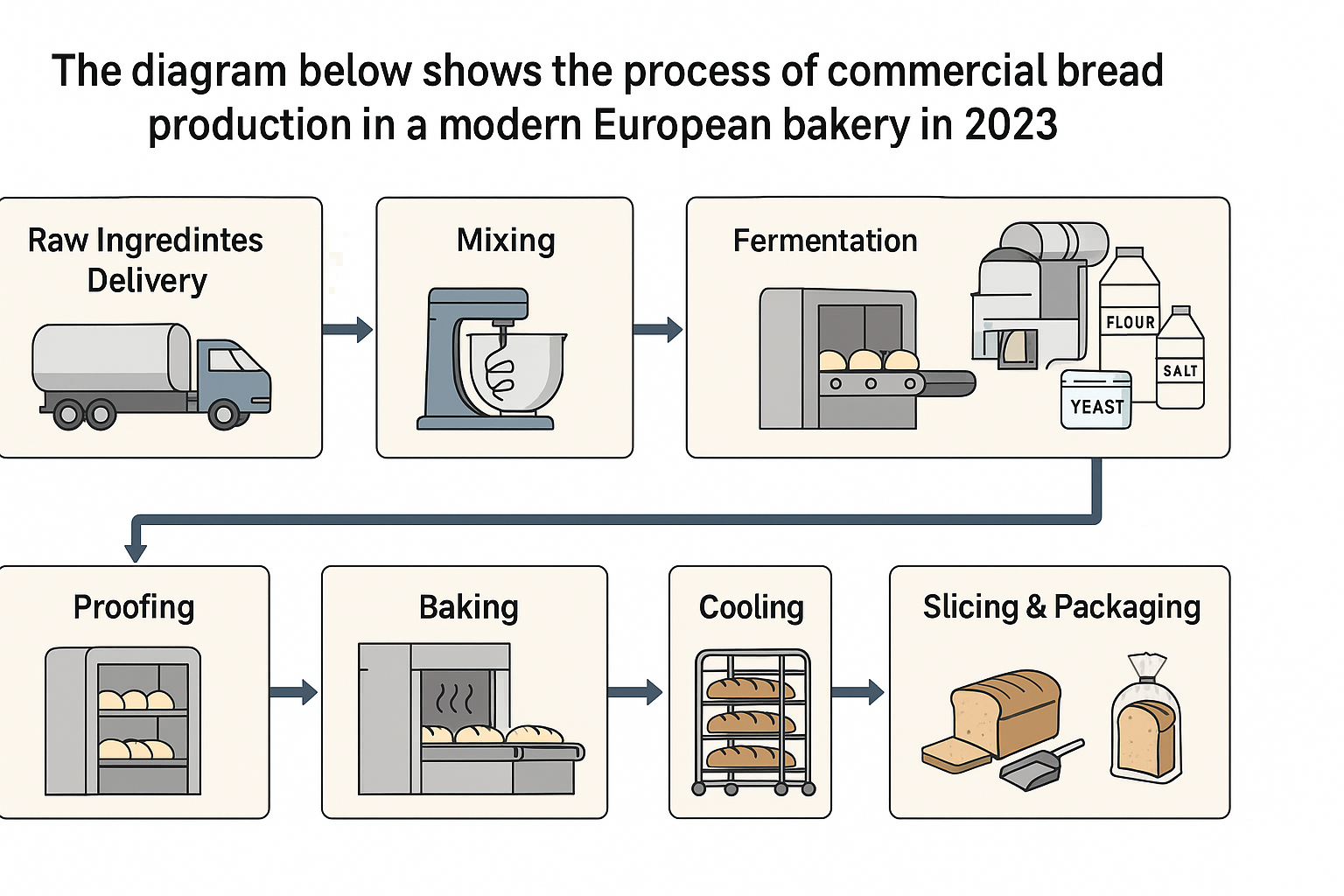
Click the diagram to view full screen & zoom
×
Pinch/scroll to zoom – Tap/click anywhere to exit
Your Answer:
Tip: After writing, check your grammar, describe every stage, and use sequence words (“First, Then, Next, Finally”) for a Band 7+ answer!
Band 9 Model Answer & Step-by-Step Explanations
Read the full Band 9 sample answer for the commercial bread process diagram, then expand each step to see why it earns a high score. Test your understanding with an interactive quiz!
1
Introduction:
(Show/Hide)
The diagram illustrates the linear process involved in the commercial production of bread in a modern European bakery as of 2023.
Explanation:
This introduction paraphrases the task and specifies both the context and timeframe. The use of “illustrates the linear process” shows accurate, academic language. No opinions or extra details—just clear context, which is essential for a Band 9 start.
2
Overview:
(Show/Hide)
Overall, the process consists of several sequential stages, beginning with the mixing of ingredients and culminating in the packaging of baked loaves for sale.
Explanation:
This overview highlights the linear nature and starting/ending points of the process, without listing all stages. It summarises the “big picture” for the examiner, which is crucial for a high band in Task Achievement and Coherence.
3
Body 1: Mixing and Kneading
(Show/Hide)
Initially, flour, water, yeast, and salt are combined in an industrial mixer to create dough. This mixture is then kneaded mechanically to ensure the correct consistency and the even distribution of ingredients.
Explanation:
This paragraph uses the passive voice (“are combined”), accurate vocabulary (“industrial mixer,” “kneaded mechanically”), and describes only what is shown in the diagram. “Initially” is a clear sequence connector.
4
Body 2: Proofing, Shaping, Baking
(Show/Hide)
After kneading, the dough is allowed to rest and rise in a proofing chamber, where fermentation causes it to expand. Once sufficiently risen, the dough is divided, shaped into individual loaves, and transferred to industrial ovens, where it is baked at a controlled temperature.
Explanation:
Key process verbs (“is allowed to rest,” “is divided,” “is baked”), logical sequencing, and academic phrasing are used. There’s no opinion or irrelevant detail—just precise, stepwise reporting.
5
Body 3: Cooling and Packaging
(Show/Hide)
Once baked, the loaves are cooled on racks before being automatically packaged. The finished, wrapped bread is then ready for storage or immediate distribution to retailers.
Explanation:
The answer finishes the process in clear, logical order. Passive verbs (“are cooled,” “are packaged”), sequencing, and concise reporting are present throughout, all of which are expected for a Band 9 answer.
Test Yourself: Process Writing Mastery Quiz
Choose the best answer for each question about the Band 9 model and process writing strategy. Instantly see a full explanation!
20 Crucial Words for Describing a Bread Production Process
Master these key vocabulary items to write high-scoring process answers. Tap/click each word for its meaning, pattern, example, and common mistakes!
dough ▼
Phonetics: /dəʊ/ (BrE), /doʊ/ (AmE)
Part of speech: noun
Pattern: bread dough; knead the dough
Definition: A thick, soft mixture of flour, water, and other ingredients, used to make bread.
Example: “The dough is kneaded before baking.” (The mixture is worked before baking.)
Common synonym: mixture (context)
Common mistakes: Confusing with “batter” (which is runnier and used for cakes/pancakes).
Part of speech: noun
Pattern: bread dough; knead the dough
Definition: A thick, soft mixture of flour, water, and other ingredients, used to make bread.
Example: “The dough is kneaded before baking.” (The mixture is worked before baking.)
Common synonym: mixture (context)
Common mistakes: Confusing with “batter” (which is runnier and used for cakes/pancakes).
knead ▼
Phonetics: /niːd/ (BrE & AmE)
Part of speech: verb
Pattern: knead the dough
Definition: To press, fold, and stretch dough to develop its texture.
Example: “The dough is kneaded for ten minutes.” (It is worked for ten minutes.)
Common synonym: work
Common mistakes: Using “need” instead of “knead” (they sound the same).
Part of speech: verb
Pattern: knead the dough
Definition: To press, fold, and stretch dough to develop its texture.
Example: “The dough is kneaded for ten minutes.” (It is worked for ten minutes.)
Common synonym: work
Common mistakes: Using “need” instead of “knead” (they sound the same).
proof ▼
Phonetics: /pruːf/ (BrE & AmE)
Part of speech: verb, noun
Pattern: proof the dough; proofing stage
Definition: To allow dough to rise before baking, usually in a warm place.
Example: “The dough is proofed for 45 minutes.” (Left to rise for 45 minutes.)
Common synonym: ferment
Common mistakes: Using “proof” only as evidence; here, it means letting dough rise.
Part of speech: verb, noun
Pattern: proof the dough; proofing stage
Definition: To allow dough to rise before baking, usually in a warm place.
Example: “The dough is proofed for 45 minutes.” (Left to rise for 45 minutes.)
Common synonym: ferment
Common mistakes: Using “proof” only as evidence; here, it means letting dough rise.
fermentation ▼
Phonetics: /ˌfɜː.menˈteɪ.ʃən/ (BrE), /ˌfɝː.menˈteɪ.ʃən/ (AmE)
Part of speech: noun
Pattern: fermentation of the dough
Definition: A process where yeast converts sugars into gases, causing dough to rise.
Example: “Fermentation makes the bread light and airy.”
Common synonym: rising
Common mistakes: Confusing with “ferment” as a verb.
Part of speech: noun
Pattern: fermentation of the dough
Definition: A process where yeast converts sugars into gases, causing dough to rise.
Example: “Fermentation makes the bread light and airy.”
Common synonym: rising
Common mistakes: Confusing with “ferment” as a verb.
ingredient ▼
Phonetics: /ɪnˈɡriː.di.ənt/ (BrE & AmE)
Part of speech: noun
Pattern: main ingredient; list of ingredients
Definition: Any of the foods or substances that are combined to make a particular dish.
Example: “Yeast is a crucial ingredient in bread.”
Common synonym: component
Common mistakes: Writing “ingredient” for tools/equipment (it only refers to food parts).
Part of speech: noun
Pattern: main ingredient; list of ingredients
Definition: Any of the foods or substances that are combined to make a particular dish.
Example: “Yeast is a crucial ingredient in bread.”
Common synonym: component
Common mistakes: Writing “ingredient” for tools/equipment (it only refers to food parts).
mixture ▼
Phonetics: /ˈmɪks.tʃər/ (BrE), /ˈmɪks.tʃɚ/ (AmE)
Part of speech: noun
Pattern: mixture of flour and water
Definition: A combination of two or more substances blended together.
Example: “The mixture is placed in a mixer.”
Common synonym: blend
Common mistakes: Using “mixture” for a finished product.
Part of speech: noun
Pattern: mixture of flour and water
Definition: A combination of two or more substances blended together.
Example: “The mixture is placed in a mixer.”
Common synonym: blend
Common mistakes: Using “mixture” for a finished product.
chamber ▼
Phonetics: /ˈtʃeɪm.bər/ (BrE), /ˈtʃeɪm.bɚ/ (AmE)
Part of speech: noun
Pattern: proofing chamber
Definition: A room or enclosed space for a special purpose.
Example: “The dough rises in a proofing chamber.”
Common synonym: compartment
Common mistakes: Confusing with “container” (a chamber is usually built-in or fixed).
Part of speech: noun
Pattern: proofing chamber
Definition: A room or enclosed space for a special purpose.
Example: “The dough rises in a proofing chamber.”
Common synonym: compartment
Common mistakes: Confusing with “container” (a chamber is usually built-in or fixed).
divide ▼
Phonetics: /dɪˈvaɪd/ (BrE & AmE)
Part of speech: verb
Pattern: divide the dough into loaves
Definition: To separate into parts or groups.
Example: “The dough is divided into equal pieces.”
Common synonym: split
Common mistakes: Using “divide” for mixing together.
Part of speech: verb
Pattern: divide the dough into loaves
Definition: To separate into parts or groups.
Example: “The dough is divided into equal pieces.”
Common synonym: split
Common mistakes: Using “divide” for mixing together.
shape ▼
Phonetics: /ʃeɪp/ (BrE & AmE)
Part of speech: verb, noun
Pattern: shape the dough
Definition: To form or mould into a particular form.
Example: “The dough is shaped into loaves.”
Common synonym: form
Common mistakes: Using “form” for the baking process itself.
Part of speech: verb, noun
Pattern: shape the dough
Definition: To form or mould into a particular form.
Example: “The dough is shaped into loaves.”
Common synonym: form
Common mistakes: Using “form” for the baking process itself.
oven ▼
Phonetics: /ˈʌv.ən/ (BrE & AmE)
Part of speech: noun
Pattern: industrial oven
Definition: A compartment used for baking or roasting food.
Example: “The loaves are baked in an oven.”
Common synonym: bakery (context)
Common mistakes: Confusing with “stove” (the top part used for boiling/frying).
Part of speech: noun
Pattern: industrial oven
Definition: A compartment used for baking or roasting food.
Example: “The loaves are baked in an oven.”
Common synonym: bakery (context)
Common mistakes: Confusing with “stove” (the top part used for boiling/frying).
package ▼
Phonetics: /ˈpæk.ɪdʒ/ (BrE & AmE)
Part of speech: verb, noun
Pattern: package the loaves
Definition: To wrap or box products for sale or transport.
Example: “The bread is packaged before sale.”
Common synonym: wrap
Common mistakes: Writing “package” for raw ingredients.
Part of speech: verb, noun
Pattern: package the loaves
Definition: To wrap or box products for sale or transport.
Example: “The bread is packaged before sale.”
Common synonym: wrap
Common mistakes: Writing “package” for raw ingredients.
automatically ▼
Phonetics: /ˌɔː.təˈmæt.ɪ.kli/ (BrE), /ˌɑː.t̬əˈmæt̬.ɪ.kli/ (AmE)
Part of speech: adverb
Pattern: is automatically packaged
Definition: Done by machines, not by people.
Example: “Loaves are automatically wrapped after baking.”
Common synonym: mechanically
Common mistakes: Spelling errors: auto-matically, automaticaly.
Part of speech: adverb
Pattern: is automatically packaged
Definition: Done by machines, not by people.
Example: “Loaves are automatically wrapped after baking.”
Common synonym: mechanically
Common mistakes: Spelling errors: auto-matically, automaticaly.
distribution ▼
Phonetics: /ˌdɪs.trɪˈbjuː.ʃən/ (BrE), /ˌdɪs.trəˈbjuː.ʃən/ (AmE)
Part of speech: noun
Pattern: distribution to retailers
Definition: The act of delivering products to different places for sale.
Example: “Bread is ready for distribution after packaging.”
Common synonym: delivery
Common mistakes: Using “distribution” for the mixing stage.
Part of speech: noun
Pattern: distribution to retailers
Definition: The act of delivering products to different places for sale.
Example: “Bread is ready for distribution after packaging.”
Common synonym: delivery
Common mistakes: Using “distribution” for the mixing stage.
commercial ▼
Phonetics: /kəˈmɜː.ʃəl/ (BrE), /kəˈmɝː.ʃəl/ (AmE)
Part of speech: adjective
Pattern: commercial bakery; commercial production
Definition: Related to business, for profit, not homemade.
Example: “Bread is produced on a commercial scale.”
Common synonym: industrial
Common mistakes: Using “commercial” for advertisements only.
Part of speech: adjective
Pattern: commercial bakery; commercial production
Definition: Related to business, for profit, not homemade.
Example: “Bread is produced on a commercial scale.”
Common synonym: industrial
Common mistakes: Using “commercial” for advertisements only.
consistency ▼
Phonetics: /kənˈsɪs.tən.si/ (BrE & AmE)
Part of speech: noun
Pattern: correct consistency
Definition: The thickness, firmness, or texture of a substance.
Example: “The dough is kneaded until the correct consistency is reached.”
Common synonym: texture
Common mistakes: Using “consistence.”
Part of speech: noun
Pattern: correct consistency
Definition: The thickness, firmness, or texture of a substance.
Example: “The dough is kneaded until the correct consistency is reached.”
Common synonym: texture
Common mistakes: Using “consistence.”
industrial ▼
Phonetics: /ɪnˈdʌs.tri.əl/ (BrE & AmE)
Part of speech: adjective
Pattern: industrial oven; industrial mixer
Definition: Used in factories or large-scale production.
Example: “Bread is baked in an industrial oven.”
Common synonym: commercial
Common mistakes: Using “industry” as an adjective.
Part of speech: adjective
Pattern: industrial oven; industrial mixer
Definition: Used in factories or large-scale production.
Example: “Bread is baked in an industrial oven.”
Common synonym: commercial
Common mistakes: Using “industry” as an adjective.
rest ▼
Phonetics: /rest/ (BrE & AmE)
Part of speech: verb
Pattern: let the dough rest
Definition: To leave dough alone for a period so it rises.
Example: “The dough is left to rest before shaping.”
Common synonym: pause
Common mistakes: Using only for sleep or relaxation.
Part of speech: verb
Pattern: let the dough rest
Definition: To leave dough alone for a period so it rises.
Example: “The dough is left to rest before shaping.”
Common synonym: pause
Common mistakes: Using only for sleep or relaxation.
loaf / loaves ▼
Phonetics: /ləʊf/ (BrE), /loʊf/ (AmE)
Part of speech: noun
Pattern: loaf of bread; loaves of bread
Definition: A shaped mass of baked bread.
Example: “The dough is divided into loaves.”
Common synonym: bread (context)
Common mistakes: Plural is “loaves” (not “loafs”).
Part of speech: noun
Pattern: loaf of bread; loaves of bread
Definition: A shaped mass of baked bread.
Example: “The dough is divided into loaves.”
Common synonym: bread (context)
Common mistakes: Plural is “loaves” (not “loafs”).
texture ▼
Phonetics: /ˈteks.tʃər/ (BrE), /ˈteks.tʃɚ/ (AmE)
Part of speech: noun
Pattern: the texture of bread
Definition: The feel or appearance of a surface or substance.
Example: “Fermentation improves the texture of bread.”
Common synonym: consistency
Common mistakes: Using “textile” (which means fabric).
Part of speech: noun
Pattern: the texture of bread
Definition: The feel or appearance of a surface or substance.
Example: “Fermentation improves the texture of bread.”
Common synonym: consistency
Common mistakes: Using “textile” (which means fabric).
retailer ▼
Phonetics: /ˈriː.teɪ.lər/ (BrE), /ˈriː.teɪ.lɚ/ (AmE)
Part of speech: noun
Pattern: sent to retailers
Definition: A person or business selling goods to the public.
Example: “The packaged bread is sent to retailers.”
Common synonym: shop
Common mistakes: Using for producers or factories.
Part of speech: noun
Pattern: sent to retailers
Definition: A person or business selling goods to the public.
Example: “The packaged bread is sent to retailers.”
Common synonym: shop
Common mistakes: Using for producers or factories.
20 Crucial Phrases & Expressions for Bread Process Diagrams
Use these natural expressions to boost coherence, cohesion, and vocabulary range. Tap/click a phrase for all the details!
combine ingredients ▼
Phonetics: /kəmˈbaɪn ɪnˈɡriː.di.ənts/ (BrE & AmE)
Part of speech: verb phrase
Pattern: combine [ingredients]
Definition: To put different ingredients together to make a mixture.
Example: “Flour, water, and yeast are combined.” (They are put together.)
Common synonym: mix
Common mistakes: Confusing “combine” with “collect.”
Part of speech: verb phrase
Pattern: combine [ingredients]
Definition: To put different ingredients together to make a mixture.
Example: “Flour, water, and yeast are combined.” (They are put together.)
Common synonym: mix
Common mistakes: Confusing “combine” with “collect.”
knead the dough ▼
Phonetics: /niːd ðə dəʊ/ (BrE), /niːd ðə doʊ/ (AmE)
Part of speech: verb phrase
Pattern: knead [the dough]
Definition: To press and fold dough to make it ready for baking.
Example: “Next, the baker kneads the dough.” (The dough is worked by hand or machine.)
Common synonym: work the dough
Common mistakes: Writing “need” instead of “knead.”
Part of speech: verb phrase
Pattern: knead [the dough]
Definition: To press and fold dough to make it ready for baking.
Example: “Next, the baker kneads the dough.” (The dough is worked by hand or machine.)
Common synonym: work the dough
Common mistakes: Writing “need” instead of “knead.”
allow to rise ▼
Phonetics: /əˈlaʊ tə raɪz/ (BrE & AmE)
Part of speech: verb phrase
Pattern: allow [dough] to rise
Definition: Let dough rest so yeast can expand it.
Example: “The mixture is allowed to rise for 30 minutes.” (Left to expand.)
Common synonym: let rise
Common mistakes: Forgetting the passive: “is allowed to rise.”
Part of speech: verb phrase
Pattern: allow [dough] to rise
Definition: Let dough rest so yeast can expand it.
Example: “The mixture is allowed to rise for 30 minutes.” (Left to expand.)
Common synonym: let rise
Common mistakes: Forgetting the passive: “is allowed to rise.”
shape into loaves ▼
Phonetics: /ʃeɪp ˈɪntuː ləʊvz/ (BrE), /ʃeɪp ˈɪntuː loʊvz/ (AmE)
Part of speech: verb phrase
Pattern: shape [dough] into loaves
Definition: Form dough pieces into bread shapes.
Example: “The dough is shaped into loaves.”
Common synonym: form
Common mistakes: Using “shape” as a noun (“The shape into loaves…”).
Part of speech: verb phrase
Pattern: shape [dough] into loaves
Definition: Form dough pieces into bread shapes.
Example: “The dough is shaped into loaves.”
Common synonym: form
Common mistakes: Using “shape” as a noun (“The shape into loaves…”).
transfer to oven ▼
Phonetics: /trænsˈfɜːr tə ˈʌv.ən/ (BrE), /trænsˈfɝː tə ˈʌv.ən/ (AmE)
Part of speech: verb phrase
Pattern: transfer [loaves] to [oven]
Definition: Move the shaped dough into the oven.
Example: “Loaves are transferred to the oven for baking.”
Common synonym: move to oven
Common mistakes: Confusing with “transport” (used for long distances).
Part of speech: verb phrase
Pattern: transfer [loaves] to [oven]
Definition: Move the shaped dough into the oven.
Example: “Loaves are transferred to the oven for baking.”
Common synonym: move to oven
Common mistakes: Confusing with “transport” (used for long distances).
bake at a controlled temperature ▼
Phonetics: /beɪk ət ə kənˈtrəʊld ˈtem.pər.ə.tʃər/ (BrE), /beɪk ət ə kənˈtroʊld ˈtem.pɚ.ə.tʃɚ/ (AmE)
Part of speech: verb phrase
Pattern: bake [bread] at [controlled temperature]
Definition: Cook bread using a set/precise heat.
Example: “The bread is baked at a controlled temperature.”
Common synonym: bake precisely
Common mistakes: Using “temperature” without “controlled” for process writing.
Part of speech: verb phrase
Pattern: bake [bread] at [controlled temperature]
Definition: Cook bread using a set/precise heat.
Example: “The bread is baked at a controlled temperature.”
Common synonym: bake precisely
Common mistakes: Using “temperature” without “controlled” for process writing.
cool on racks ▼
Phonetics: /kuːl ɒn ræks/ (BrE), /kuːl ɑːn ræks/ (AmE)
Part of speech: verb phrase
Pattern: cool [loaves] on [racks]
Definition: Leave bread on racks to cool after baking.
Example: “The baked loaves are cooled on racks.”
Common synonym: leave to cool
Common mistakes: Using “cool” for temperature, not the process.
Part of speech: verb phrase
Pattern: cool [loaves] on [racks]
Definition: Leave bread on racks to cool after baking.
Example: “The baked loaves are cooled on racks.”
Common synonym: leave to cool
Common mistakes: Using “cool” for temperature, not the process.
package for sale ▼
Phonetics: /ˈpæk.ɪdʒ fə seɪl/ (BrE), /ˈpæk.ɪdʒ fər seɪl/ (AmE)
Part of speech: verb phrase
Pattern: package [bread] for sale
Definition: Wrap/box bread so it can be sold.
Example: “Bread is packaged for sale after cooling.”
Common synonym: wrap for sale
Common mistakes: Using “package” for mixing or baking.
Part of speech: verb phrase
Pattern: package [bread] for sale
Definition: Wrap/box bread so it can be sold.
Example: “Bread is packaged for sale after cooling.”
Common synonym: wrap for sale
Common mistakes: Using “package” for mixing or baking.
ready for distribution ▼
Phonetics: /ˈredi fə ˌdɪs.trɪˈbjuː.ʃən/ (BrE), /ˈredi fər ˌdɪs.trəˈbjuː.ʃən/ (AmE)
Part of speech: adjective phrase
Pattern: ready for [distribution]
Definition: Prepared for delivery to shops.
Example: “The packaged bread is ready for distribution.”
Common synonym: ready for delivery
Common mistakes: Using “distribution” for production or baking.
Part of speech: adjective phrase
Pattern: ready for [distribution]
Definition: Prepared for delivery to shops.
Example: “The packaged bread is ready for distribution.”
Common synonym: ready for delivery
Common mistakes: Using “distribution” for production or baking.
begin with / end with ▼
Phonetics: /bɪˈɡɪn wɪð/ /end wɪð/ (BrE & AmE)
Part of speech: verb phrase
Pattern: begin with [stage]; end with [stage]
Definition: To start or finish with a particular process.
Example: “The process begins with mixing and ends with packaging.”
Common synonym: start with / finish with
Common mistakes: Using “by” instead of “with.”
Part of speech: verb phrase
Pattern: begin with [stage]; end with [stage]
Definition: To start or finish with a particular process.
Example: “The process begins with mixing and ends with packaging.”
Common synonym: start with / finish with
Common mistakes: Using “by” instead of “with.”
involves several stages ▼
Phonetics: /ɪnˈvɒlvz ˈsev.ər.əl ˈsteɪ.dʒɪz/ (BrE), /ɪnˈvɑːlvz ˈsev.ɚ.əl ˈsteɪ.dʒɪz/ (AmE)
Part of speech: verb phrase
Pattern: involves [number] stages
Definition: Includes different steps.
Example: “Bread production involves several stages.”
Common synonym: consists of steps
Common mistakes: Writing “is involving.”
Part of speech: verb phrase
Pattern: involves [number] stages
Definition: Includes different steps.
Example: “Bread production involves several stages.”
Common synonym: consists of steps
Common mistakes: Writing “is involving.”
is carried out ▼
Phonetics: /ɪz ˈkær.id aʊt/ (BrE & AmE)
Part of speech: passive verb phrase
Pattern: is carried out by [machines/people]
Definition: Is done or performed.
Example: “Kneading is carried out by machine.”
Common synonym: is performed
Common mistakes: Using “carry on” (which means continue).
Part of speech: passive verb phrase
Pattern: is carried out by [machines/people]
Definition: Is done or performed.
Example: “Kneading is carried out by machine.”
Common synonym: is performed
Common mistakes: Using “carry on” (which means continue).
at a controlled temperature ▼
Phonetics: /ət ə kənˈtrəʊld ˈtem.pər.ə.tʃər/ (BrE), /ət ə kənˈtroʊld ˈtem.pɚ.ə.tʃɚ/ (AmE)
Part of speech: prepositional phrase
Pattern: [process] at a controlled temperature
Definition: Using a set temperature.
Example: “The loaves are baked at a controlled temperature.”
Common synonym: precisely
Common mistakes: Writing “control temperature.”
Part of speech: prepositional phrase
Pattern: [process] at a controlled temperature
Definition: Using a set temperature.
Example: “The loaves are baked at a controlled temperature.”
Common synonym: precisely
Common mistakes: Writing “control temperature.”
following this step ▼
Phonetics: /ˈfɒl.əʊ.ɪŋ ðɪs step/ (BrE), /ˈfɑː.loʊ.ɪŋ ðɪs step/ (AmE)
Part of speech: adverbial phrase
Pattern: Following this step, [next action]
Definition: After this stage.
Example: “Following this step, the dough is shaped.”
Common synonym: afterwards
Common mistakes: Writing “after step” instead.
Part of speech: adverbial phrase
Pattern: Following this step, [next action]
Definition: After this stage.
Example: “Following this step, the dough is shaped.”
Common synonym: afterwards
Common mistakes: Writing “after step” instead.
subsequently ▼
Phonetics: /ˈsʌb.sɪ.kwənt.li/ (BrE), /ˈsʌb.sɪ.kwənt.li/ (AmE)
Part of speech: adverb
Pattern: Subsequently, [next action]
Definition: After a particular thing has happened.
Example: “Subsequently, the bread is cooled and packaged.”
Common synonym: afterwards
Common mistakes: Spelling errors: subsiquently, subcequently.
Part of speech: adverb
Pattern: Subsequently, [next action]
Definition: After a particular thing has happened.
Example: “Subsequently, the bread is cooled and packaged.”
Common synonym: afterwards
Common mistakes: Spelling errors: subsiquently, subcequently.
for storage or immediate distribution ▼
Phonetics: /fə ˈstɔː.rɪdʒ ɔː ɪˈmiː.di.ət ˌdɪs.trɪˈbjuː.ʃən/ (BrE), /fər ˈstɔːr.ɪdʒ ɔːr ɪˈmiː.di.ət ˌdɪs.trəˈbjuː.ʃən/ (AmE)
Part of speech: prepositional phrase
Pattern: for [storage/distribution]
Definition: To be kept or sent out.
Example: “The bread is ready for storage or immediate distribution.”
Common synonym: for keeping or delivery
Common mistakes: Using “for store.”
Part of speech: prepositional phrase
Pattern: for [storage/distribution]
Definition: To be kept or sent out.
Example: “The bread is ready for storage or immediate distribution.”
Common synonym: for keeping or delivery
Common mistakes: Using “for store.”
is ready to be sold ▼
Phonetics: /ɪz ˈredi tə bi səʊld/ (BrE), /ɪz ˈredi tə bi soʊld/ (AmE)
Part of speech: verb phrase
Pattern: is ready to be [sold/distributed]
Definition: Can now be sold.
Example: “The packaged bread is ready to be sold.”
Common synonym: available for sale
Common mistakes: Forgetting “to be.”
Part of speech: verb phrase
Pattern: is ready to be [sold/distributed]
Definition: Can now be sold.
Example: “The packaged bread is ready to be sold.”
Common synonym: available for sale
Common mistakes: Forgetting “to be.”
bread production process ▼
Phonetics: /bred prəˈdʌk.ʃən ˈprəʊ.ses/ (BrE), /bred prəˈdʌk.ʃən ˈprɑː.ses/ (AmE)
Part of speech: noun phrase
Pattern: [bread] production process
Definition: All stages of making bread.
Example: “The bread production process is fully automated.”
Common synonym: bread making
Common mistakes: Mixing order: “production bread process.”
Part of speech: noun phrase
Pattern: [bread] production process
Definition: All stages of making bread.
Example: “The bread production process is fully automated.”
Common synonym: bread making
Common mistakes: Mixing order: “production bread process.”
industrial mixer ▼
Phonetics: /ɪnˈdʌs.tri.əl ˈmɪk.sər/ (BrE), /ɪnˈdʌs.tri.əl ˈmɪk.sɚ/ (AmE)
Part of speech: noun phrase
Pattern: use an industrial mixer
Definition: A large machine used for mixing bread ingredients.
Example: “The ingredients are mixed in an industrial mixer.”
Common synonym: commercial mixer
Common mistakes: Saying “industrial mix.”
Part of speech: noun phrase
Pattern: use an industrial mixer
Definition: A large machine used for mixing bread ingredients.
Example: “The ingredients are mixed in an industrial mixer.”
Common synonym: commercial mixer
Common mistakes: Saying “industrial mix.”
proofing chamber ▼
Phonetics: /ˈpruː.fɪŋ ˈtʃeɪm.bər/ (BrE), /ˈpruː.fɪŋ ˈtʃeɪm.bɚ/ (AmE)
Part of speech: noun phrase
Pattern: in a proofing chamber
Definition: A warm, controlled space where dough rises.
Example: “Dough is left in a proofing chamber.”
Common synonym: rising chamber
Common mistakes: Using “proof chamber.”
Part of speech: noun phrase
Pattern: in a proofing chamber
Definition: A warm, controlled space where dough rises.
Example: “Dough is left in a proofing chamber.”
Common synonym: rising chamber
Common mistakes: Using “proof chamber.”
Practice Exercise 1: Vocabulary & Phrases (Bread Process)
Test your mastery of the most crucial words and expressions for this IELTS Task 1 process! Choose the best answer for each, then read the detailed explanation instantly.
Practice Exercise 2: Advanced Bread Process Vocabulary & Expressions
Take your process writing skills to the next level. These questions test deeper understanding and use of IELTS Band 8–9 vocabulary and phrases from this bread production task!
Join LingExam Language Academy on social media for exclusive lessons, quizzes, daily practice, and new modules every week!