IELTS Academic Writing Task 1: Step-by-Step Band 9 Tutorial (LingExam | Ultra-Interactive | Process Diagram)
Welcome! In this tutorial, you’ll master IELTS Academic Writing Task 1 (Process Diagram) for the following real exam question:
The diagram below shows the process by which sea water is converted into drinking water in a coastal desalination plant.
Follow each step below. Hover on any step to highlight and reveal expert Band 7+ tips for describing IELTS processes.
The diagram below shows the process by which sea water is converted into drinking water in a coastal desalination plant.
Follow each step below. Hover on any step to highlight and reveal expert Band 7+ tips for describing IELTS processes.
How to Answer IELTS Process Diagrams (Desalination): 12 Expert Steps
1
Carefully read the task prompt and all diagram labels. Understand what process is being described (here, turning sea water into drinking water). Underline the main purpose and note the input (sea water), output (drinking water), and overall context (coastal desalination plant). Identifying what you’re being asked to explain is the first step in writing a focused, clear report. Many candidates skip this and then misunderstand the diagram’s purpose, which lowers their band.
Example: The diagram describes each stage in desalination, from drawing sea water from the ocean to producing clean water for a city.
2
List out all major steps in the process, not just the obvious ones. For this diagram, stages include: sea water intake, coarse filtering, pre-treatment, high-pressure reverse osmosis, brine disposal, fresh water storage, mineral treatment, and final water distribution. Number the stages on a draft paper if you wish. This helps ensure you don’t miss any important details when you write.
Tip: Most IELTS processes have 6–10 clear steps; list each one before writing.
3
Write a brief introduction in your own words, paraphrasing the task. Use synonyms where possible and avoid copying the prompt exactly. Clearly state what the process is, and what the diagram illustrates.
Example: "The diagram illustrates the sequence of steps used to convert sea water into potable water in a desalination plant located by the coast."
4
Summarise the whole process in 1–2 sentences, covering the input, key transformations, and output. This shows you can see the “big picture” and is vital for Band 7+. Avoid mentioning detailed figures or individual steps here.
Example: "Overall, sea water undergoes several filtration and treatment stages, eventually being transformed into drinking water suitable for distribution."
5
Describe each stage in the order shown by the diagram (often left to right or top to bottom). Make sure to follow the actual flow—do not jump around or describe out of order, or you’ll lose coherence. If there are parallel stages, mention them after the main linear process.
Tip: In this diagram, start at the sea water intake and end with city distribution.
6
For each step, use the passive voice to describe the process. E.g., "Sea water is drawn from the ocean," "Water is passed through a filter," "Brine is discharged." This makes your writing more academic and formal, and is a key mark of Band 7+ answers.
Example: "Next, the water is pumped into a pre-treatment tank where additional filtering occurs."
7
Use linking phrases to show sequence and logical flow: "First," "After that," "Then," "Subsequently," "Once this is complete," "Finally." This improves your cohesion and progression score. Use a wide variety—not just "then"—for the highest bands.
Examples: "Initially," "At the next stage," "Once the process is complete..."
8
Describe not just the main product, but any waste or by-products. In this process, the main product is drinking water, but brine is also produced and returned to the sea. Mentioning these outputs makes your answer more complete.
Tip: Never ignore arrows showing materials going out of the system!
9
Use precise vocabulary from the diagram (but paraphrased if possible): "coarse filter," "pre-treatment tank," "reverse osmosis," "brine," "mineral treatment," "distribution." This shows you understand technical terms, a must for Band 8+.
Examples: "The water undergoes high-pressure reverse osmosis," "Brine is discharged into the ocean."
10
If the process has any stages happening simultaneously, mention this: Use phrases like "At the same time," "Meanwhile," or "In parallel." In this process, most steps are linear, but you can still comment on how the main stream splits into brine and fresh water after reverse osmosis.
Example: "Following high-pressure filtration, the water stream is split, with brine removed while the remaining water continues to purification."
11
Never explain why the process works, give opinions, or add information not shown in the diagram. Stick to what is visible and described in the image and labels only. Examiners reduce marks for speculation or extra info.
Example: "Brine is discharged into the sea," not "Brine is discharged because it is waste."
12
Proofread your report. Check that every stage is covered in logical order, passive voice is used, all arrows and outputs are mentioned, and your overview summarises the entire process. Make sure you have not given reasons, opinions, or missed any stages.
Checklist: Did you mention all key objects? Did you avoid extra explanation? Is your writing clear and easy to follow?
Band 9 Example Introduction & Overview
Introduction Example:
"The diagram illustrates the sequence of stages in which sea water is processed and transformed into drinking water in a coastal desalination plant."
Overview Example:
"Overall, sea water is collected from the ocean and passes through several filtration and purification stages, ultimately resulting in fresh drinking water that is distributed to city residents, while waste brine is returned to the sea."
"The diagram illustrates the sequence of stages in which sea water is processed and transformed into drinking water in a coastal desalination plant."
Overview Example:
"Overall, sea water is collected from the ocean and passes through several filtration and purification stages, ultimately resulting in fresh drinking water that is distributed to city residents, while waste brine is returned to the sea."
IELTS Academic Writing Task 1 – Process Diagram
Task:
The diagram below shows the process by which sea water is converted into drinking water in a coastal desalination plant.
Summarise the information by selecting and reporting the main features, and make comparisons where relevant.
Diagram: Sea Water Desalination Process
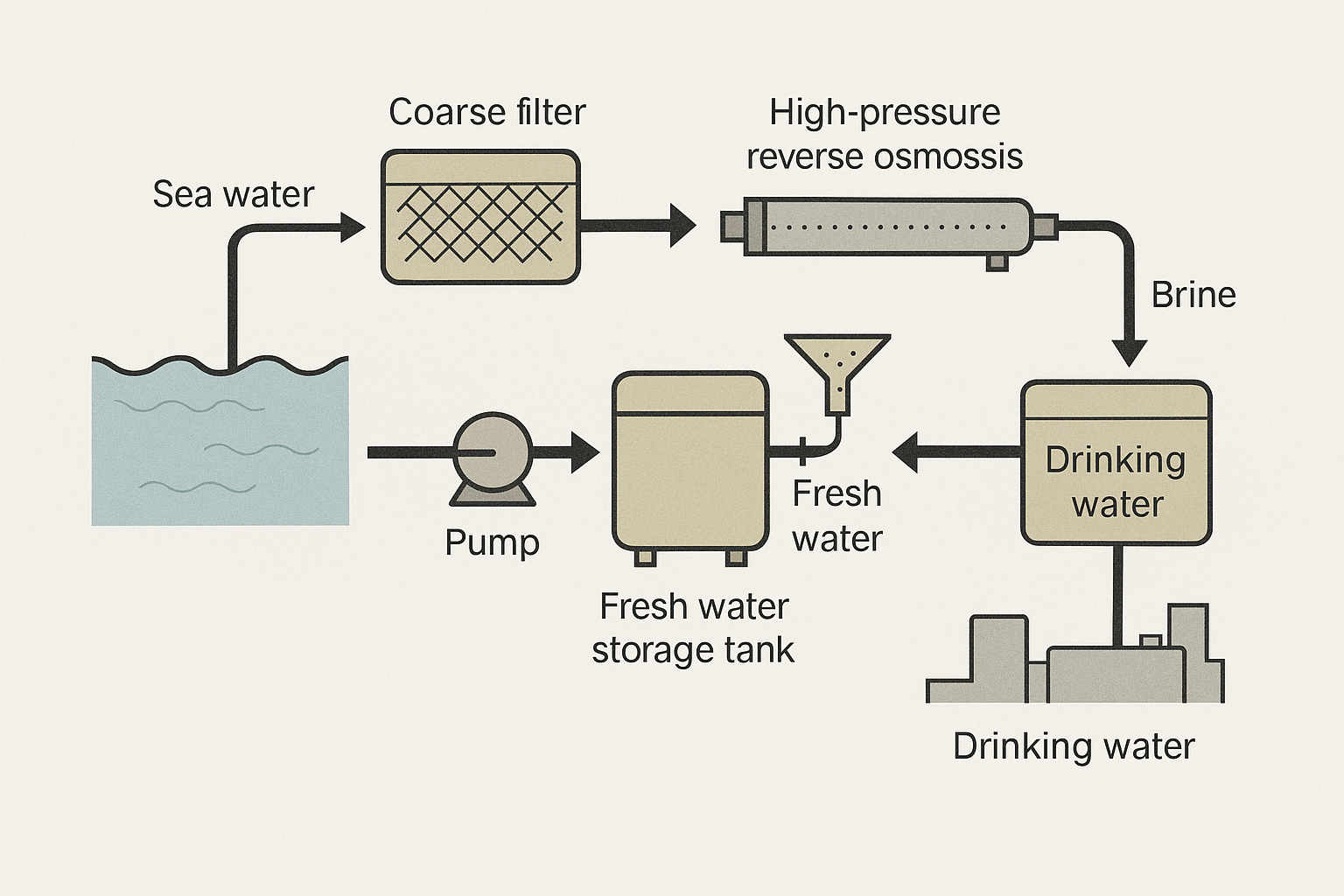
Click the diagram to view full screen & zoom
Your Answer:
Tip: After writing, check your grammar and make sure you describe each step of the process in clear, logical order!
Band 9 Model Answer & Step-by-Step Explanations
Read the full Band 9 sample answer, then expand each section for a deep explanation. Test your process writing skills with instant-feedback quiz questions!
1
Introduction
(Show/Hide)
2
Overview
(Show/Hide)
3
Detailed Stage-by-Stage Description
(Show/Hide)
4
Final Summary Sentence
(Show/Hide)
Test Yourself: Process Diagram Quiz
Choose the best answer for each question about the model response. Instantly see a full explanation for each choice!
20 Crucial Words for This IELTS Process Diagram Task
Master these high-impact vocabulary items for describing processes, technology, and scientific diagrams. Tap/click each word for a deep explanation, sample sentence, and common mistakes!
desalination ▼
potable ▼
filtration ▼
brine ▼
reverse osmosis ▼
intake ▼
coarse ▼
pre-treatment ▼
membrane ▼
discharge ▼
tank ▼
purification ▼
mineral ▼
distribution ▼
debris ▼
residue ▼
consume ▼
process ▼
output ▼
stage ▼
20 Crucial Phrases & Expressions for IELTS Process Diagrams
Learn and master the most useful expressions for describing, sequencing, and analysing processes in IELTS Task 1. Tap/click each phrase for a detailed breakdown, sample, and usage tip!
is drawn from ▼
passes through ▼
undergoes filtration ▼
is pumped into ▼
undergoes high-pressure reverse osmosis ▼
is separated from ▼
is discharged back into ▼
is stored in ▼
is treated with ▼
is distributed to ▼
at the next stage ▼
following this ▼
is finally ▼
as a result ▼
at each stage ▼
the main output ▼
by means of ▼
in sequence ▼
the diagram illustrates ▼
the final product ▼
Exercise 1: Master Key Words & Phrases
Practice your understanding of the most important words and phrases for describing process diagrams. Select the best answer for each question and get instant feedback!
Exercise 2: Deepen Your Mastery (Words & Phrases)
Strengthen your process vocabulary with another challenging quiz! Select the best answer for each question and review the detailed instant feedback.
🚀 Keep learning and connect with thousands of motivated IELTS learners!
Follow LingExam Language Academy on your favourite social platforms for exclusive tutorials, daily vocabulary, exam strategies, and community support—plus lots of interactive content!
✨ Join us to upgrade your IELTS skills every day!