![Unlock your highest IELTS Writing Task 1 band with this ultra-interactive tutorial! Featuring step-by-step strategies, a complex sample task with model answers, vocabulary and phrases breakdown, and instant practice quizzes—all based on the latest IELTS trends for 2025. Master waste management charts, expand your academic vocabulary, and boost your writing skills with LingExam’s expert guide. Perfect for serious IELTS candidates aiming for Band 7 and above! - IELTS Academic Writing Task 1: Ultra-Interactive Guide, Practice, and Model Answers – Waste Management Trends [2025] - LingExam Language Academy - Lingexam.com](https://lingexam.com/wp-content/uploads/2025/07/Article-Thumbnail-38.jpg)
IELTS Academic Writing Task 1: Step-by-Step Band 9 Tutorial (LingExam | Ultra-Interactive)
Welcome! In this tutorial, you’ll master IELTS Academic Writing Task 1 for the following complex question type:
The charts below show the percentage of waste material recycled, landfilled, and incinerated in three European countries (Germany, Italy, and the United Kingdom) in 2015 and 2025 (projected).
Follow each step below. Hover on any step to highlight and reveal advanced notes for Band 7+.
The charts below show the percentage of waste material recycled, landfilled, and incinerated in three European countries (Germany, Italy, and the United Kingdom) in 2015 and 2025 (projected).
Follow each step below. Hover on any step to highlight and reveal advanced notes for Band 7+.
How to Answer IELTS Academic Writing Task 1 (Charts): 12 Essential Steps
1
Read the question carefully. Make sure you know exactly what is being shown. Identify the countries, the years, and the types of waste management. Always underline or mentally note all categories and time periods.
2
Scan both charts/images and spot all the main categories. Here, look for recycled, landfilled, and incinerated waste in Germany, Italy, and the UK, in both 2015 and 2025. Note which country leads or lags in each method.
3
Quickly identify the overall changes and contrasts. For example, does recycling increase everywhere? Does landfilling drop? Is there a method that remains stable? This gives you a roadmap for your report structure.
4
Write a high-level overview in your mind. For Band 7+, you need to summarise overall trends, not list all details. Use phrases like “Overall, recycling increased while landfilling decreased in all countries.”
5
Group the data meaningfully. For example, compare all countries’ recycling rates in both years, then all landfilling rates, etc. Grouping shows examiner you can compare, not just describe.
6
Make comparisons with precise language. “Germany recycled the highest percentage in both years, while Italy’s rates were lower but increased.” Use comparatives (higher, lower, more than, less than) and transitions (whereas, while, in contrast).
7
Always support your claims with data from the charts. For example, “Germany’s recycling rate increased from 62% in 2015 to 70% in 2025.” Avoid opinions or explanations for changes!
8
Don’t overload your overview paragraph with numbers. Give the big picture in your overview, and leave specific data for the following paragraphs.
9
Structure your writing into logical paragraphs. Usually, one for overall trends and one or two for details (e.g., recycling, landfilling, incineration, or by country). This helps coherence and progression.
10
Use synonyms and varied sentence structures. For example, “percentage,” “proportion,” “share,” “rate,” “accounted for.” This shows your lexical resource and improves your score.
11
Describe past data in past simple, future data with “is projected to,” “is expected to.” Use the passive for formality: “was recycled,” “is projected to be landfilled.”
12
Review for grammar, data accuracy, and full task coverage. Did you summarise, make comparisons, use data, and avoid personal opinions? Proofread for errors before moving on!
Band 9 Sample Plan & Example Notes
Overview Example: “Overall, all three countries are projected to increase the percentage of waste recycled by 2025, while landfilling is expected to decrease. Germany remains the leader in recycling both years.”
Grouping Example: “Recycling rates were highest in Germany (62% in 2015), increasing to 70% by 2025, while the UK saw a significant rise from 45% to 58%.”
Grouping Example: “Recycling rates were highest in Germany (62% in 2015), increasing to 70% by 2025, while the UK saw a significant rise from 45% to 58%.”
IELTS Academic Writing Task 1
Task:
The charts below show the percentage of waste material recycled, landfilled, and incinerated in three European countries (Germany, Italy, and the United Kingdom) in 2015 and 2025 (projected).
Summarise the information by selecting and reporting the main features, and make comparisons where relevant.
Charts: Waste Management in Three European Countries (2015 & 2025)
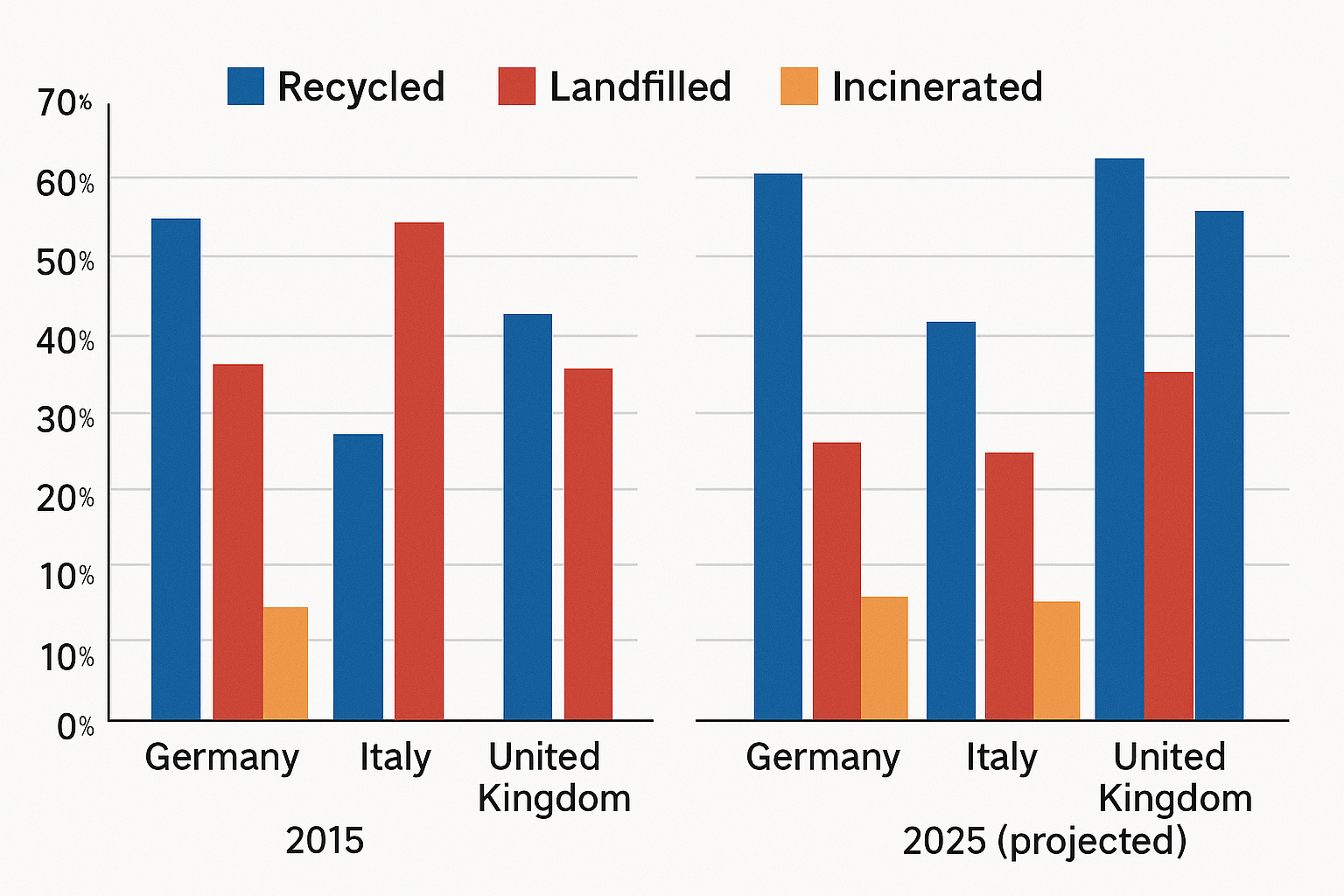
Click the image to view full screen & zoom
Your Answer:
Tip: After writing, check your grammar, data, and make at least two clear comparisons between countries and between years!
Band 9 Model Answer & Step-by-Step Explanations
Review the full Band 9 sample answer and reveal step-by-step how each part achieves a high score. Expand each step for a deep explanation, and test yourself with interactive quiz questions!
1
Introduction:
(Show/Hide)
2
Overview:
(Show/Hide)
3
Body Paragraph 1: Recycling Data & Comparisons
(Show/Hide)
4
Body Paragraph 2: Landfilling & Incineration
(Show/Hide)
5
Final Summary & Key Comparisons
(Show/Hide)
Test Yourself: Band 9 Answer Key Quiz
Choose the best answer for each analysis question about the model response. Instantly see a full explanation for each choice!
20 Crucial Words for This IELTS Task
Master these high-impact vocabulary items from the model answer and chart. Tap/click each word for a deep explanation, example, and common mistakes!
proportion ▼
projected ▼
decline ▼
category ▼
method ▼
compare ▼
significant ▼
remain ▼
rate ▼
trend ▼
decline ▼
dominate ▼
account for ▼
overall ▼
respectively ▼
increase ▼
contrast ▼
stability ▼
fluctuate ▼
analysis ▼
20 Crucial Phrases & Expressions for IELTS Task 1
Learn and master the most useful expressions for describing, comparing, and analysing data. Tap/click each phrase for details and usage notes!
the largest proportion of ▼
by contrast ▼
is projected to ▼
remains the leader ▼
followed by ▼
accounted for ▼
there was a decline in ▼
respectively ▼
it is expected that ▼
make comparisons ▼
by 2025 ▼
remained stable ▼
there was a rise in ▼
in terms of ▼
in all three countries ▼
the least-used method ▼
in comparison to ▼
was most common in ▼
is set to ▼
to summarise ▼
Interactive Exercise 1: Vocabulary & Phrases Practice
Test your mastery of the most important words and expressions from this IELTS Writing Task 1! Select the correct answer. Get an instant explanation after every choice.
Interactive Exercise 2: Phrases & Expressions in Context
Practise using the most important IELTS Task 1 phrases. Read the sentence and choose the answer that fits best in context. Instantly view a deep explanation for every answer!


Stay Connected & Boost Your IELTS Progress!