Introduction: The Real-Life Importance of Team Leadership
In today’s rapidly changing professional landscape, the ability to lead a team project is a highly sought-after skill in both English-speaking and international workplaces. Whether you are working on a marketing campaign, developing a new software application, or managing a community event, team projects are everywhere. The modern global workforce thrives on collaboration and cross-cultural communication, making English not only the language of business but also the tool for successful teamwork.
Imagine you’ve just been promoted to a team leader in an international company. Your first big task? Deliver a project within a tight deadline with a multicultural team. How do you delegate responsibilities, motivate your colleagues, and ensure that every member is working toward the same goal? This article will guide you through the essential skills, language, and strategies you need to lead a team project effectively, especially in English.
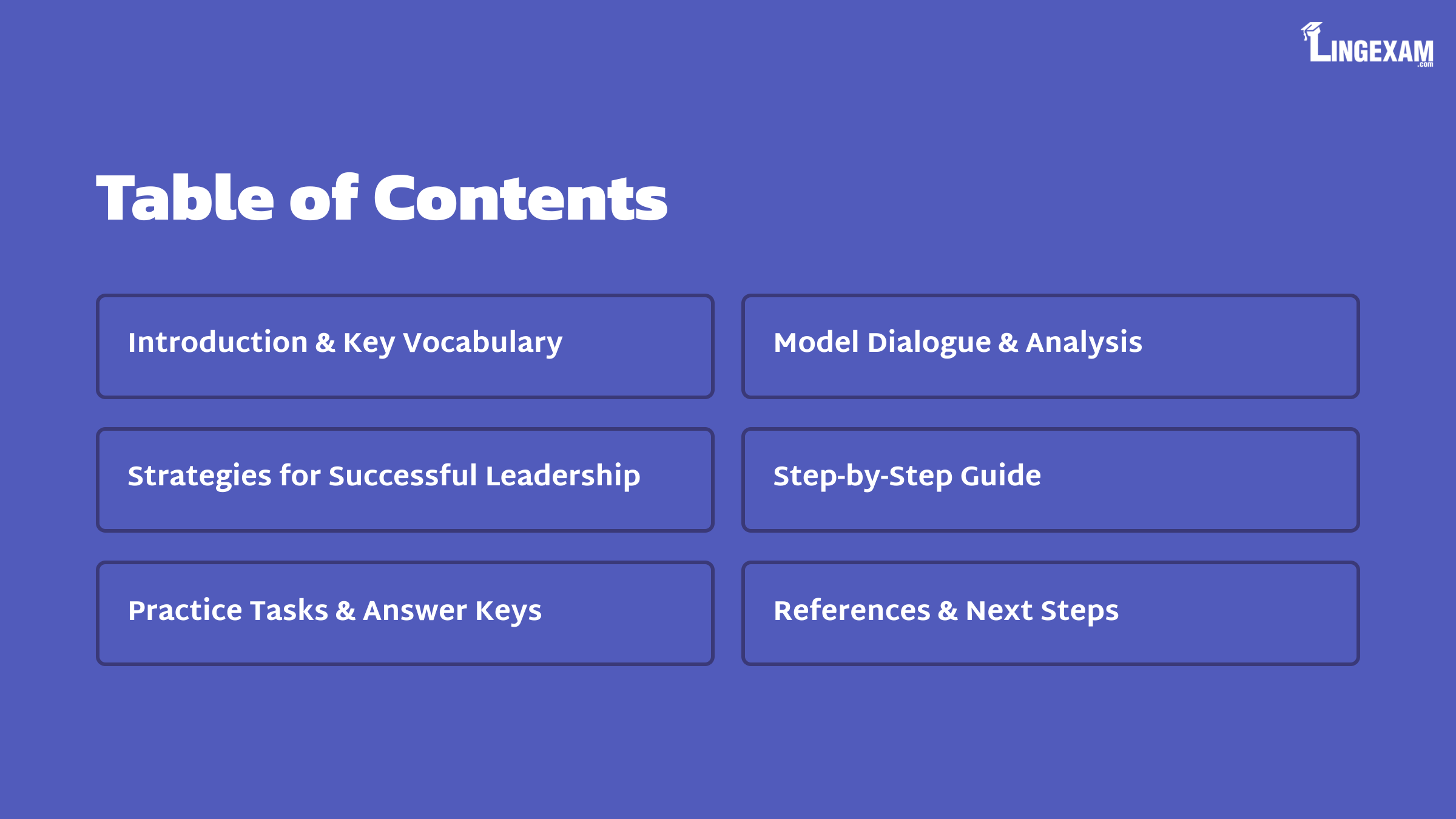
Table of Contents
Introduction: The Real-Life Importance of Team Leadership
Key Vocabulary & Useful Phrases for Leading a Team Project
Model Dialogue: Natural English for Team Leadership
Strategies for Successful Team Project Leadership
Step-by-Step Guide to Leading a Team Project
Practice Tasks & Questions (With Answer Keys and Explanations)
References
Next Steps: Keep Learning at Lingexam Language Academy
Key Vocabulary & Useful Phrases for Leading a Team Project
Before diving into practical tips, let’s focus on the language you’ll need. Mastering the right vocabulary is the first step to sounding confident and competent as a team leader.
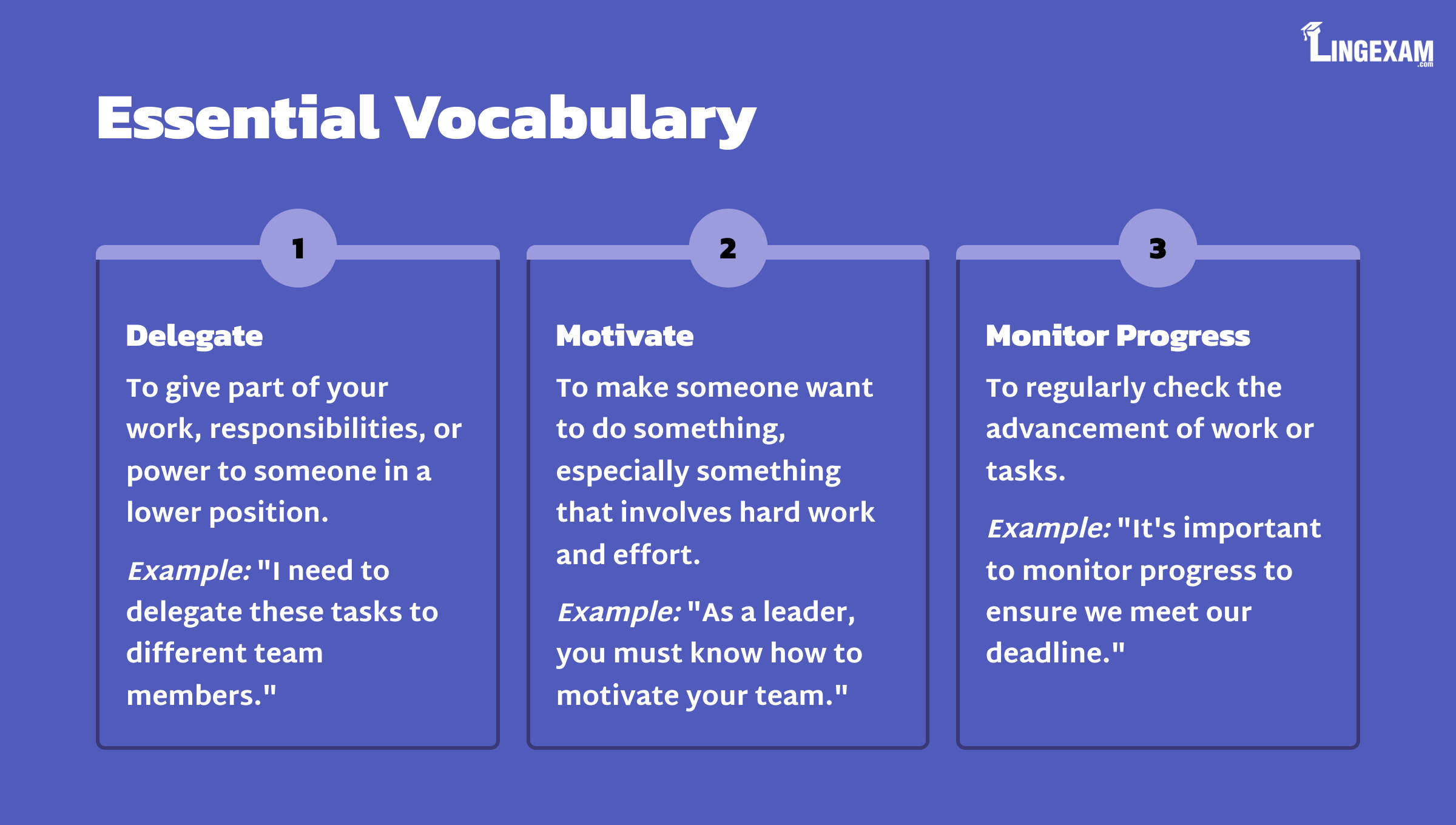
1. Essential Vocabulary
Delegate (verb): To give part of your work, responsibilities, or power to someone in a lower position.
Example: “I need to delegate these tasks to different team members.”Motivate (verb): To make someone want to do something, especially something that involves hard work and effort.
Example: “As a leader, you must know how to motivate your team.”Monitor Progress (verb phrase): To regularly check the advancement of work or tasks.
Example: “It’s important to monitor progress to ensure we meet our deadline.”Set Clear Goals (verb phrase): To establish specific and understandable objectives.
Example: “Let’s set clear goals so everyone knows what we’re working toward.”Deadlines (noun): The time or date by which something must be done.
Example: “We need to finish this project before the deadline.”Communicate Expectations (verb phrase): To tell your team what you expect from them clearly and directly.
Example: “Make sure to communicate your expectations from the beginning.”Diplomatically (adverb): In a way that does not offend people and tries to avoid conflict.
Example: “Address problems diplomatically to keep the team motivated.”Constructive Feedback (noun phrase): Helpful suggestions and comments to improve someone’s work, rather than criticizing them harshly.
Example: “Give constructive feedback to help team members improve.”Empathy (noun): The ability to understand and share the feelings of others.
Example: “Good leaders show empathy toward their team.”Authority (noun): The power or right to give orders, make decisions, and enforce obedience.
Example: “A leader must balance authority and empathy.”
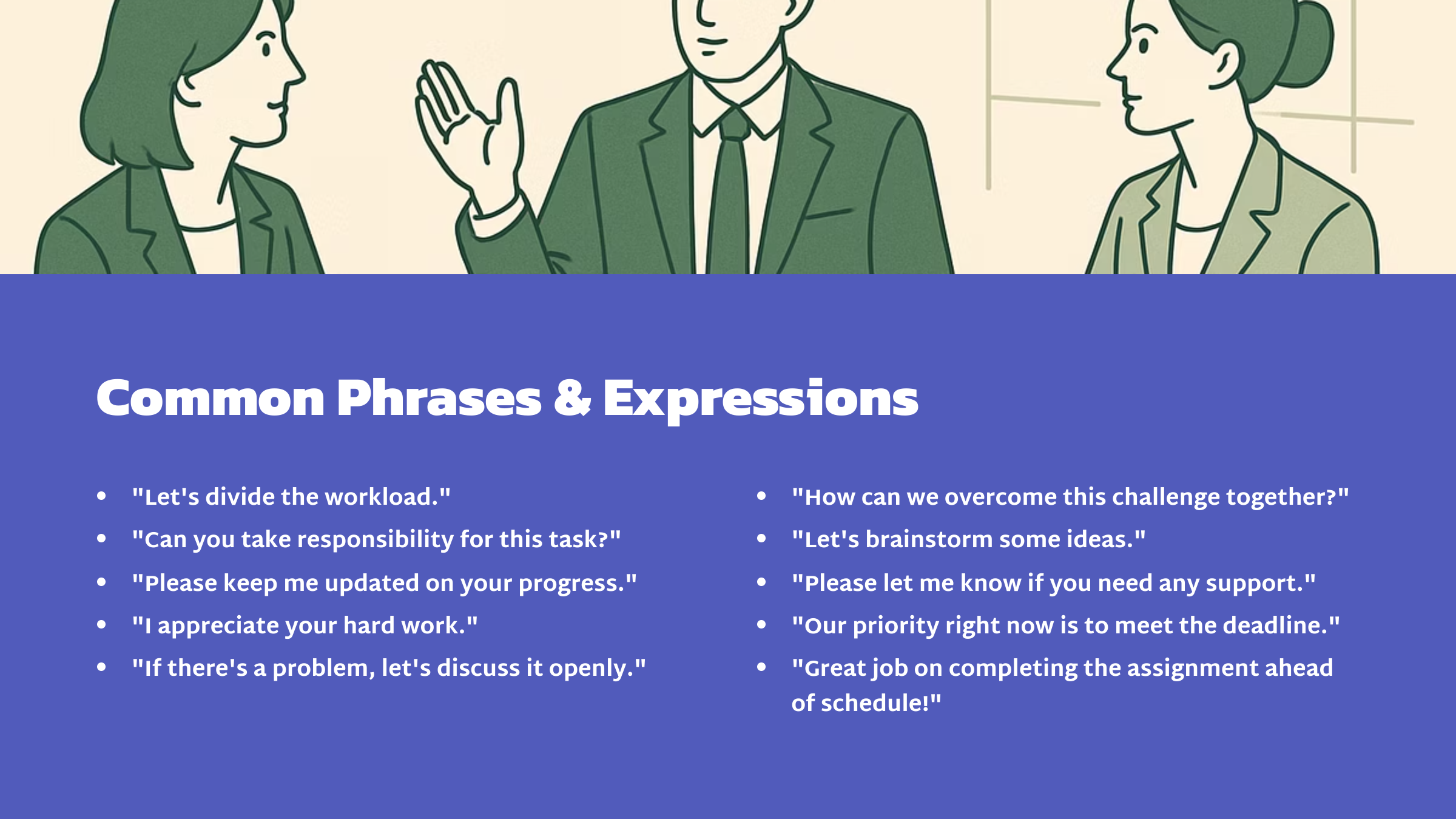
2. Common Phrases & Expressions
“Let’s divide the workload.”
“Can you take responsibility for this task?”
“Please keep me updated on your progress.”
“I appreciate your hard work.”
“If there’s a problem, let’s discuss it openly.”
“How can we overcome this challenge together?”
“Let’s brainstorm some ideas.”
“Please let me know if you need any support.”
“Our priority right now is to meet the deadline.”
“Great job on completing the assignment ahead of schedule!”
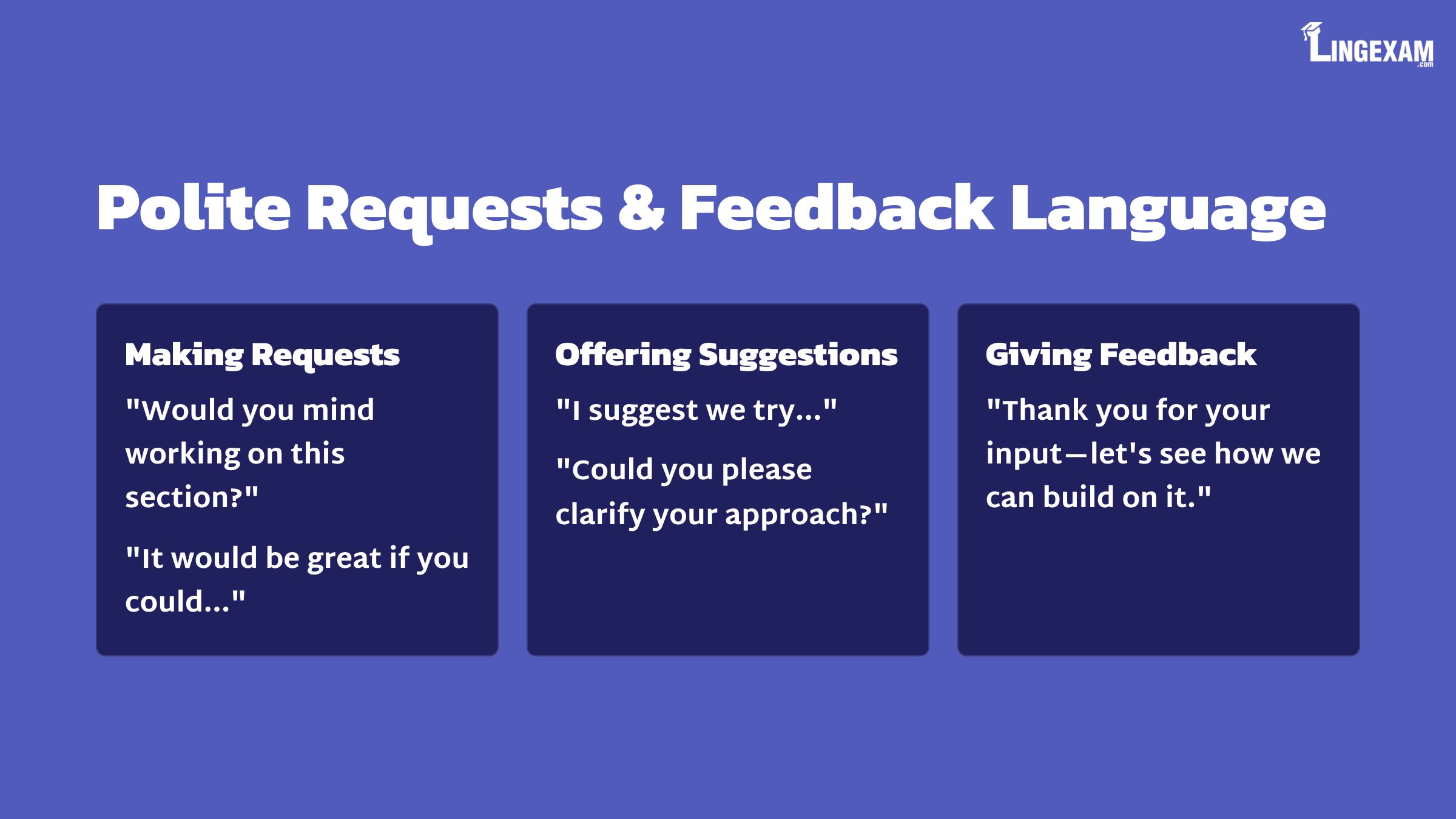
3. Polite Requests & Feedback Language
“Would you mind working on this section?”
“It would be great if you could…”
“I suggest we try…”
“Could you please clarify your approach?”
“Thank you for your input—let’s see how we can build on it.”
Model Dialogue: Leading a Team Project in English
Below is a model conversation that demonstrates natural English used in team project settings. This example shows a weekly check-in meeting with a multicultural team.
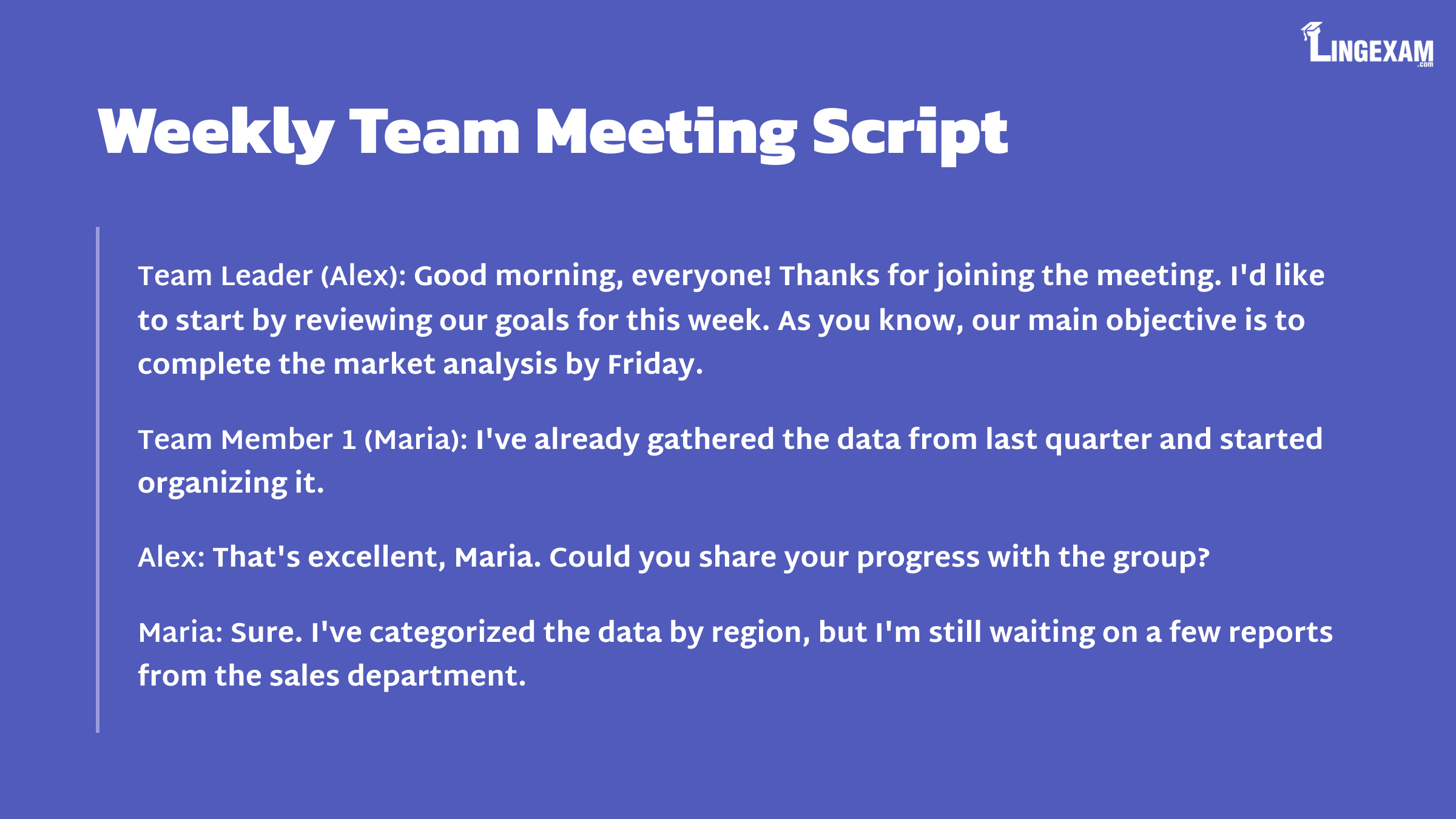
Model Script: Weekly Team Meeting
Team Leader (Alex): Good morning, everyone! Thanks for joining the meeting. I’d like to start by reviewing our goals for this week. As you know, our main objective is to complete the market analysis by Friday.
Team Member 1 (Maria): I’ve already gathered the data from last quarter and started organizing it.
Alex: That’s excellent, Maria. Could you share your progress with the group?
Maria: Sure. I’ve categorized the data by region, but I’m still waiting on a few reports from the sales department.
Alex: Understood. John, could you follow up with sales and see if they can send the missing reports by tomorrow?
John: Absolutely, I’ll do that right after the meeting.
Alex: Great. Emily, how’s the competitor research coming along?
Emily: I’ve run into a couple of issues with accessing their financial statements. I might need some help.
Alex: No problem. Let’s discuss this after the meeting and find a solution together. Remember, if anyone is facing obstacles, please let me know as soon as possible.
Alex: Just a quick reminder—please keep your sections updated in the shared folder so I can monitor our overall progress.
Maria: Will do!
Alex: Fantastic. If anyone has suggestions for improving our workflow, I’m all ears. Let’s keep the communication open and support one another. Thanks, everyone, and let’s aim to finish ahead of schedule!

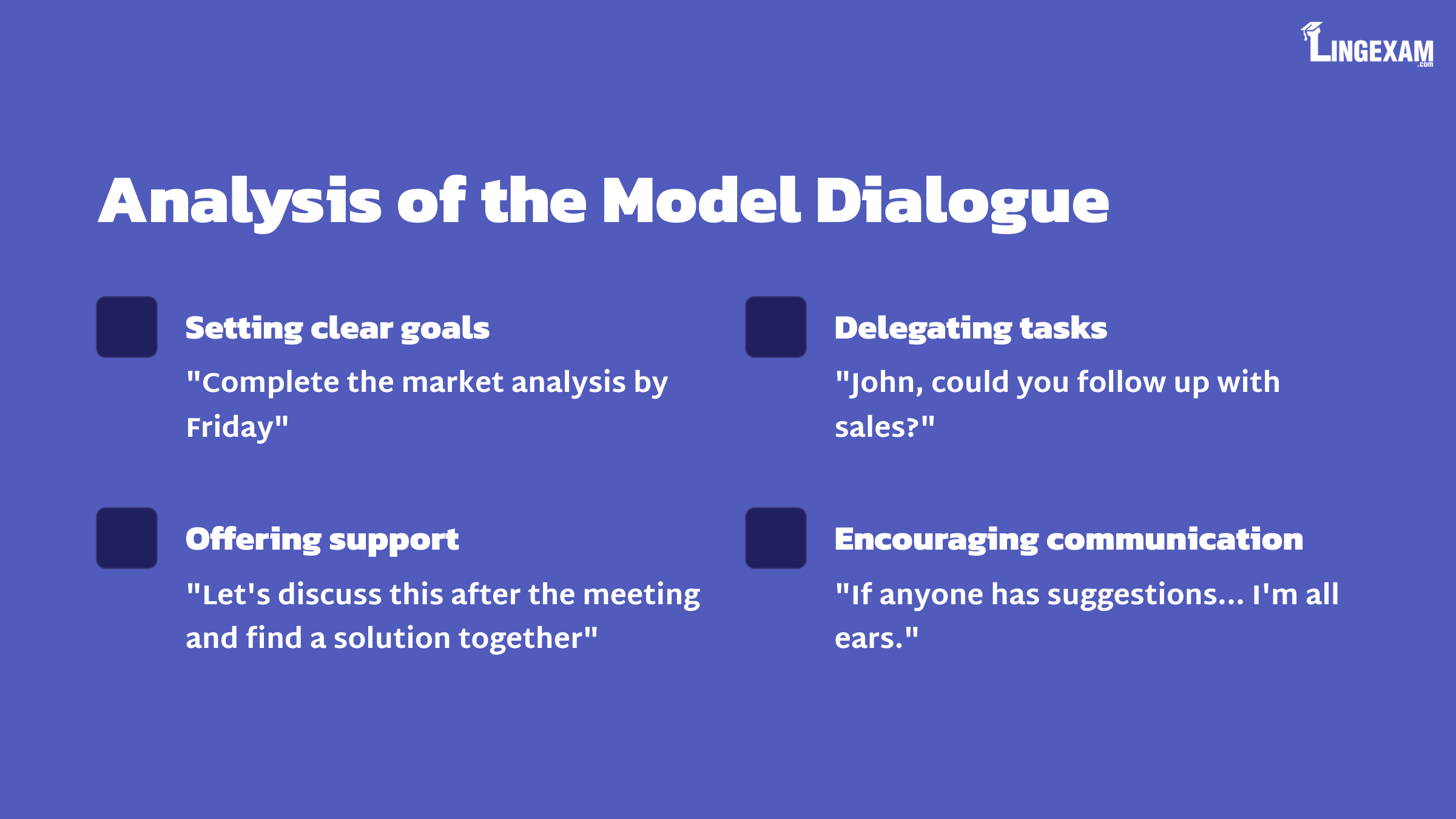
Analysis of the Model Dialogue
Key strategies used:
Setting clear goals (“complete the market analysis by Friday”)
Delegating tasks (“John, could you follow up with sales?”)
Offering support and addressing issues (“Let’s discuss this after the meeting and find a solution together”)
Encouraging open communication (“If anyone has suggestions… I’m all ears.”)
Using polite language and positive reinforcement (“That’s excellent, Maria.” / “Fantastic.”)
Strategies for Successful Team Project Leadership
To be an effective team leader, you need to master both the language and the practical strategies that drive team performance. Below is a comprehensive guide with actionable steps, real-life examples, and practical advice.
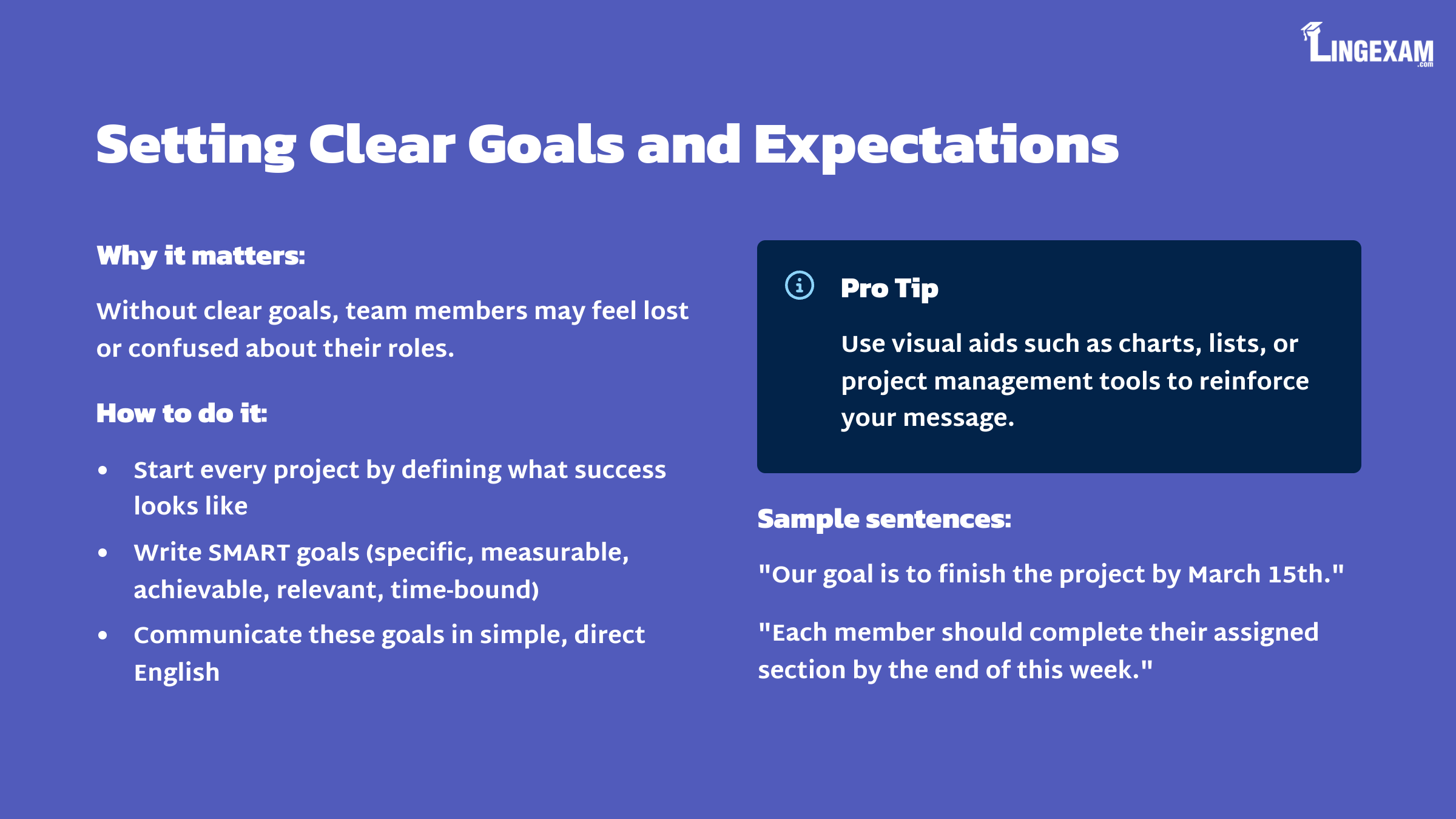
1. Setting Clear Goals and Expectations
Why it matters: Without clear goals, team members may feel lost or confused about their roles.
How to do it:
Start every project by defining what success looks like.
Write specific, measurable, achievable, relevant, and time-bound (SMART) goals.
Communicate these goals to every member in simple, direct English.
Sample sentences:
“Our goal is to finish the project by March 15th.”
“Each member should complete their assigned section by the end of this week.”
Pro Tip: Use visual aids such as charts, lists, or project management tools to reinforce your message.
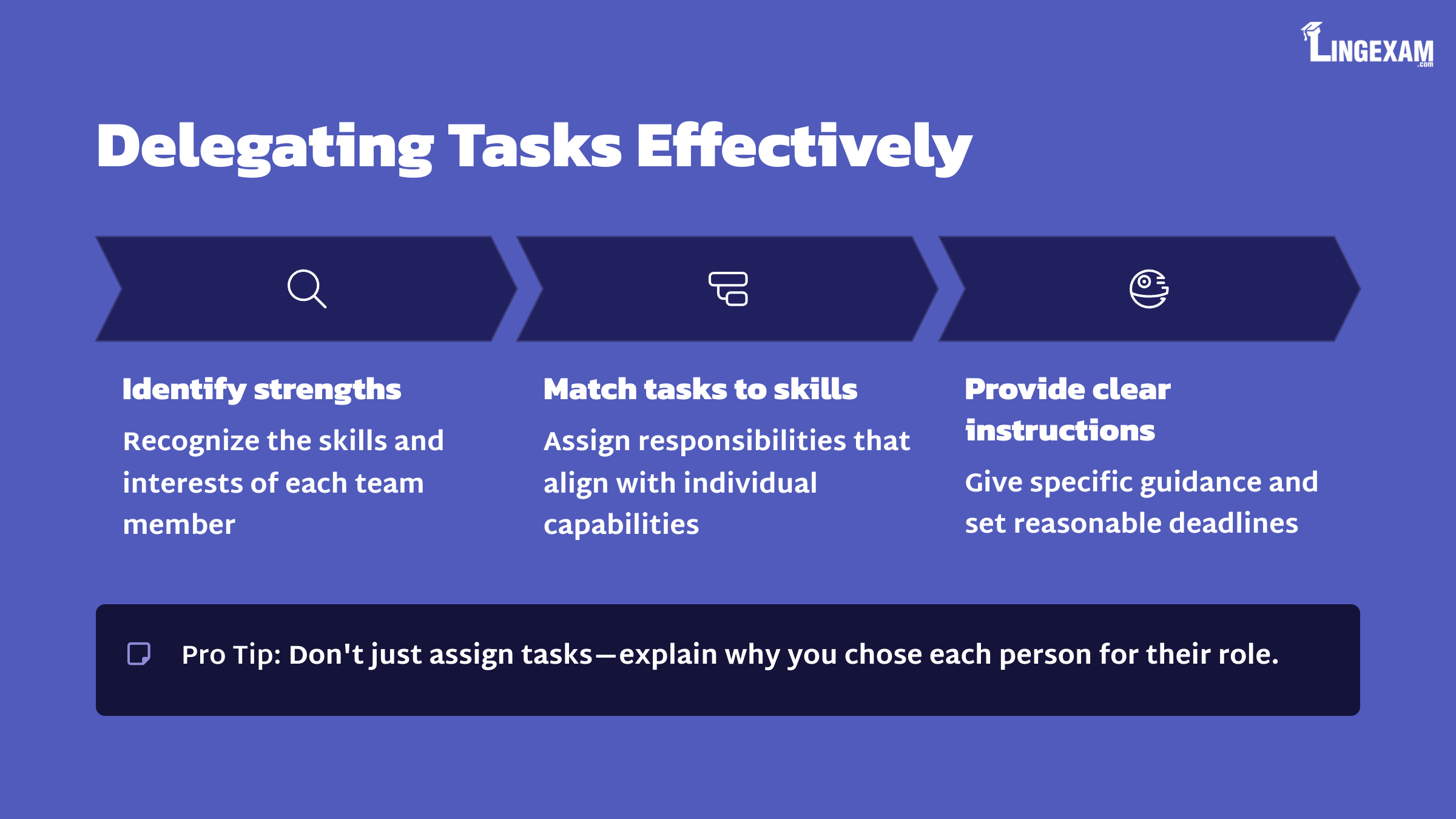
2. Delegating Tasks Effectively
Why it matters: Good leaders know they can’t do everything themselves. Delegation empowers team members and increases productivity.
How to do it:
Identify the strengths and interests of each team member.
Assign tasks that match their skills and experience.
Provide clear instructions and deadlines.
Sample sentences:
“Emily, could you handle the data analysis?”
“John, I’d like you to lead the presentation.”
Pro Tip: Don’t just assign tasks—explain why you chose each person for their role.
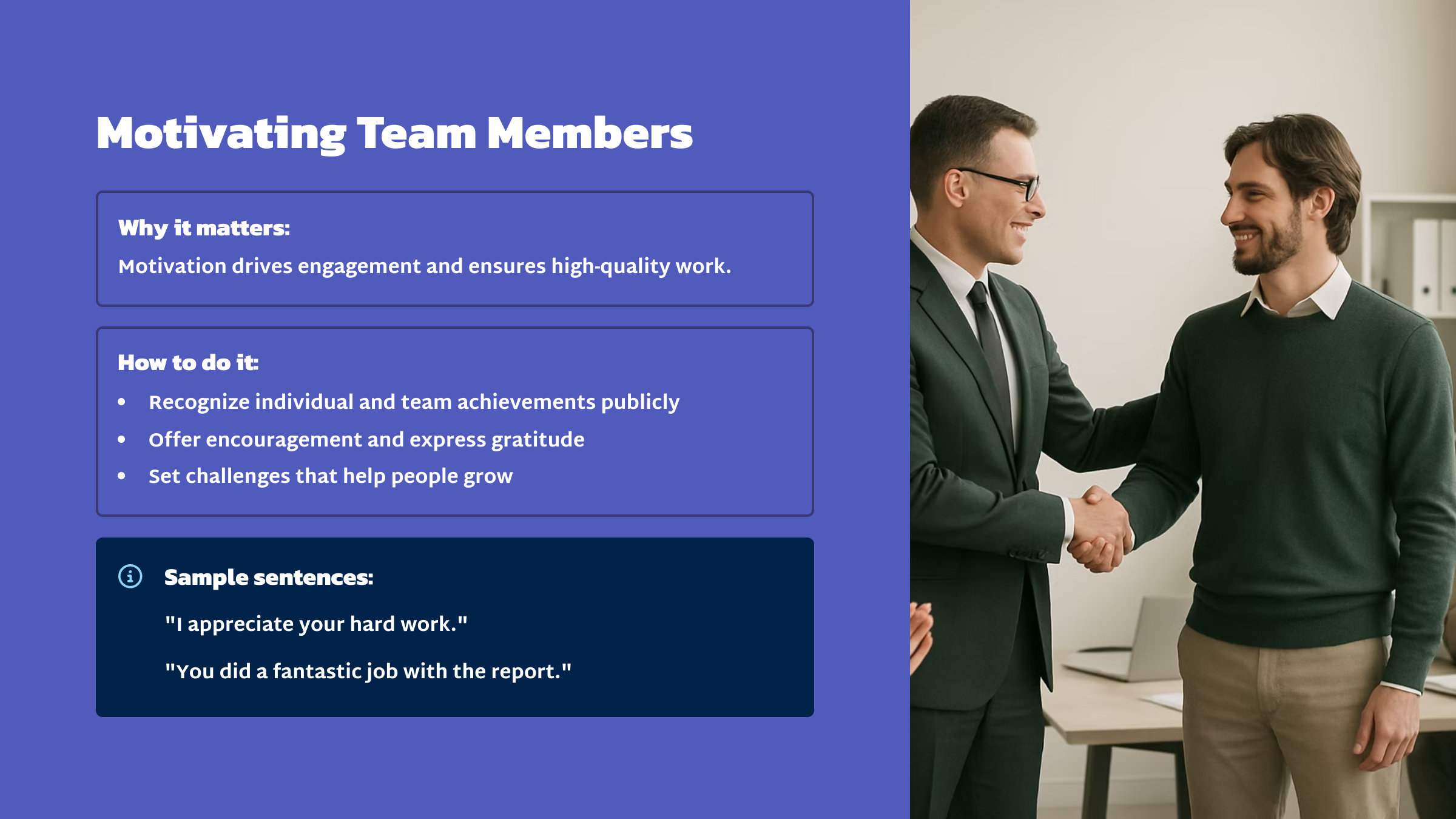
3. Motivating Team Members
Why it matters: Motivation drives engagement and ensures high-quality work.
How to do it:
Recognize individual and team achievements publicly.
Offer encouragement and express gratitude.
Set challenges that help people grow.
Sample sentences:
“I appreciate your hard work.”
“You did a fantastic job with the report.”
Pro Tip: Tailor your motivation style to the personalities in your team—some prefer public recognition, others value private praise.
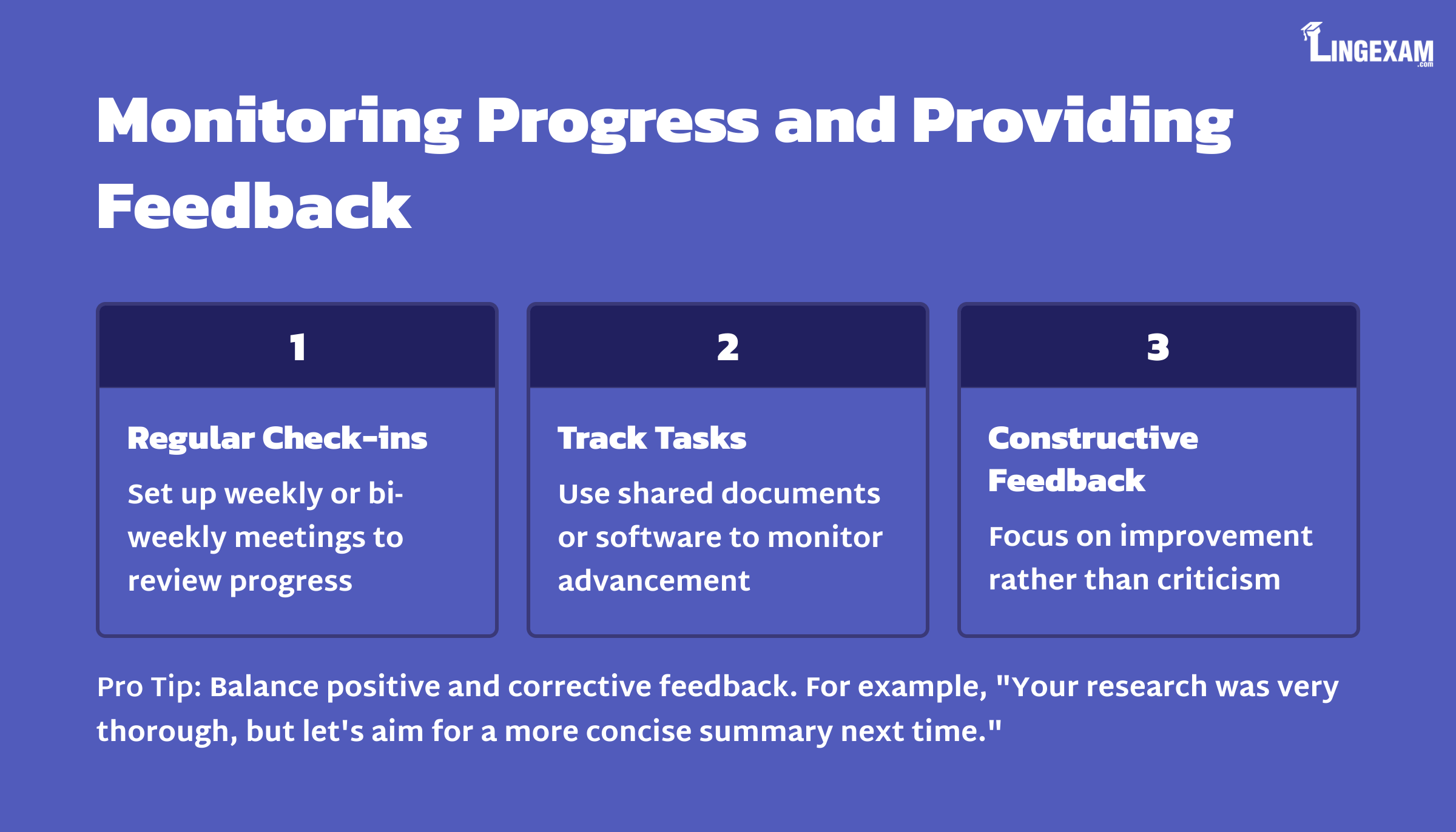
4. Monitoring Progress and Providing Feedback
Why it matters: Regular check-ins help prevent problems from growing and keep everyone on track.
How to do it:
Set up weekly or bi-weekly meetings to review progress.
Use shared documents or software to track tasks.
Offer constructive feedback, focusing on improvement.
Sample sentences:
“Let’s review our progress so far.”
“I noticed some areas for improvement—let’s discuss how we can address them.”
Pro Tip: Balance positive and corrective feedback. For example, “Your research was very thorough, but let’s aim for a more concise summary next time.”
5. Handling Problems Diplomatically
Why it matters: Conflicts or misunderstandings are inevitable. Diplomacy keeps the team focused and united.
How to do it:
Address issues privately and respectfully.
Listen to all sides before making decisions.
Offer solutions, not just criticism.
Sample sentences:
“I understand your concerns. Let’s see how we can resolve this.”
“Can we find a compromise that works for everyone?”
Pro Tip: Use “I” statements (“I feel…” or “I think…”) to express your viewpoint without sounding accusatory.
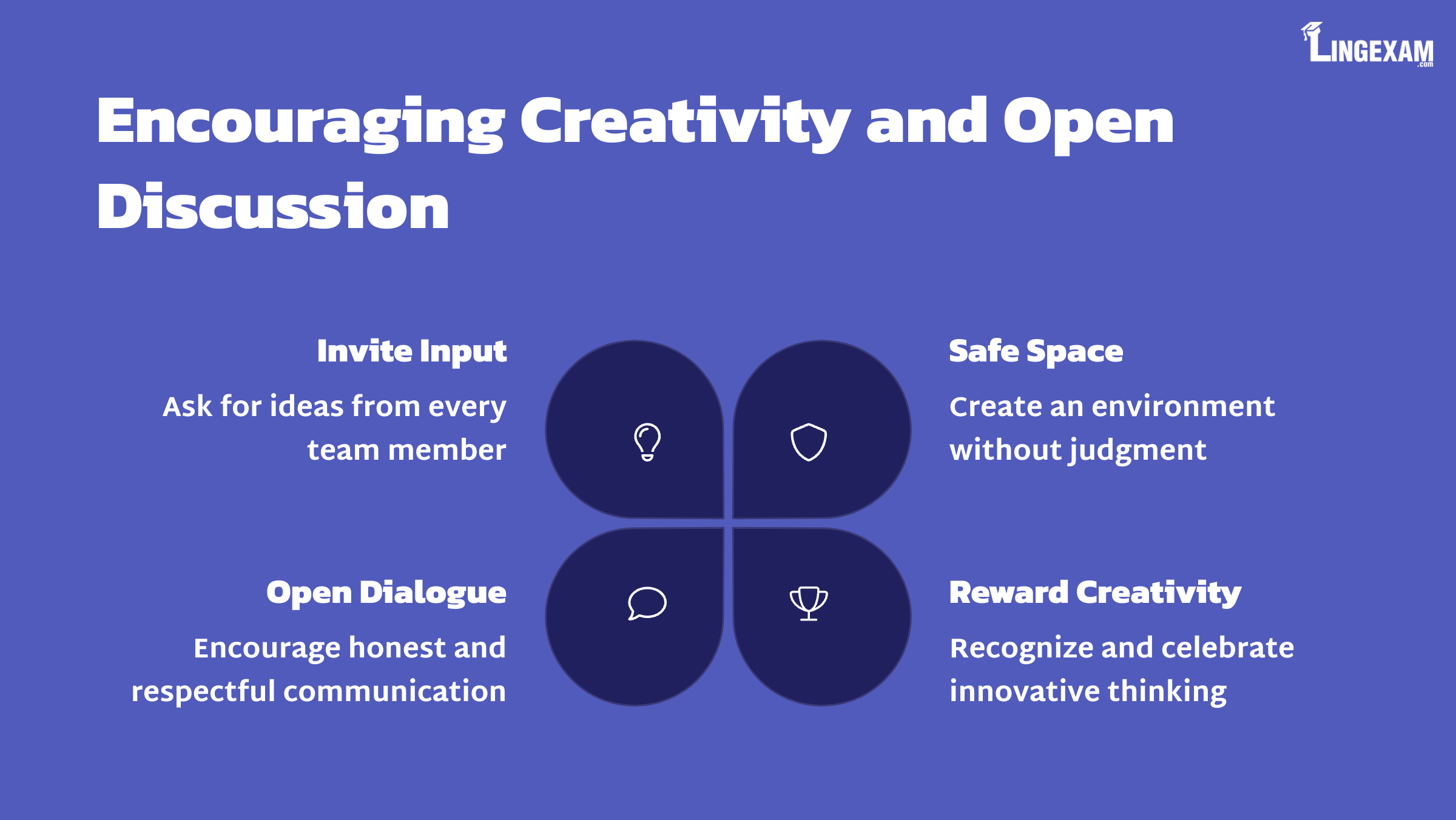
6. Encouraging Creativity and Open Discussion
Why it matters: Innovative solutions often come from group brainstorming and open dialogue.
How to do it:
Invite input from every team member.
Create a safe space for sharing ideas without judgment.
Reward creative thinking.
Sample sentences:
“Let’s brainstorm possible solutions.”
“No idea is too small—let’s hear your suggestions.”
Pro Tip: Hold regular “idea sessions” where team members can pitch their thoughts.
7. Balancing Authority and Empathy
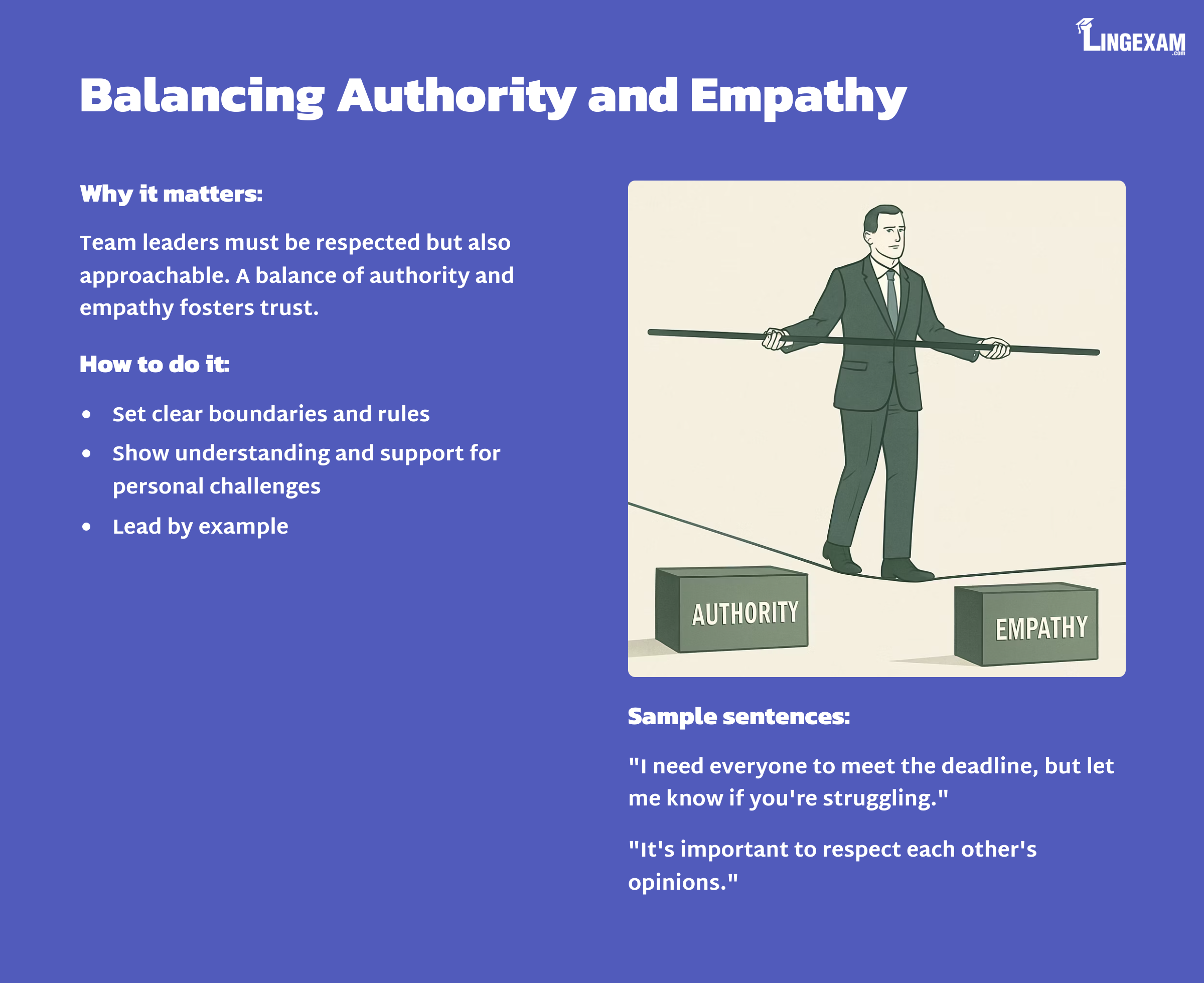
Why it matters: Team leaders must be respected but also approachable. A balance of authority and empathy fosters trust.
How to do it:
Set clear boundaries and rules.
Show understanding and support for personal challenges.
Lead by example.
Sample sentences:
“I need everyone to meet the deadline, but let me know if you’re struggling.”
“It’s important to respect each other’s opinions.”
Pro Tip: Admit when you make mistakes—this shows humility and earns respect.
Step-by-Step Guide to Leading a Team Project
Let’s break down the process into clear steps so you can apply everything you’ve learned:
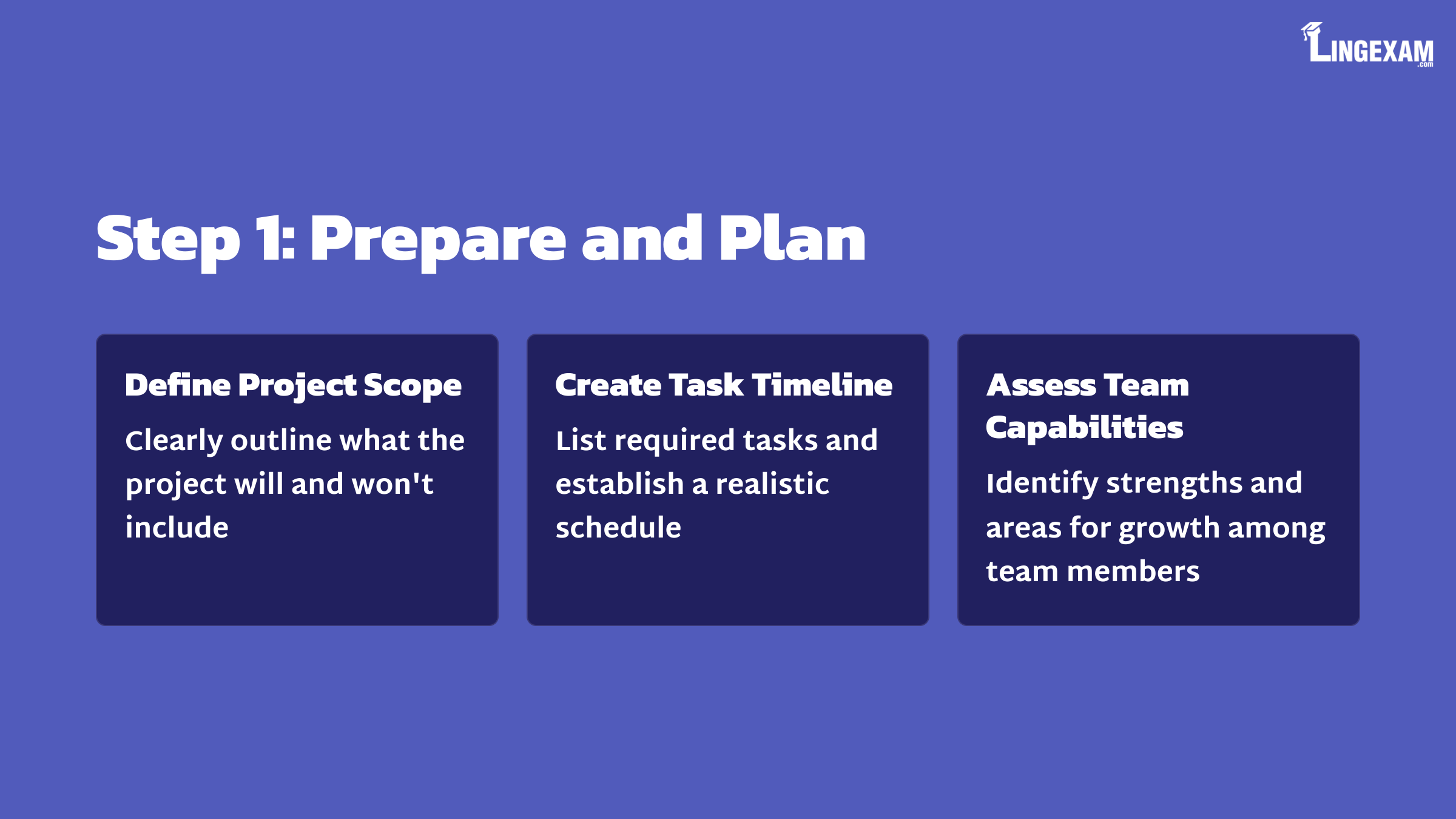
Step 1: Prepare and Plan
Define the project scope.
List the required tasks and timeline.
Identify the team’s strengths and areas for growth.
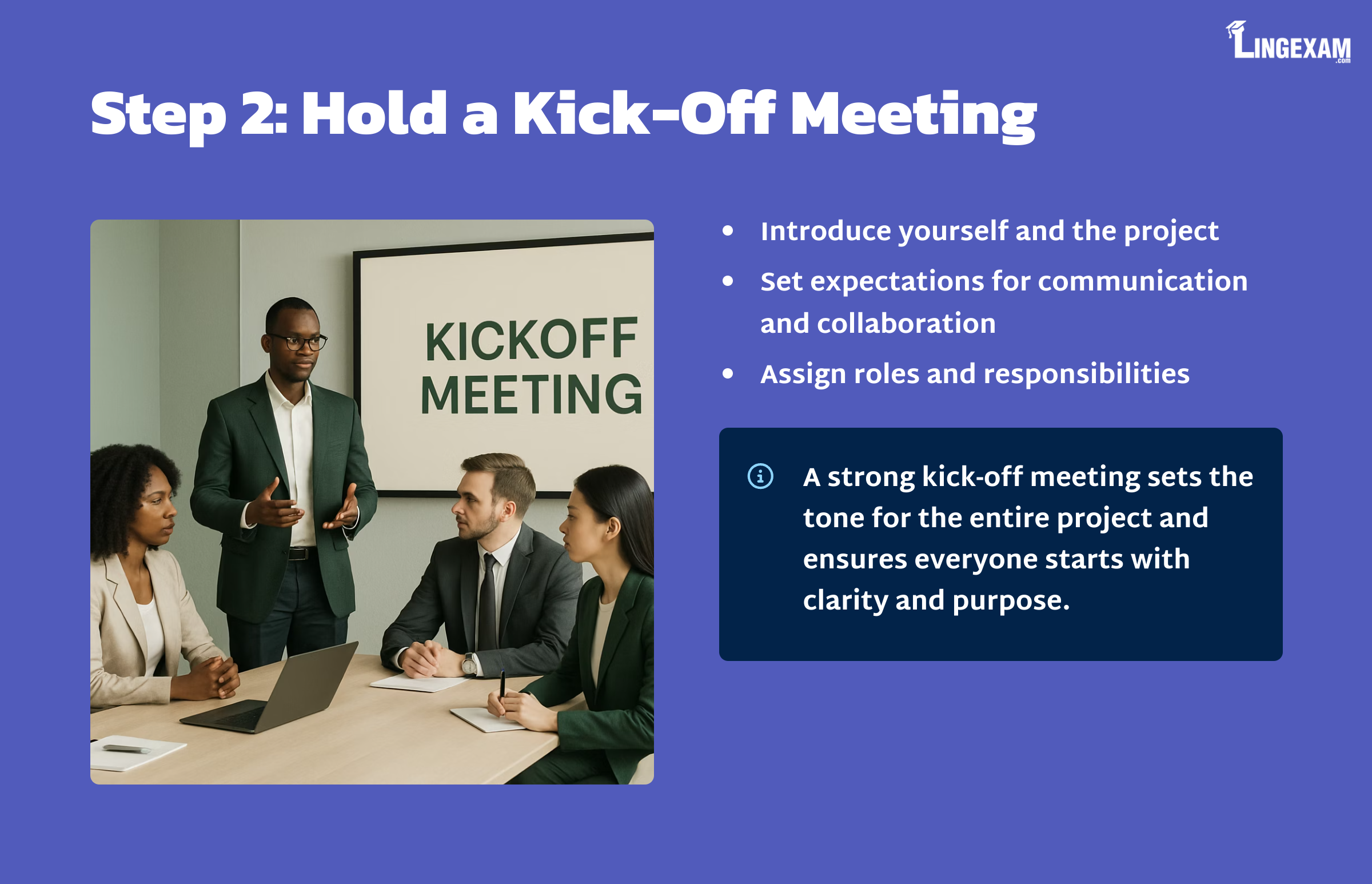
Step 2: Hold a Kick-Off Meeting
Introduce yourself and the project.
Set expectations for communication and collaboration.
Assign roles and responsibilities.
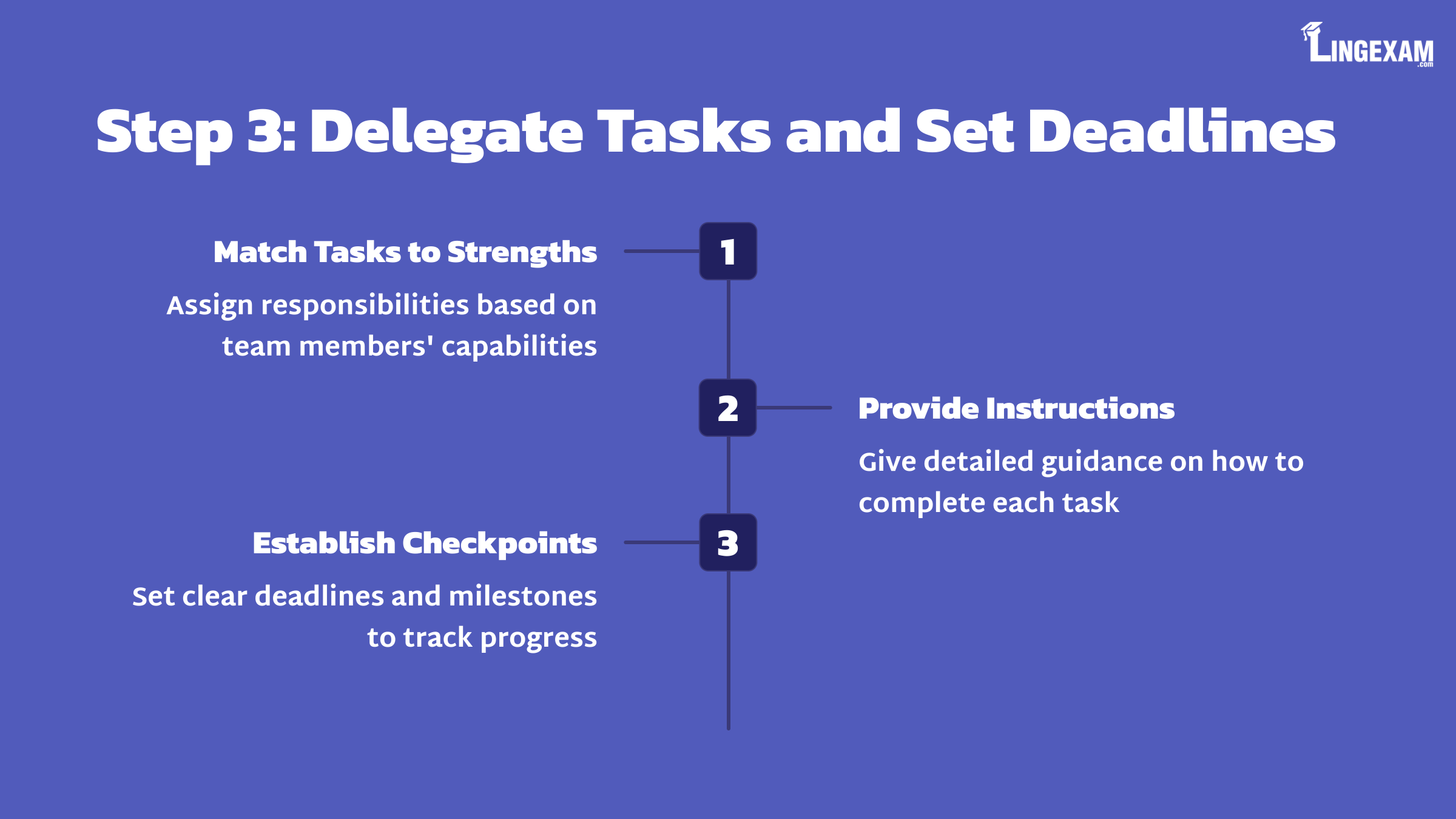
Step 3: Delegate Tasks and Set Deadlines
Match tasks to team members’ strengths.
Provide detailed instructions.
Establish checkpoints and deadlines.
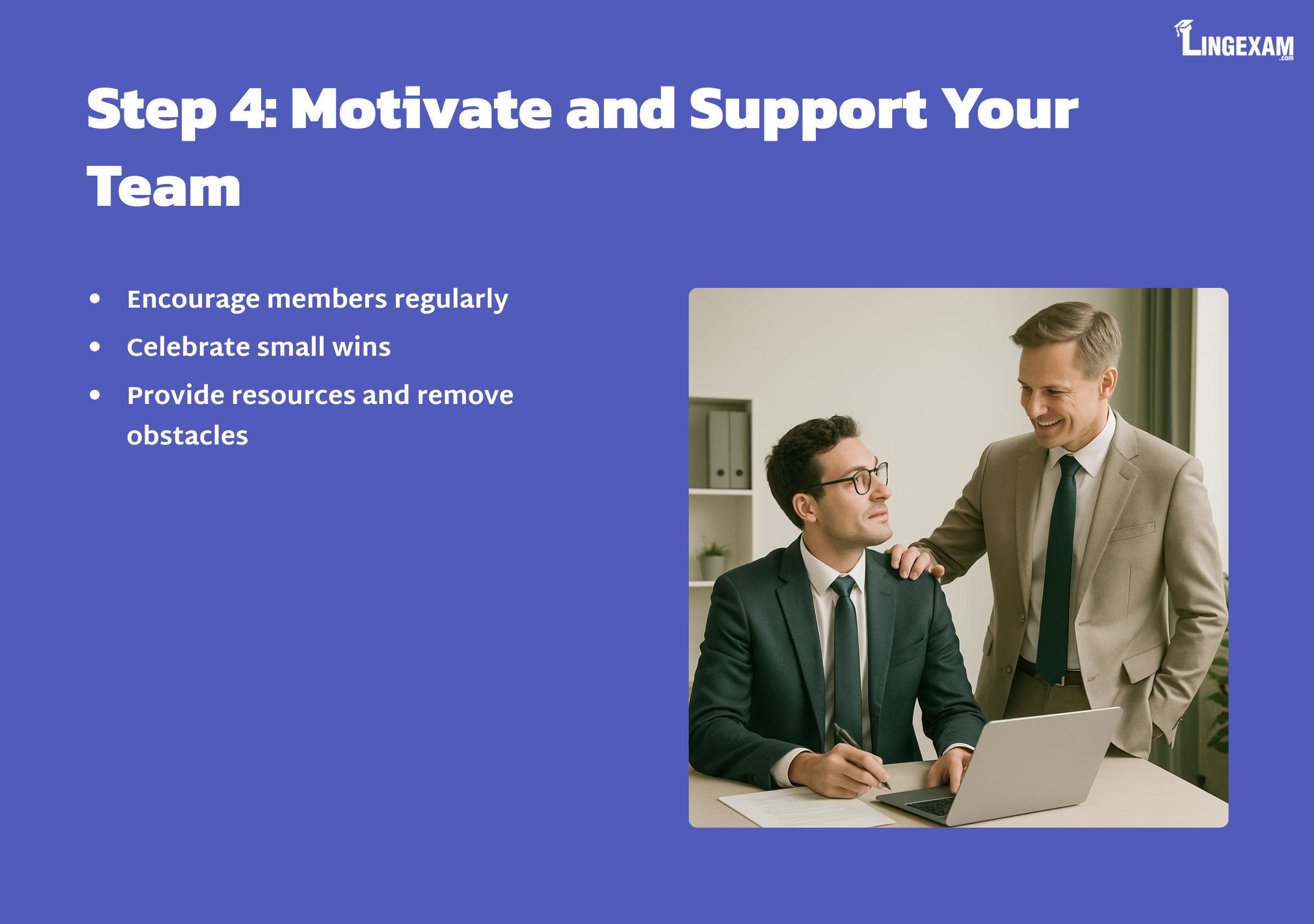
Step 4: Motivate and Support Your Team
Encourage members regularly.
Celebrate small wins.
Provide resources and remove obstacles.
Step 5: Monitor Progress
Schedule regular check-ins.
Use digital tools (like Trello, Asana, or Google Workspace) to track progress.
Ask for status updates and provide feedback.
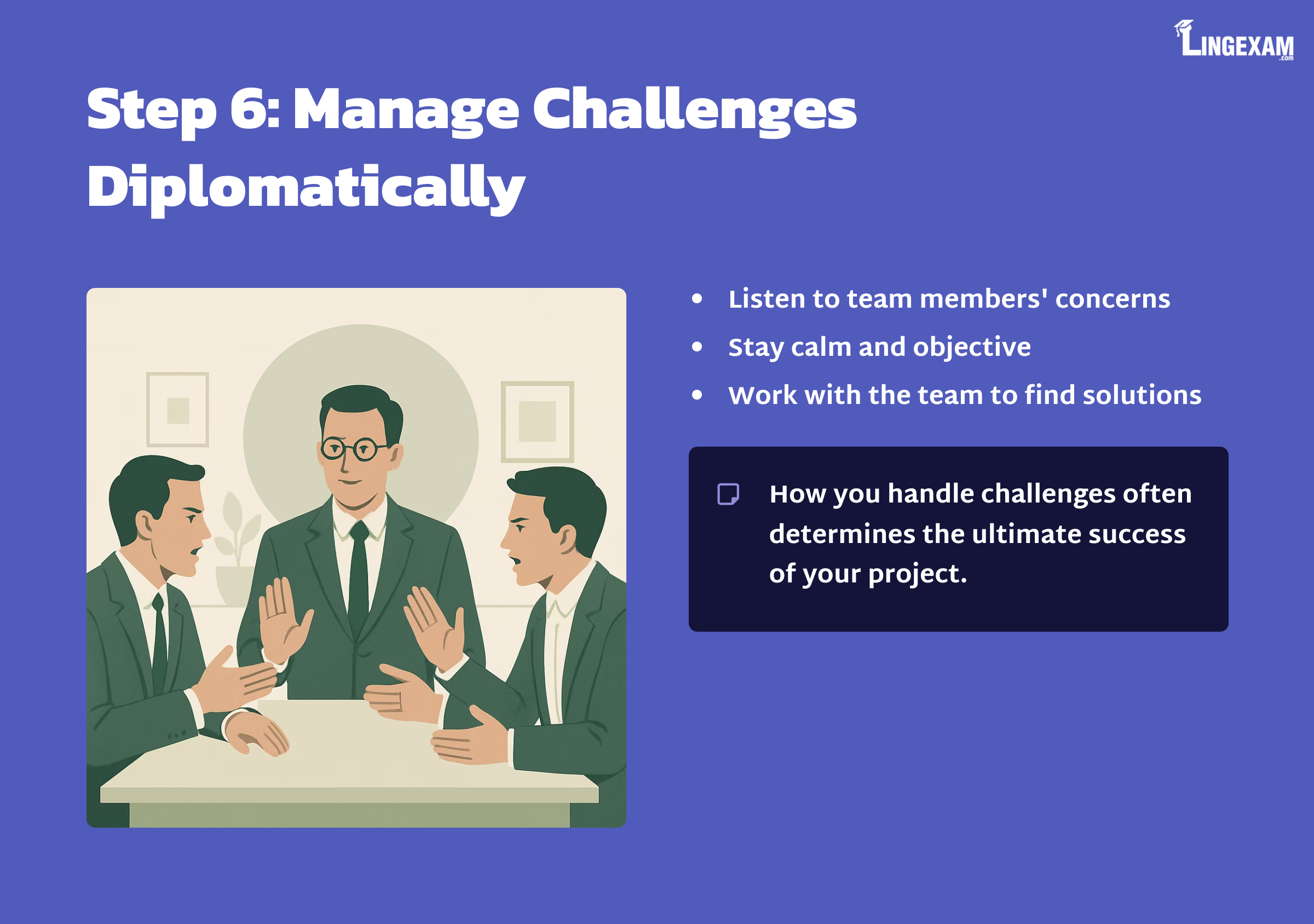
Step 6: Manage Challenges Diplomatically
Listen to team members’ concerns.
Stay calm and objective.
Work with the team to find solutions.
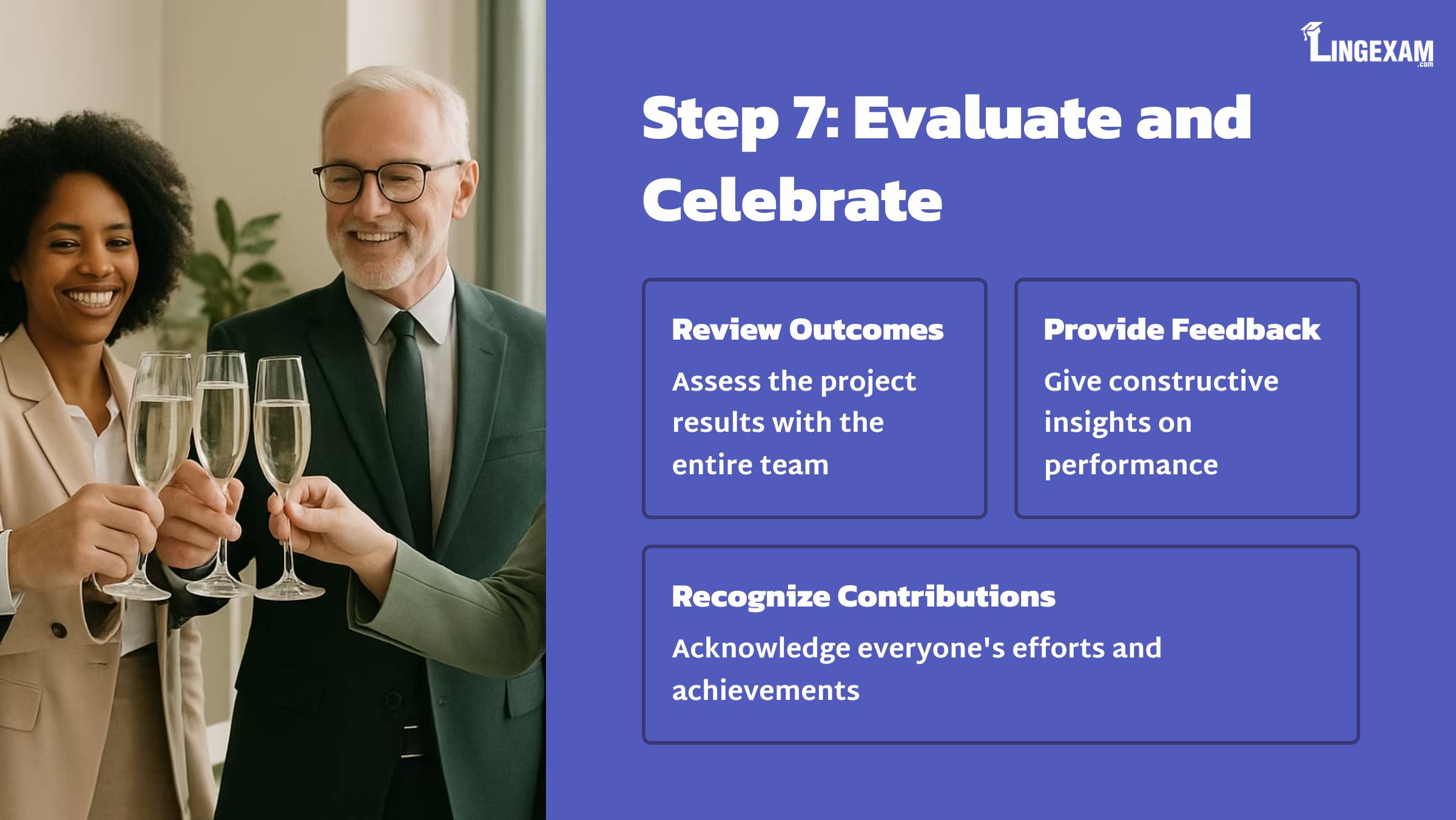
Step 7: Evaluate and Celebrate
Review the project outcome with the team.
Give constructive feedback.
Acknowledge everyone’s contributions.
Practice Tasks for Learners
Below are practice exercises to help you apply the concepts and vocabulary from this article.
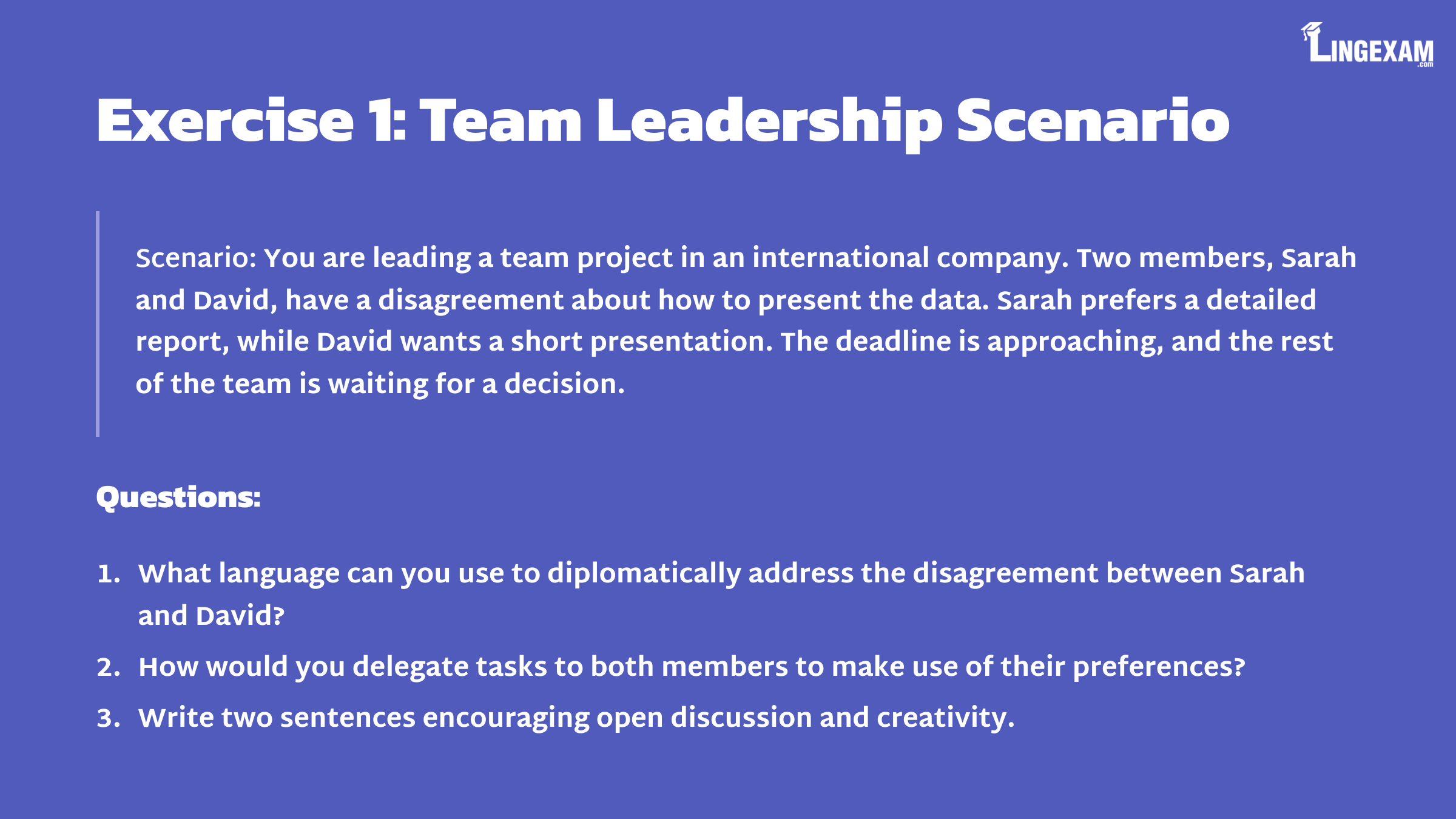
Exercise 1: Team Leadership Scenario
Instructions:
Read the scenario below and answer the questions that follow.
Scenario:
You are leading a team project in an international company. Two members, Sarah and David, have a disagreement about how to present the data. Sarah prefers a detailed report, while David wants a short presentation. The deadline is approaching, and the rest of the team is waiting for a decision.
Questions:
What language can you use to diplomatically address the disagreement between Sarah and David?
How would you delegate tasks to both members to make use of their preferences?
Write two sentences encouraging open discussion and creativity.
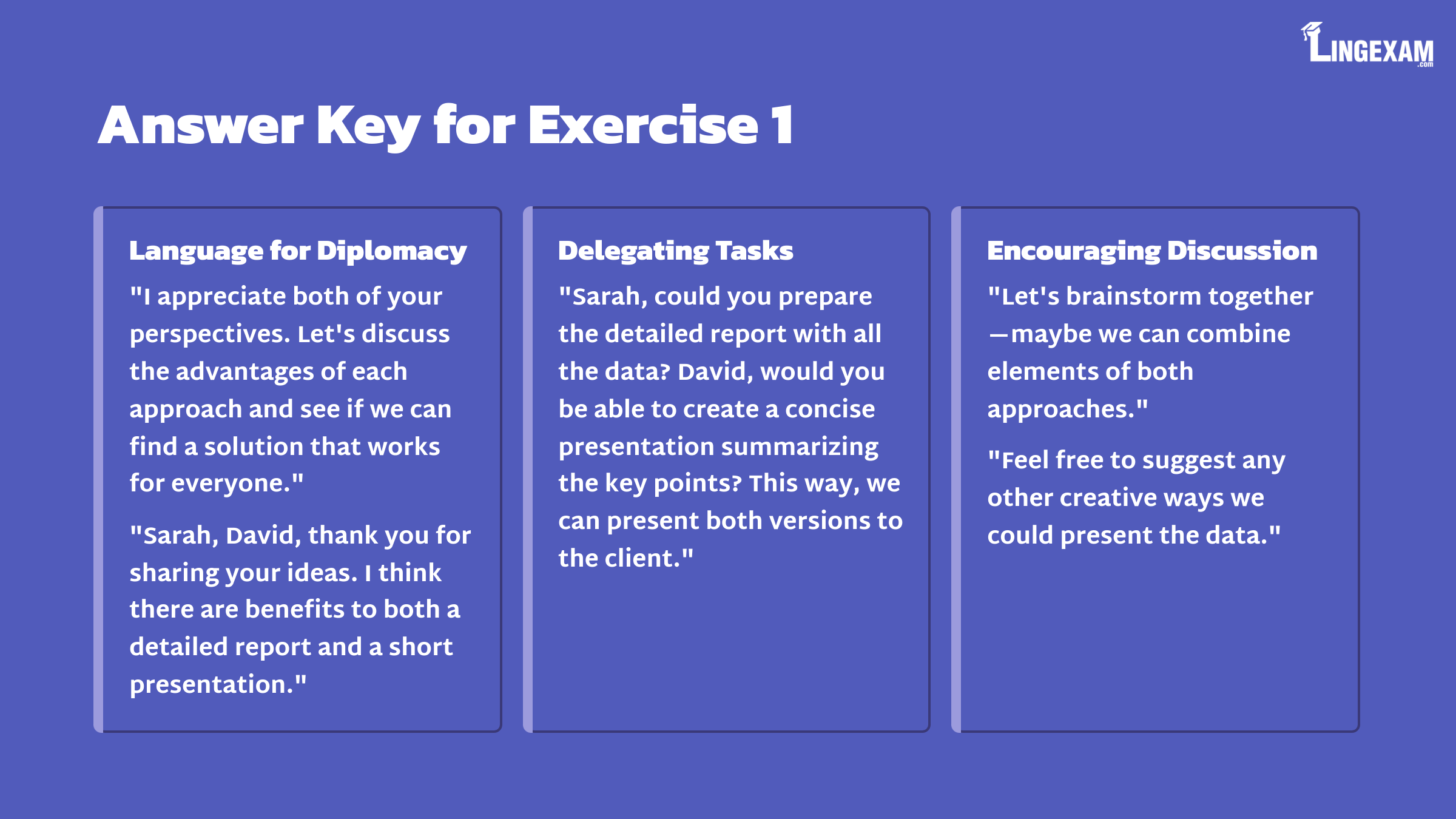
Answer Key for Exercise 1
Language for Diplomacy:
“I appreciate both of your perspectives. Let’s discuss the advantages of each approach and see if we can find a solution that works for everyone.”
“Sarah, David, thank you for sharing your ideas. I think there are benefits to both a detailed report and a short presentation.”
Delegating Tasks:
“Sarah, could you prepare the detailed report with all the data? David, would you be able to create a concise presentation summarizing the key points? This way, we can present both versions to the client.”
Encouraging Open Discussion and Creativity:
“Let’s brainstorm together—maybe we can combine elements of both approaches.”
“Feel free to suggest any other creative ways we could present the data.”
Explanation:
Using polite language and acknowledging both sides helps resolve conflict. Assigning tasks that suit each member’s preference keeps everyone engaged. Encouraging creativity and open discussion helps the team find the best solution.
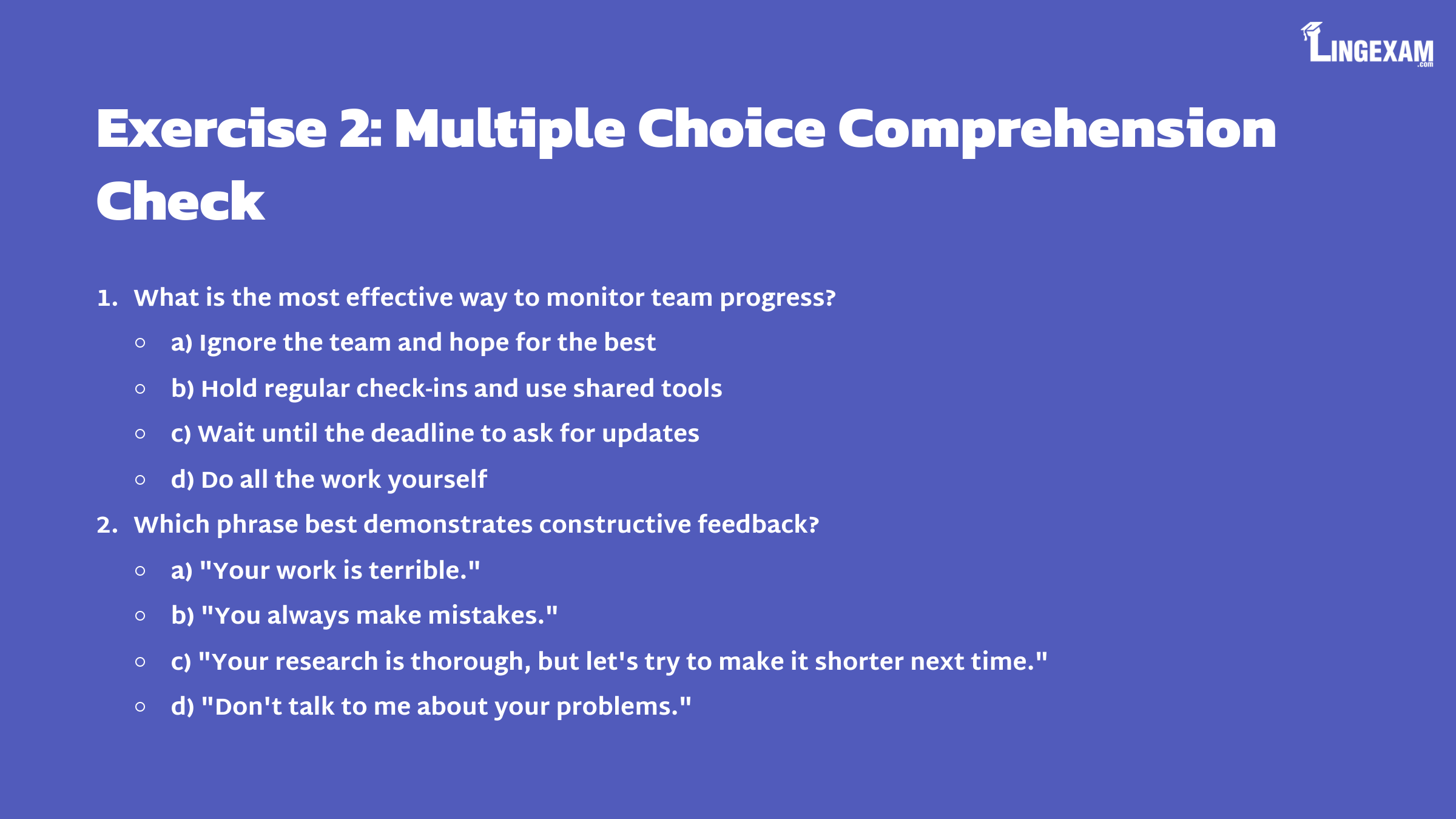
Exercise 2: Multiple Choice Comprehension Check
Instructions:
Choose the correct answer for each question.
What is the most effective way to monitor team progress?
a) Ignore the team and hope for the best
b) Hold regular check-ins and use shared tools
c) Wait until the deadline to ask for updates
d) Do all the work yourselfWhich phrase best demonstrates constructive feedback?
a) “Your work is terrible.”
b) “You always make mistakes.”
c) “Your research is thorough, but let’s try to make it shorter next time.”
d) “Don’t talk to me about your problems.”Which of the following is NOT a recommended strategy for leading a team project?
a) Delegating tasks based on strengths
b) Setting clear goals and deadlines
c) Encouraging creativity and open discussion
d) Micromanaging every single detail
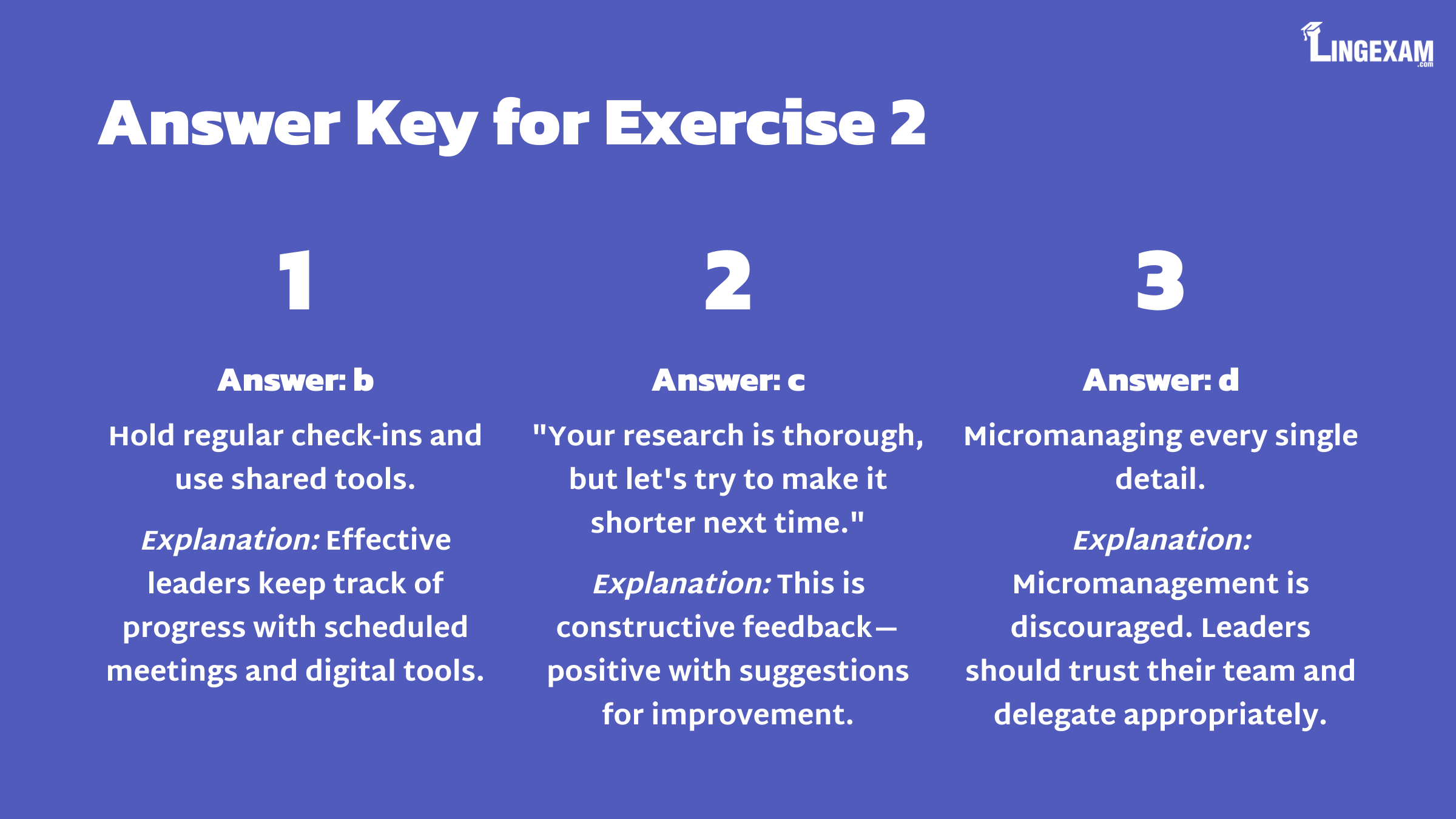
Answer Key for Exercise 2
b) Hold regular check-ins and use shared tools.
Explanation: Effective leaders keep track of progress with scheduled meetings and digital tools.c) “Your research is thorough, but let’s try to make it shorter next time.”
Explanation: This is constructive feedback—positive with suggestions for improvement.d) Micromanaging every single detail.
Explanation: Micromanagement is discouraged. Leaders should trust their team and delegate appropriately.
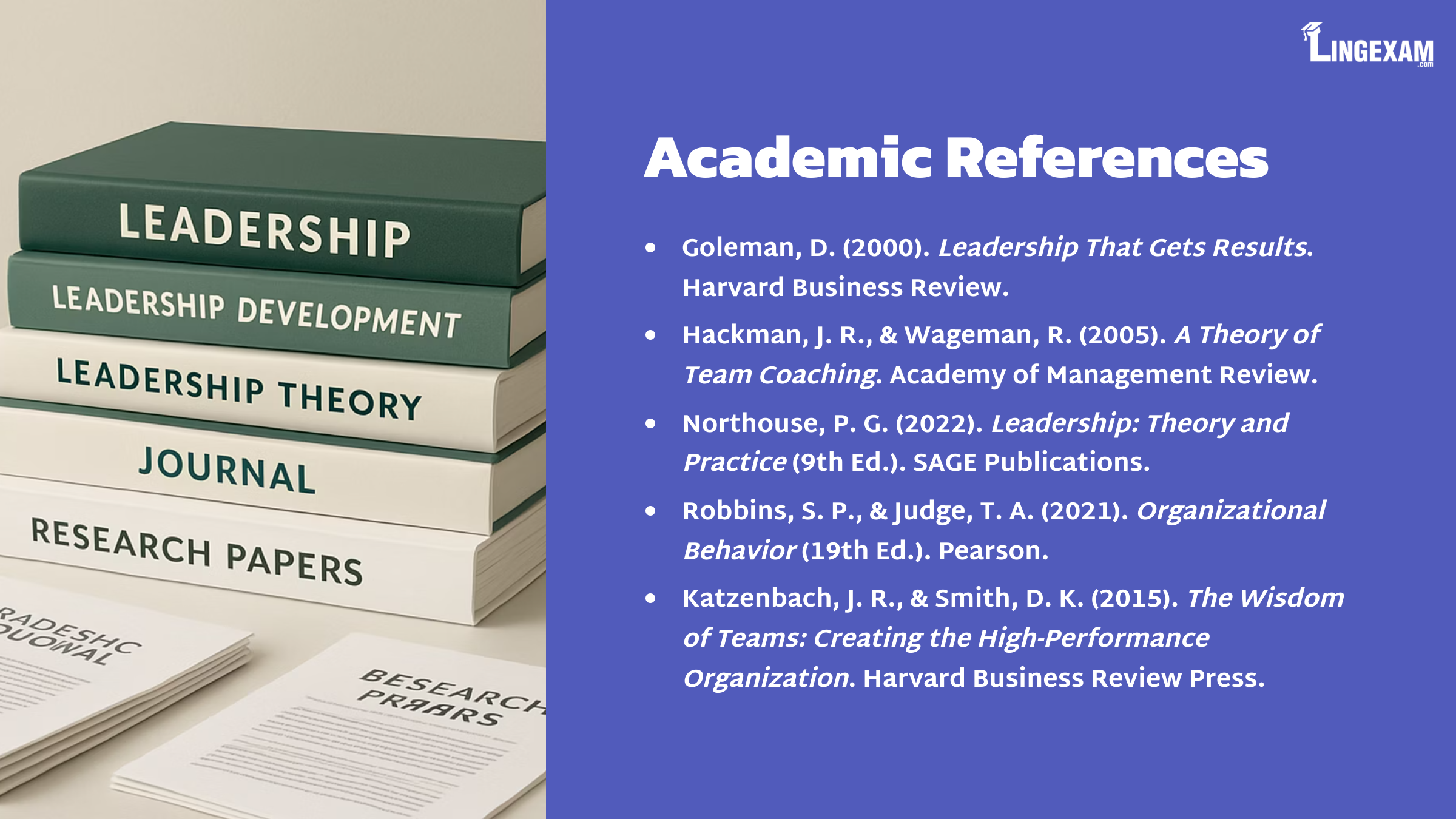
Academic References
Goleman, D. (2000). Leadership That Gets Results. Harvard Business Review.
Hackman, J. R., & Wageman, R. (2005). A Theory of Team Coaching. Academy of Management Review.
Northouse, P. G. (2022). Leadership: Theory and Practice (9th Ed.). SAGE Publications.
Robbins, S. P., & Judge, T. A. (2021). Organizational Behavior (19th Ed.). Pearson.
Katzenbach, J. R., & Smith, D. K. (2015). The Wisdom of Teams: Creating the High-Performance Organization. Harvard Business Review Press.
Next Steps: Keep Learning!
Congratulations on completing this comprehensive guide to Leading a Team Project! Remember, becoming a great team leader takes practice, empathy, and continual learning. If you enjoyed this article, we encourage you to check out our next tutorial on the Lingexam Language Academy website: “Explaining a Technical Problem to Customer Support”—another vital skill for English communication in daily life.
Stay motivated, keep practicing, and take your leadership skills to the next level with Lingexam!