
Lesson 4: Master Present Perfect Continuous Tense | Full Guide + Exercises
-
February 8, 2026
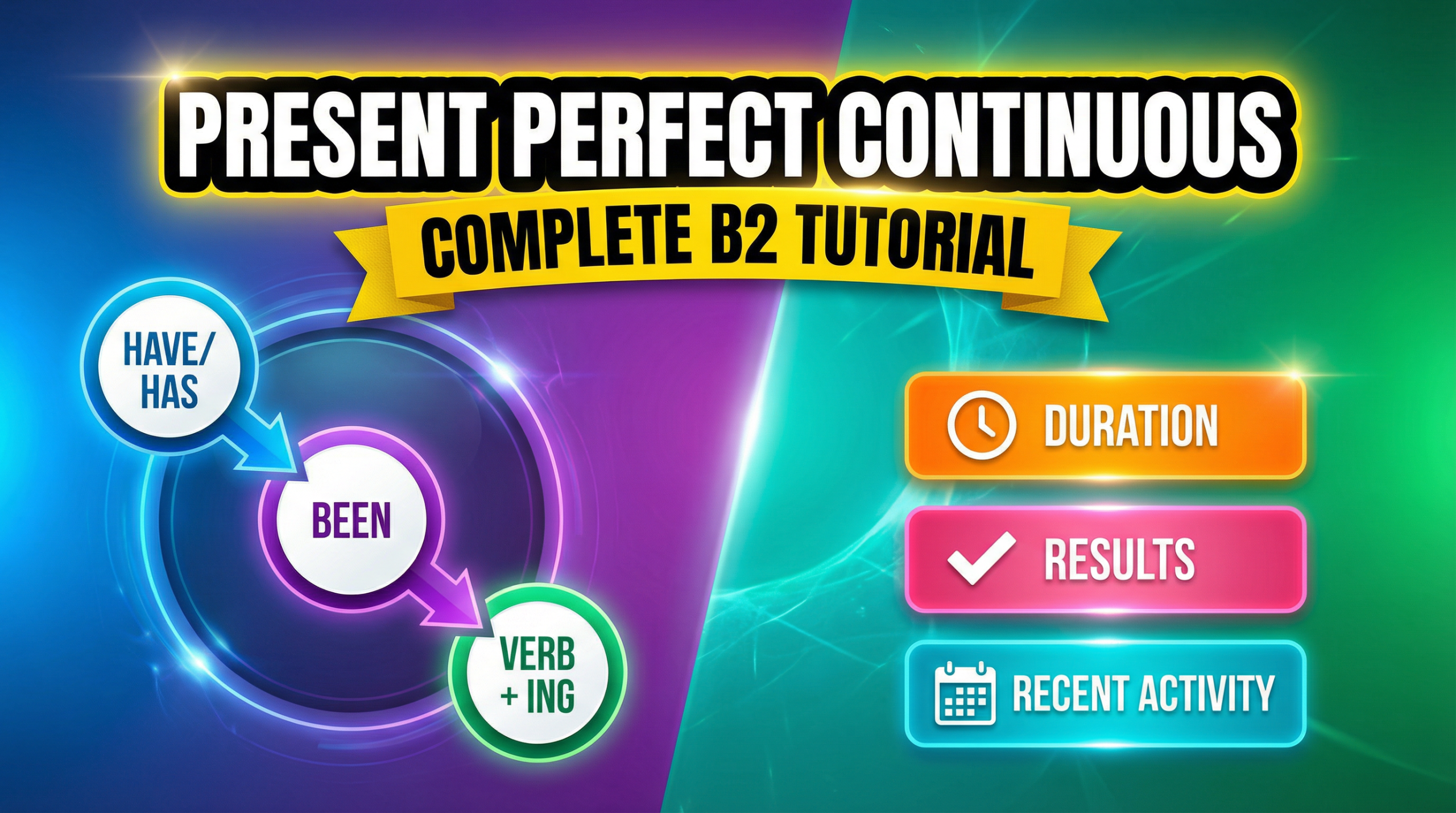
PRESENT PERFECT CONTINUOUS: COMPLETE B2 LEVEL TUTORIAL
Master one of the most sophisticated tenses in English grammar with this comprehensive guide designed for B2-level learners.
📚 Introduction
The Present Perfect Continuous is one of the most sophisticated tenses in English grammar, particularly important for B2-level learners who need to express ongoing actions with connections to the present moment. This comprehensive tutorial will guide you through every aspect of this tense, from its formation to its practical applications in real-world communication.
📝 Part 1: Form and Structure
✅ Affirmative Form
Formula: Subject + have/has + been + verb-ing
Examples:
- I have been studying English for three years.
- She has been working at the company since 2020.
- They have been living in London for six months.
- We have been waiting for the bus for 20 minutes.
- He has been playing tennis all morning.
❌ Negative Form
Formula: Subject + have/has + not + been + verb-ing
Contractions: haven't been, hasn't been
Examples:
- I haven't been sleeping well lately.
- She hasn't been feeling well this week.
- They haven't been attending classes regularly.
- We haven't been exercising enough.
- He hasn't been eating properly.
❓ Question Form
Formula: Have/Has + subject + been + verb-ing?
Examples:
- Have you been studying for the exam?
- Has she been working overtime?
- Have they been traveling around Europe?
- Has he been practicing his presentation?
- Have we been making progress?
🔍 Wh- Questions
Formula: Wh- word + have/has + subject + been + verb-ing?
Examples:
- How long have you been learning English?
- What has she been doing all day?
- Where have they been staying?
- Why has he been avoiding me?
- Who has been using my computer?
🎯 Part 2: Uses and Functions
Use 1: Actions Continuing Up to the Present Moment
The Present Perfect Continuous emphasizes the duration of an action that started in the past and is still continuing now.
• for (+ period of time): for two hours, for three weeks, for ages
• since (+ point in time): since Monday, since 2020, since I was a child
• all day/week/month/year
• recently, lately
Examples:
- We have been driving for five hours. Can't we have a break soon?
(We started driving five hours ago and we're still driving now) - She has been teaching at this school since 2015.
(She started in 2015 and still teaches there) - I have been trying to contact you all day!
(I started this morning and I'm still trying) - They have been renovating their house for months.
(The renovation started months ago and continues now) - How long have you been waiting?
(You started waiting in the past and you're still waiting)
Use 2: Actions That Have Just Stopped with Present Results
The Present Perfect Continuous describes an action that was in progress until very recently, and we can see or feel the results now.
Examples:
- I'm out of breath because I've been running to get here in time.
(I just stopped running, and the result is that I'm breathless now) - Why are your eyes red? Have you been crying?
(The crying has just stopped, but the evidence remains) - The ground is wet. It has been raining.
(The rain has just stopped, and we can see the result) - You look tired. Have you been working all night?
(The work has just finished, and the tiredness is visible) - My hands are dirty because I've been gardening.
(The gardening activity has just ended, and the result is visible)
Use 3: Repeated Actions Over a Period
The Present Perfect Continuous can describe repeated actions over a period of time up to now.
Examples:
- I've been going to the gym three times a week.
(This is a repeated action over a period) - She's been calling me every day this week.
(Multiple calls over the week) - We've been having problems with the internet lately.
(Repeated problems recently)
⚖️ Part 3: Present Perfect Simple vs. Present Perfect Continuous
Understanding when to use each tense is crucial for B2-level proficiency.
When There's Little or No Difference
Sometimes both tenses can be used with similar meanings, especially with verbs like: live, work, teach, study, feel
Examples:
- I have worked at the airport for four years.
I have been working at the airport for four years.
(Both emphasize the duration; meaning is essentially the same) - She has lived in Paris since 2019.
She has been living in Paris since 2019.
(Both are acceptable with similar meanings) - How long have you studied English?
How long have you been studying English?
(Both ask about duration)
When There IS a Difference
Focus on Completion vs. Duration
✓ Present Perfect Simple
Focus on completion or result
⏱ Present Perfect Continuous
Focus on duration or activity
Examples:
- I have read that book about cruise ships.
(Finished - I completed the book) - I have been reading that book about cruise ships.
(Not finished - I'm still reading it; emphasis on the activity)
- She has written three reports today.
(Completed - focus on the number finished) - She has been writing reports all day.
(Ongoing activity - focus on the duration)
- They have painted the house.
(Finished - the job is complete) - They have been painting the house.
(Ongoing or just finished - focus on the activity)
Permanent vs. Temporary Situations
✓ Present Perfect Simple
Often suggests something more permanent
⏱ Present Perfect Continuous
Often suggests something more temporary
Examples:
- He has worked in banking. (Career/permanent)
He has been working in a café. (Temporary job) - I have lived in Spain. (Life experience/permanent period)
I have been living with my parents. (Temporary arrangement)
⏰ Part 4: Time Expressions
Common Time Expressions with Present Perfect Continuous
| Expression Type | Examples |
|---|---|
| For (duration) | for two hours, for a week, for ages, for a long time, for years |
| Since (starting point) | since Monday, since last week, since 2020, since I arrived, since this morning |
| Other expressions | all day/morning/week/year, lately, recently, just, how long...? |
Examples:
- I've been learning Spanish for six months.
- She's been working here since January.
- They've been arguing all morning.
- We've been having technical issues lately.
- He's just been exercising. (British English)
- How long have you been standing there?
⚠️ Part 5: Important Notes and Common Mistakes
⚡ Watch Out! Important Points
1. Not Used with "Ever" and "Never"
The Present Perfect Continuous is NOT normally used with ever and never.
✓ Correct:
Have you ever flown in a helicopter before? (Present Perfect Simple)
I have never tried sushi.
Has she ever visited Japan?
✗ Incorrect:
Have you ever been flying in a helicopter before?
I have never been trying sushi.
Has she ever been visiting Japan?
2. State Verbs
State verbs (non-action verbs) are generally not used in continuous forms, including the Present Perfect Continuous.
• Mental states: know, believe, understand, remember, forget, think (opinion)
• Emotions: love, hate, like, prefer, want, need
• Senses: see, hear, smell, taste (involuntary)
• Possession: have (possession), own, belong, possess
• Other: be, seem, appear, consist, contain, depend
✓ Correct:
I have known him for ten years. (Present Perfect Simple)
She has loved classical music since childhood.
We have owned this car for five years.
✗ Incorrect:
I have been knowing him for ten years.
She has been loving classical music since childhood.
We have been owning this car for five years.
3. Questions with "How Long"
When asking about duration, "How long" is very commonly used with the Present Perfect Continuous.
Examples:
- How long have you been waiting?
- How long has she been studying?
- How long have they been dating?
- How long has it been raining?
4. British vs. American English
British English uses the Present Perfect Continuous more frequently than American English, especially with "just."
- British English: I've just been talking to Sarah.
- American English (more common): I just talked to Sarah. (Simple Past)
🚀 Part 6: Advanced Usage at B2 Level
Emphasis and Nuance
The Present Perfect Continuous can add emphasis to show:
1. Frustration or annoyance:
- I've been trying to call you all day! (Where have you been?)
- Who's been using my laptop? (I'm annoyed about this)
2. Exhaustion:
- I've been working on this project for 12 hours straight.
- We've been walking for miles. I need to rest.
3. Explanation:
- Sorry I'm late. I've been dealing with a family emergency.
- That's why I'm so happy – I've been receiving good news all day!
Multiple Time Periods
You can use the Present Perfect Continuous to describe activities across different time periods:
Examples:
- I've been going to that gym on and off for two years.
- She's been visiting her grandmother every weekend since the summer.
- We've been having meetings about this issue for months now.
📋 EXERCISES
Now let's practice what you've learned with five progressive exercises, moving from accuracy to activation.
Exercise 1: Form Practice (Accuracy)
Exercise 2: Present Perfect Simple vs. Continuous
a) have read
b) have been reading
Explanation: Completed action with number
a) has read
b) has been reading
Explanation: Ongoing, not finished
a) have you sent
b) have you been sending
Explanation: Asking for number/completion
a) have worked
b) have been working
Explanation: Emphasis on duration and present result
a) have lived
b) have been living
c) both are correct
Explanation: Little difference with "live"
a) have never tried
b) have never been trying
Explanation: Never = Present Perfect Simple
a) has painted
b) has been painting
Explanation: Completed with visible result
a) has eaten
b) has been eating
Explanation: Completed action - it's all gone
a) have known
b) have been knowing
Explanation: State verb
a) have had
b) have been having
c) both are correct
Explanation: Acceptable with both
a) have you studied
b) have you been studying
c) both are correct
Explanation: Acceptable with both
a) have written
b) have been writing
Explanation: Emphasis on duration of activity
a) has written
b) has been writing
Explanation: Completed with number
a) Have you ever visited
b) Have you ever been visiting
Explanation: Ever = Present Perfect Simple
a) have fixed
b) have been fixing
Explanation: Recent activity with present result
Exercise 3: Error Correction
Explanation: State verb - cannot use continuous
Explanation: Use Simple Past with "yesterday"
Explanation: Use Present Perfect Simple with "ever"
Explanation: State verb - cannot use continuous
Explanation: State verb - cannot use continuous
Explanation: Asking for number = Present Perfect Simple
Explanation: State verb when meaning "meet/encounter"
Explanation: Better with Present Perfect Simple
Exercise 4: Gap-Fill with Context
Dialogue 1:
Answer (3): haven't taken
Answer (6): haven't finished
Answer (9): hasn't responded
Dialogue 2:
Answer (12): have you been
Answer (14): didn't start (Simple Past for specific time "this morning")
Exercise 5: Free Production (Activation)
🎓 Conclusion
The Present Perfect Continuous is a versatile and expressive tense that allows you to communicate duration, ongoing actions, and recent activities with present results. At the B2 level, mastering this tense—and knowing when to use it instead of the Present Perfect Simple—is essential for natural, fluent English.
🔑 Key Points to Remember:
- Form: have/has + been + verb-ing
- Main uses:
- Actions continuing to the present
- Recent actions with present results
- Emphasis on duration and activity
- Not used with: ever, never, state verbs
- Common with: for, since, all day/week, lately, recently, how long
📚 Want More English Learning Resources?
Visit LingExam.com for comprehensive tutorials, practice exercises, and expert guidance on mastering English grammar, vocabulary, and communication skills!
You May Also Like
-
Feb 7, 2026

-
Feb 4, 2026
-
Feb 2, 2026

-
Oct 28, 2025
Sign up to receive our latest updates
Get in touch
Address