
Lesson 3: Present Perfect Simple: Complete B2 Level Tutorial with Practice Exercises
-
February 7, 2026
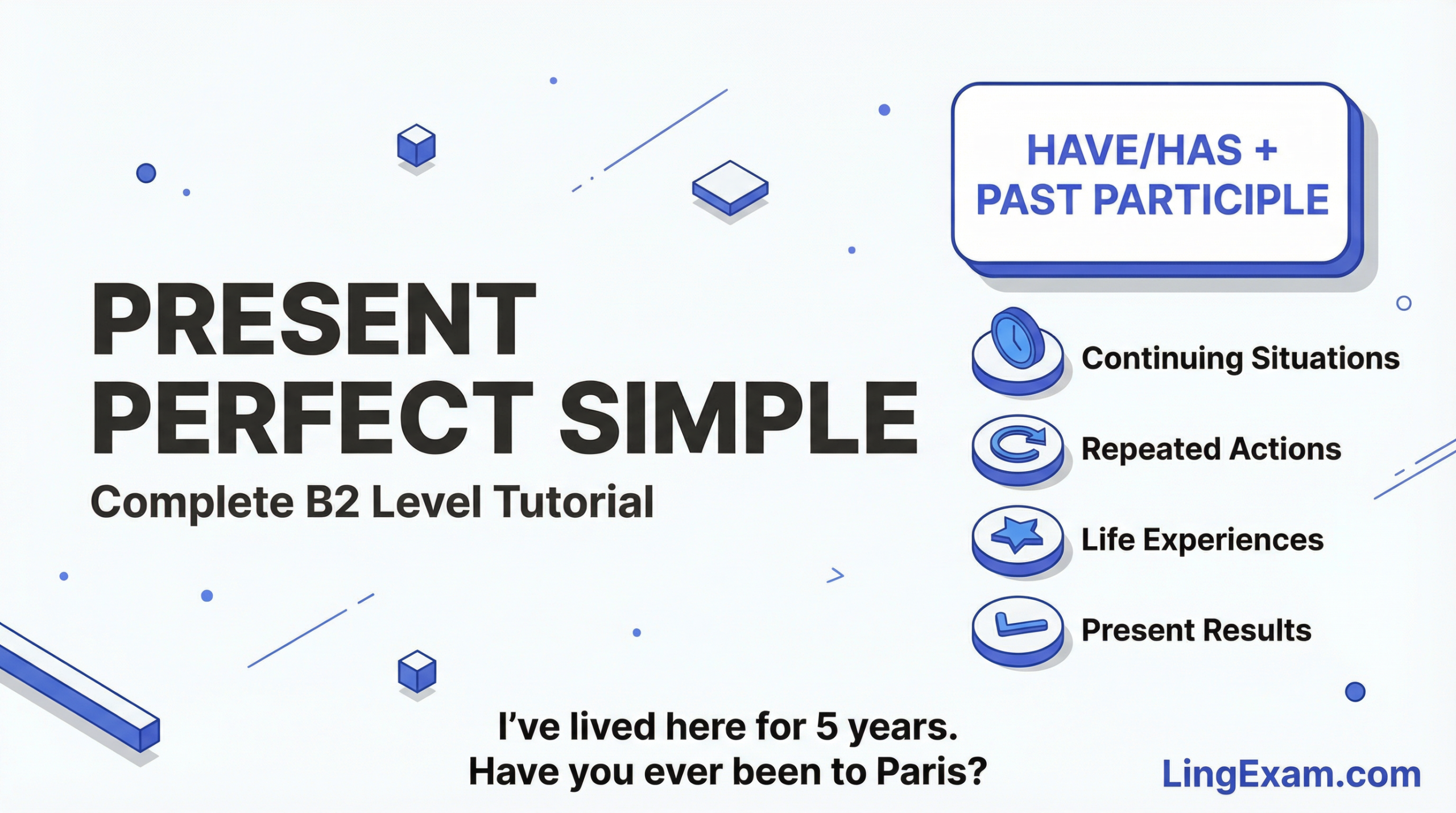
Present Perfect Simple: Complete B2 Level Tutorial
Master the Present Perfect Simple with comprehensive explanations and practical exercises
Struggling with when to use "I have done" vs "I did"? You're not alone! The Present Perfect Simple is one of the most challenging yet essential tenses in English. This comprehensive B2-level tutorial breaks down everything you need to know: how to form it correctly, the 4 key uses that native speakers rely on, and the crucial differences between FOR and SINCE. You'll master time expressions like JUST, ALREADY, YET, EVER, and NEVER, and finally understand when to use Present Perfect instead of Past Simple. With practical examples, common mistake corrections, and hands-on exercises with answers, you'll gain the confidence to use this tense naturally in conversation and writing. Whether you're preparing for Cambridge exams, IELTS, or simply want to sound more fluent, this tutorial has you covered. Ready to bridge the gap between past and present? Let's dive in!
Introduction
The Present Perfect Simple is one of the most important and frequently used tenses in English. It creates a bridge between the past and the present, allowing us to talk about past actions that have relevance to the current moment. Mastering this tense is essential for achieving B2-level proficiency in English.
Form and Structure
Affirmative Form
The Present Perfect Simple is formed using have/has + past participle:
Structure: Subject + have/has + past participle
I/You/We/They + have + past participle
- I have worked here for five years.
- They have visited Paris three times.
- We have finished the project.
He/She/It + has + past participle
- She has lived in London since 2018.
- He has written several books.
- It has rained all day.
Negative Form
To form negatives, we add "not" after have/has:
Structure: Subject + have/has + not + past participle
I/You/We/They + haven't + past participle
- I haven't seen that movie yet.
- They haven't arrived at the station.
- We haven't eaten lunch.
He/She/It + hasn't + past participle
- She hasn't called me back.
- He hasn't finished his homework.
- It hasn't stopped raining.
Question Form
To form questions, we invert the subject and have/has:
Structure: Have/Has + subject + past participle + ?
Have + I/you/we/they + past participle?
- Have you ever been to Japan?
- Have they completed the assignment?
- Have we met before?
Has + he/she/it + past participle?
- Has she arrived yet?
- Has he spoken to the manager?
- Has it been repaired?
Contractions
In spoken and informal written English, we commonly use contractions:
• I have = I've
• You have = You've
• He has = He's
• She has = She's
• It has = It's
• We have = We've
• They have = They've
• Have not = Haven't
• Has not = Hasn't
Uses of the Present Perfect Simple
Use 1: Situations and States That Started in the Past and Are Still True
We use the Present Perfect Simple to describe situations, states, or conditions that began in the past and continue to the present moment.
Examples:
- She's had her motorbike for over six years. (She still has it)
- I've known Sarah since we were children. (I still know her)
- They've lived in this house for twenty years. (They still live here)
- He's been a teacher since 2010. (He's still a teacher)
- We've owned this car for five years. (We still own it)
Key time expressions: for, since, all my life, always
Use 2: A Series of Actions Continuing Up to Now
We use the Present Perfect Simple to talk about repeated actions or a series of actions that have occurred from the past until now.
Examples:
- We've travelled by taxi, bus, plane and train – all in the last twenty-four hours!
- I've read five books this month.
- She's called me three times today.
- They've visited us several times this year.
- He's changed jobs four times in the last decade.
Key time expressions: today, this week, this month, this year, recently, lately, so far
Use 3: Completed Actions at a Time in the Past Which Is Not Mentioned
We use the Present Perfect Simple when we talk about past experiences without specifying exactly when they happened. The focus is on the experience itself, not the time.
Examples:
- Have you ever flown in a helicopter?
- I've been to Italy. (sometime in my life)
- She's met the President. (at some point in the past)
- They've seen that film before.
- He's tried sushi. (at least once)
Key time expressions: ever, never, before, once, twice, many times
Use 4: Completed Actions Where the Important Thing Is the Present Result
We use the Present Perfect Simple when a past action has a present result or consequence that is important now.
Examples:
- I've booked the coach tickets. (Result: We have tickets now)
- She's lost her keys. (Result: She doesn't have them now)
- They've painted the kitchen. (Result: The kitchen is painted now)
- He's broken his leg. (Result: His leg is broken now)
- We've run out of milk. (Result: There's no milk now)
Key time expressions: just, already, yet, recently
Time Expressions with Present Perfect Simple
FOR and SINCE
FOR (Duration)
Used with a period of time:
- for two hours
- for three days
- for six months
- for ten years
- for a long time
SINCE (Starting Point)
Used with a point in time:
- since Monday
- since 2020
- since last week
- since I was a child
- since 9 o'clock
Examples:
- I've worked here for five years.
- I've worked here since 2021.
- She's been ill for three days.
- She's been ill since Tuesday.
JUST, ALREADY, YET
JUST = a short time ago (used in affirmative sentences)
- I've just finished my homework.
- They've just arrived.
ALREADY = sooner than expected (used in affirmative sentences and questions)
- I've already eaten lunch.
- Have you already finished?
YET = until now (used in negative sentences and questions)
- I haven't finished yet.
- Have you done your homework yet?
EVER and NEVER
EVER = at any time (used in questions)
- Have you ever been to Australia?
- Has she ever tried skydiving?
NEVER = at no time (used in affirmative sentences with negative meaning)
- I've never been to Australia.
- She's never tried skydiving.
Present Perfect Simple vs. Past Simple
This is one of the most challenging aspects for learners. Here's the key difference:
Present Perfect Simple
- Connection to the present
- Time not specified or not important
- Focus on the experience or result
Examples:
- I've lost my keys. (I don't have them now)
- Have you ever been to Paris? (experience in your life)
- She's written three emails. (up to now)
Past Simple
- Finished action in the past
- Specific time mentioned or implied
- Focus on when it happened
Examples:
- I lost my keys yesterday. (specific time)
- Did you go to Paris in 2019? (specific time)
- She wrote three emails this morning. (finished time period)
Common Mistakes to Avoid
Mistake 1: Using Present Perfect with Specific Past Time
❌ I have seen him yesterday.
✅ I saw him yesterday.
Mistake 2: Forgetting the Auxiliary Verb
❌ I seen that movie.
✅ I have seen that movie.
Mistake 3: Using the Wrong Participle Form
❌ I have went to the store.
✅ I have gone to the store.
Mistake 4: Confusing FOR and SINCE
❌ I've lived here since five years.
✅ I've lived here for five years.
Mistake 5: Using Present Perfect for Finished Time Periods
❌ I have worked there in 2019.
✅ I worked there in 2019.
Special Expressions with Present Perfect Simple
"It's the first/second/third time..."
This expression is ALWAYS followed by the Present Perfect Simple:
- It's the first time I've been to Italy.
- It's the second time she's visited us this year.
- It's the third time they've called today.
"This is the best/worst/most..."
These superlative expressions are followed by the Present Perfect Simple:
- This is the best meal I've ever eaten.
- She's the most interesting person I've ever met.
- That's the worst film I've ever seen.
US vs. UK Usage
There are some differences between American and British English:
Past Simple vs. Present Perfect
American English often uses the Past Simple where British English uses the Present Perfect:
US: I already saw that movie.
UK: I've already seen that movie.
US: Did you eat lunch yet?
UK: Have you eaten lunch yet?
GOTTEN vs. GOT
American English uses "gotten" as the past participle of "get" (except for "have got" meaning possession):
US: I've gotten a new job. (obtained)
UK: I've got a new job.
Both US and UK: I've got a car. (possession)
Practice Exercises
Exercise 1: Form Practice (Accuracy)
Instructions: Complete the sentences with the correct form of the Present Perfect Simple using the verbs in brackets.
1. I __________ (never/visit) Australia before.
Answer: have never visited
2. She __________ (live) in Paris for three years.
Answer: has lived
3. __________ you __________ (finish) your homework yet?
Answer: Have / finished
4. They __________ (not/arrive) at the airport.
Answer: haven't arrived / have not arrived
5. He __________ (just/leave) the office.
Answer: has just left
6. We __________ (know) each other since childhood.
Answer: have known
7. __________ she __________ (ever/try) sushi?
Answer: Has / ever tried
8. The train __________ (already/depart).
Answer: has already departed
9. I __________ (not/see) that film.
Answer: haven't seen / have not seen
10. How long __________ you __________ (work) here?
Answer: have / worked
11. My parents __________ (be) married for 30 years.
Answer: have been
12. __________ he __________ (call) you back yet?
Answer: Has / called
13. They __________ (travel) to five countries this year.
Answer: have travelled / have traveled
14. She __________ (not/complete) the project.
Answer: hasn't completed / has not completed
15. We __________ (have) this car since 2018.
Answer: have had
Exercise 2: FOR and SINCE (Accuracy to Controlled Practice)
Instructions: Choose the correct option (FOR or SINCE) to complete each sentence.
1. I've known her __________ (for/since) 2015.
Answer: since
2. They've been waiting __________ (for/since) two hours.
Answer: for
3. She's worked here __________ (for/since) last summer.
Answer: since
4. We've lived in this house __________ (for/since) ten years.
Answer: for
5. He's been studying __________ (for/since) 6 o'clock this morning.
Answer: since
6. I haven't seen them __________ (for/since) a long time.
Answer: for
7. She's been ill __________ (for/since) Monday.
Answer: since
8. They've owned that restaurant __________ (for/since) decades.
Answer: for
9. We've been friends __________ (for/since) we were children.
Answer: since
10. He hasn't called __________ (for/since) three weeks.
Answer: for
11. I've had this phone __________ (for/since) my birthday.
Answer: since
12. She's been learning English __________ (for/since) five years.
Answer: for
13. They've been married __________ (for/since) 1995.
Answer: since
14. We haven't travelled abroad __________ (for/since) ages.
Answer: for
15. He's lived alone __________ (for/since) his wife died.
Answer: since
Exercise 3: Present Perfect vs. Past Simple (Controlled Practice)
Instructions: Choose the correct tense (Present Perfect Simple or Past Simple) to complete each sentence.
1. I __________ (see/have seen) that movie last week.
Answer: saw (specific time: last week)
2. She __________ (lived/has lived) in London since 2019.
Answer: has lived (since 2019, still living there)
3. __________ (Did you ever go/Have you ever been) to Japan?
Answer: Have you ever been (life experience)
4. They __________ (finished/have finished) the project yesterday.
Answer: finished (specific time: yesterday)
5. We __________ (knew/have known) each other for ten years.
Answer: have known (for ten years, still know each other)
6. He __________ (just left/left just) the building.
Answer: has just left (recent action, present result)
7. I __________ (didn't eat/haven't eaten) breakfast this morning.
Answer: didn't eat (finished time period: this morning - if it's now afternoon/evening)
8. __________ (Did she call/Has she called) you yet?
Answer: Has she called (yet - present perfect)
9. They __________ (got married/have got married) in 2010.
Answer: got married (specific time: in 2010)
10. I __________ (never tried/have never tried) skydiving.
Answer: have never tried (life experience)
11. When __________ (did you arrive/have you arrived)?
Answer: did you arrive (asking about specific time)
12. She __________ (worked/has worked) there for five years, but she left last month.
Answer: worked (she no longer works there - finished)
13. We __________ (already saw/have already seen) that exhibition.
Answer: have already seen (already - present perfect)
14. He __________ (lost/has lost) his keys and can't find them.
Answer: has lost (present result: can't find them now)
15. __________ (Did you finish/Have you finished) reading that book I lent you last month?
Answer: Have you finished (yet implied, present result important)
Exercise 4: JUST, ALREADY, YET, EVER, NEVER (Guided Practice)
Instructions: Complete the sentences using the Present Perfect Simple and the words in brackets. Add JUST, ALREADY, YET, EVER, or NEVER where appropriate.
1. I can't come to the cinema because I __________ (already/see) that film.
Answer: have already seen
2. __________ (you/ever/meet) a famous person?
Answer: Have you ever met
3. She __________ (just/arrive) at the station.
Answer: has just arrived
4. They __________ (not/finish) their dinner __________.
Answer: haven't finished / yet
5. He __________ (never/be) to Africa.
Answer: has never been
6. __________ (she/call) you __________?
Answer: Has she called / yet
7. We __________ (already/book) our holiday.
Answer: have already booked
8. I __________ (just/hear) the news!
Answer: have just heard
9. __________ (you/ever/try) Thai food?
Answer: Have you ever tried
10. They __________ (not/reply) to my email __________.
Answer: haven't replied / yet
11. She __________ (never/forget) her first day at school.
Answer: has never forgotten
12. He __________ (just/leave) the office.
Answer: has just left
13. __________ (you/do) your homework __________?
Answer: Have you done / yet
14. I __________ (already/tell) you three times!
Answer: have already told
15. We __________ (never/have) such a wonderful experience.
Answer: have never had
Exercise 5: Free Practice (Activation)
Instructions: Complete the following tasks using the Present Perfect Simple. Write complete sentences based on your own experience or imagination.
1. Write three things you have done today.
Sample Answers:
- I have eaten breakfast.
- I have studied English grammar.
- I have talked to my friend on the phone.
2. Write two places you have visited in your life.
Sample Answers:
- I have visited Paris.
- I have been to the mountains in my country.
3. Write three things you have never done but would like to do.
Sample Answers:
- I have never travelled to Asia, but I'd love to visit Japan.
- I have never learned to play a musical instrument, but I want to learn guitar.
- I have never tried scuba diving, but it looks exciting.
4. Write two things you have already done this week.
Sample Answers:
- I have already finished my homework.
- I have already gone shopping for groceries.
5. Write about something you have had for a long time (use FOR or SINCE).
Sample Answers:
- I have had my bicycle for five years.
- I have known my best friend since primary school.
6. Write two questions to ask a classmate about their experiences (use EVER).
Sample Answers:
- Have you ever been to another country?
- Have you ever met someone famous?
7. Write about a recent action that has a present result (use JUST).
Sample Answers:
- I have just cleaned my room, so it looks nice now.
- My sister has just called me with some exciting news.
8. Write about something you haven't done yet but plan to do.
Sample Answers:
- I haven't finished reading my book yet, but I'm almost done.
- I haven't replied to my teacher's email yet.
9. Write about the best or worst experience you have ever had.
Sample Answers:
- The best holiday I have ever had was when my family went to the beach last summer.
- The worst film I have ever seen was a horror movie that wasn't scary at all.
10. Write about how long you have known your best friend.
Sample Answers:
- I have known my best friend for eight years.
- I have known my best friend since we were in the same class in 2016.
Summary
The Present Perfect Simple is a versatile tense that connects the past with the present. Remember these key points:
- Form: have/has + past participle
- Use it for: Situations continuing from past to present, series of actions up to now, past experiences (time not specified), and past actions with present results
- Key time expressions: for, since, just, already, yet, ever, never
- Don't use it with: specific past time expressions (yesterday, last week, in 2019, etc.)
- Common expressions: It's the first time..., This is the best...
With regular practice and attention to the differences between the Present Perfect Simple and Past Simple, you'll master this essential tense and communicate more naturally in English.
Continue Your English Learning Journey
Want more comprehensive English grammar tutorials, vocabulary lessons, and exam preparation materials?
Visit LingExam.comJoin thousands of learners improving their English every day!
You May Also Like
-
Feb 8, 2026

-
Feb 4, 2026
-
Feb 2, 2026

-
Oct 28, 2025
Sign up to receive our latest updates
Get in touch
Address