Welcome! In this tutorial, you’ll learn to answer IELTS Academic Writing Task 1 for the following type:
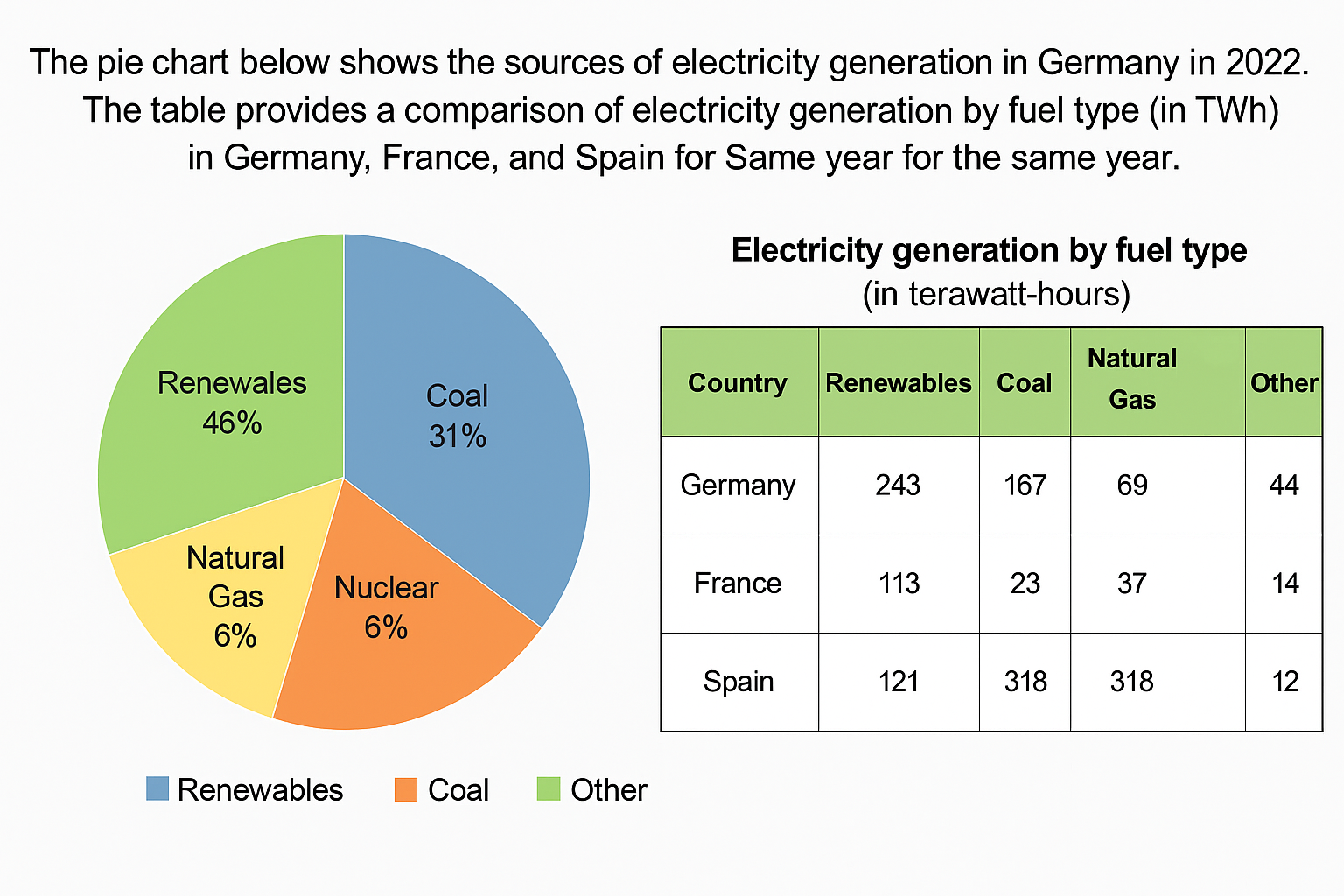
The pie chart below shows the sources of electricity generation in Germany in 2022. The table provides a comparison of electricity generation by fuel type (in terawatt-hours, TWh) in Germany, France, and Spain for the same year. Follow each step below. Hover on any step to highlight and reveal tips for Band 7+.
How to Answer IELTS Academic Writing Task 1 (Pie Chart & Table): 12 Pro Steps
1
Understand the Task Type. Identify exactly what the visuals show. Here, you have a pie chart for Germany’s electricity sources in 2022 and a table comparing Germany, France, and Spain by fuel type in TWh for the same year. Underline all data categories, years, and countries in your notes. Read the instruction line and note keywords like “main features” and “make comparisons.”
2
Examine both visuals together. What categories are in the pie chart? What fuel types are in the table? Quickly spot the biggest, smallest, and any categories that stand out. Are any categories missing from one visual or present in both? Noting this avoids missing key points.
3
Spot the big picture trends and contrasts. For example: Is any fuel the largest in Germany, and does that match in France and Spain? Are renewables more/less used than fossil fuels? Does one country rely more on nuclear? These trends shape your overview.
4
Write a clear, high-level overview. Summarise main trends, not details or all numbers. Example: “Germany generated most of its electricity from renewables in 2022, while France relied heavily on nuclear power.” This overview frames your answer for Band 7+.
5
Organise your answer by grouping related data. For example, compare all countries’ use of renewables, then fossil fuels, then nuclear. Alternatively, structure by country if the contrast is strong. Logical grouping shows the examiner you can compare, not just describe.
6
Use specific data from the visuals to back up your points. For instance, “Renewables accounted for 45% of Germany’s electricity (225 TWh), while in France, nuclear power generated 390 TWh.” Numbers must be precise and from the charts, but avoid overloading your answer with statistics.
7
Compare and contrast with clarity. Use terms like “the highest,” “the lowest,” “by contrast,” “slightly more than,” “whereas,” etc. Show you can express similarities and differences using appropriate linking words and structure.
8
Stay objective! Do not speculate about reasons for differences (e.g., “because of government policy”). IELTS Task 1 is about reporting what you see, not guessing causes or consequences.
9
Use clear paragraphing. Typical structure: Introduction, Overview, Body Paragraph 1 (main feature/group), Body Paragraph 2 (comparison/contrast). Separate your overview from details for best coherence.
10
Show off your vocabulary! Use “accounted for,” “comprised,” “generated,” “respectively,” “in contrast to,” etc. Avoid repeating “produced” or “made” and use synonyms for “amount” and “percentage.”
11
Describe all data using the past simple or passive forms. Example: “Electricity was generated…” Avoid future tenses unless data is explicitly projected. Use passive voice for formality and variation.
12
Review your answer for full coverage, accuracy, and grammar. Did you include all categories, make at least two relevant comparisons, support with numbers, and avoid opinions? Proofread for mistakes before submitting!
Sample Band 9 Plan & Useful Examples
Overview Example: “In 2022, the main source of electricity in Germany was renewables, while France generated most electricity from nuclear and Spain relied mainly on gas. The least used source in Germany was oil.”
Grouping Example: “Both Germany and Spain produced over 200 TWh from renewables, but France produced almost none. In contrast, nuclear accounted for over half of France’s electricity, while it was a minor source in Germany and Spain.”
IELTS Academic Writing Task 1
Task:
The pie chart below shows the sources of electricity generation in Germany in 2022. The table provides a comparison of electricity generation by fuel type (in terawatt-hours, TWh) in Germany, France, and Spain for the same year.
Summarise the information by selecting and reporting the main features, and make comparisons where relevant.
Visuals: Electricity Generation in Germany, France & Spain (2022)
Click the image to view full screen & zoom
×
Pinch/scroll to zoom – Tap/click anywhere to exit
Your Answer:
Tip: After writing, check your grammar, data, and make at least two clear comparisons between countries and fuel types!
Band 9 Model Answer & Step-by-Step Explanations
Review the full Band 9 sample answer and reveal step-by-step how each part achieves a high score. Expand each step for a deep explanation, and test yourself with interactive quiz questions!
1
Introduction:(Show/Hide)
The pie chart displays the proportion of electricity generated from different sources in Germany in 2022, while the table compares electricity production by fuel type among Germany, France, and Spain in the same year.
Explanation:
This introduction paraphrases the task and mentions both visuals (pie chart and table), all countries, and the year. It uses synonyms for the original words, showing range. Band 9 answers always clarify what’s being described before reporting data.
2
Overview:(Show/Hide)
Overall, the primary source of electricity in Germany in 2022 was renewables, while France relied mainly on nuclear power and Spain on natural gas. Oil contributed the least in all three countries.
Explanation:
This overview captures the main trends without specific numbers, grouping each country’s main fuel. It also notes the lowest source. Strong overviews focus on “the big picture,” using linking words such as “while” and “overall.”
3
Body Paragraph 1: Germany & Comparison(Show/Hide)
In Germany, renewables accounted for 45% of electricity generation, amounting to 225 TWh, which was higher than any other fuel. Coal provided 18% (90 TWh), followed by gas at 15% (75 TWh), nuclear at 13% (65 TWh), and oil at only 9% (45 TWh).
Explanation:
This paragraph gives the exact data from both visuals for Germany, using clear comparative language and percentages with TWh. “Accounted for,” “amounting to,” and “followed by” are excellent reporting phrases.
4
Body Paragraph 2: France & Spain(Show/Hide)
In contrast, France generated 390 TWh from nuclear power, which was by far the highest single value among all fuels in the three countries. France’s renewables output was much lower at 80 TWh. Spain, meanwhile, produced the majority of its electricity from gas (130 TWh), with renewables providing 120 TWh. Oil generation was the smallest category for both France (10 TWh) and Spain (25 TWh).
Explanation:
This section compares France and Spain, highlighting the unique situation in France (nuclear dominance) and Spain (gas). Comparatives like “in contrast,” “by far the highest,” and “meanwhile” connect ideas and show depth.
5
Final Summary & Main Features(Show/Hide)
To summarise, renewables were the top source of electricity in Germany, nuclear dominated in France, and gas was most important in Spain. Oil was consistently the least significant in all three countries, and each country showed a distinct fuel profile.
Explanation:
This conclusion restates the overall comparison, highlights contrasts, and brings the answer together without repeating the introduction. Band 9 answers always end with a high-level summary.
Test Yourself: Band 9 Answer Key Quiz
Choose the best answer for each analysis question about the model response. Instantly see a full explanation for each choice!
20 Crucial Words for This IELTS Task
Master these high-impact vocabulary items from the model answer and chart. Tap/click each word for a deep explanation, example, and common mistakes!
proportion▼
Phonetics:/prəˈpɔː.ʃən/ (BrE), /prəˈpɔr.ʃən/ (AmE) Part of speech: noun Pattern: proportion of X; a (large/small) proportion Definition: The part or share of a whole, shown as a percentage or fraction. Example: “A large proportion of Germany’s electricity came from renewables.” (A big share.) Common synonym: percentage, share Common mistakes: Confusing “proportion” (percentage of a whole) with “portion” (a piece).
generate▼
Phonetics:/ˈdʒen.ə.reɪt/ (BrE & AmE) Part of speech: verb Pattern: generate (power/electricity) from/by Definition: To produce energy, especially electricity. Example: “France generated 390 TWh from nuclear power.” (Produced electricity.) Common synonym: produce Common mistakes: Using “generate” only for ideas, not for electricity.
renewables▼
Phonetics:/rɪˈnjuː.ə.bəlz/ (BrE), /rɪˈnuː.ə.bəlz/ (AmE) Part of speech: noun (plural, informal) Pattern: renewables as main source Definition: Energy from sources that are naturally replenished, such as wind, solar, or hydro. Example: “Germany relied mainly on renewables.” (Used green energy.) Common synonym: green energy Common mistakes: Using “renewable” as a plural (should use “renewables” for energy types).
account for▼
Phonetics:/əˈkaʊnt fə(r)/ (BrE), /əˈkaʊnt fər/ (AmE) Part of speech: phrasal verb Pattern: account for X% of Definition: To make up or form a part of a total. Example: “Renewables accounted for 45% of electricity generation.” (Made up 45%.) Common synonym: represent Common mistakes: Using “explain” (it does not mean “explain” here).
dominate▼
Phonetics:/ˈdɒm.ɪ.neɪt/ (BrE), /ˈdɑː.mə.neɪt/ (AmE) Part of speech: verb Pattern: dominate X; is dominated by Definition: To be the most important or powerful element. Example: “Nuclear power dominated France’s electricity production.” Common synonym: lead, prevail Common mistakes: Using “dominate” with a person as object (not always correct).
contrast▼
Phonetics:/ˈkɒn.trɑːst/ (BrE noun), /kənˈtræst/ (AmE verb) Part of speech: noun, verb Pattern: in contrast to; contrast X with Y Definition: To show differences between things. Example: “In contrast, Spain generated most power from gas.” (Spain was different.) Common synonym: differ Common mistakes: Using “contrast” for similarities instead of differences.
significant▼
Phonetics:/sɪɡˈnɪf.ɪ.kənt/ (BrE & AmE) Part of speech: adjective Pattern: significant increase/decrease Definition: Large or important enough to affect something. Example: “There was a significant difference in the use of nuclear power.” (A big difference.) Common synonym: considerable Common mistakes: Using “significative” (not a correct word).
respectively▼
Phonetics:/rɪˈspek.tɪv.li/ (BrE & AmE) Part of speech: adverb Pattern: X and Y, respectively Definition: Referring to items in the order they are listed. Example: “Germany and France produced 225 TWh and 80 TWh from renewables, respectively.” Common synonym: in turn Common mistakes: Using with only one item.
category▼
Phonetics:/ˈkæt.ə.ɡə.ri/ (BrE), /ˈkæt̬.ə.ɡɔː.ri/ (AmE) Part of speech: noun Pattern: category of X; main category Definition: A group of things that are similar. Example: “Oil was the smallest category in all countries.” Common synonym: type, group Common mistakes: Misspelling as “catagory.”
output▼
Phonetics:/ˈaʊt.pʊt/ (BrE & AmE) Part of speech: noun Pattern: output of X; energy output Definition: The amount produced, especially of electricity or goods. Example: “France’s nuclear output was 390 TWh.” Common synonym: production Common mistakes: Using as a verb (“to output”) in formal writing.
rely on▼
Phonetics:/rɪˈlaɪ ɒn/ (BrE), /rɪˈlaɪ ɑːn/ (AmE) Part of speech: phrasal verb Pattern: rely on X for Definition: To depend on something. Example: “Germany relied on renewables for its electricity.” Common synonym: depend on Common mistakes: Forgetting the “on.”
amount to▼
Phonetics:/əˈmaʊnt tuː/ (BrE & AmE) Part of speech: phrasal verb Pattern: amount to X (number) Definition: To total or equal a particular number. Example: “Coal amounted to 90 TWh in Germany.” Common synonym: total Common mistakes: Using “amount” as a noun in this phrase (“the amount to” is incorrect).
consistently▼
Phonetics:/kənˈsɪs.tənt.li/ (BrE & AmE) Part of speech: adverb Pattern: consistently + verb Definition: Always happening in the same way. Example: “Oil was consistently the least significant source.” Common synonym: always Common mistakes: Using “consistent” instead of “consistently.”
majority▼
Phonetics:/məˈdʒɒr.ə.ti/ (BrE), /məˈdʒɔːr.ə.t̬i/ (AmE) Part of speech: noun Pattern: majority of X Definition: More than half of a group or total. Example: “The majority of Spain’s electricity came from gas.” Common synonym: most Common mistakes: Using “majority” with uncountable nouns.
minor▼
Phonetics:/ˈmaɪ.nər/ (BrE), /ˈmaɪ.nɚ/ (AmE) Part of speech: adjective Pattern: minor source/role Definition: Less important or smaller. Example: “Nuclear was a minor source in Spain.” Common synonym: less important Common mistakes: Using “minor” to mean “young person” in data context.
main feature▼
Phonetics:/meɪn ˈfiː.tʃər/ (BrE), /meɪn ˈfiː.tʃɚ/ (AmE) Part of speech: noun phrase Pattern: the main feature of Definition: The most important aspect or characteristic. Example: “The main feature of the pie chart is the dominance of renewables.” Common synonym: key aspect Common mistakes: Using “main” as a verb.
distinct▼
Phonetics:/dɪˈstɪŋkt/ (BrE & AmE) Part of speech: adjective Pattern: distinct (from); a distinct profile Definition: Clearly different; unique. Example: “Each country had a distinct fuel profile.” Common synonym: unique, different Common mistakes: Using “distinct” when “extinct” is meant.
contribute▼
Phonetics:/kənˈtrɪb.juːt/ (BrE), /kənˈtrɪb.juːt/ (AmE) Part of speech: verb Pattern: contribute to Definition: To add or give something as part of a total. Example: “Oil contributed the least to overall production.” Common synonym: add Common mistakes: “Contribute in” instead of “contribute to.”
compare▼
Phonetics:/kəmˈpeə(r)/ (BrE), /kəmˈper/ (AmE) Part of speech: verb Pattern: compare X to/with Y Definition: To consider similarities and differences. Example: “Compare the use of gas in Spain and Germany.” Common synonym: contrast Common mistakes: Using “compare” when only describing one thing.
source▼
Phonetics:/sɔːs/ (BrE), /sɔːrs/ (AmE) Part of speech: noun Pattern: source of X; main source Definition: Where something comes from or starts. Example: “Renewables were the main source of electricity.” Common synonym: origin Common mistakes: Using “resource” (a supply) instead of “source” (the origin).
20 Crucial Phrases & Expressions for IELTS Task 1
Learn and master the most useful expressions for describing, comparing, and analysing data. Tap/click each phrase for details and usage notes!
the majority of▼
Phonetics:/ðə məˈdʒɒr.ə.ti ɒv/ (BrE), /ðə məˈdʒɔːr.ə.t̬i ʌv/ (AmE) Part of speech: noun phrase Pattern: the majority of + noun Definition: More than half of a group or total. Example: “The majority of Germany’s electricity came from renewables.” (Most of it.) Common synonym: most Common mistakes: Using “majority” with uncountable nouns.
accounted for▼
Phonetics:/əˈkaʊntɪd fɔː(r)/ (BrE), /əˈkaʊntɪd fɔːr/ (AmE) Part of speech: phrasal verb (past tense) Pattern: accounted for + number/percentage Definition: Made up or formed part of something. Example: “Renewables accounted for 45% of electricity.” (They made up 45%.) Common synonym: made up Common mistakes: Using “explained” for data (wrong meaning).
by far the highest▼
Phonetics:/baɪ fɑː ðə ˈhaɪ.ɪst/ (BrE), /baɪ fɑːr ðə ˈhaɪ.əst/ (AmE) Part of speech: adverbial phrase Pattern: by far the highest/lowest Definition: Much more than any other. Example: “France had by far the highest nuclear output.” Common synonym: easily the highest Common mistakes: Writing “by far highest” (missing “the”).
in contrast▼
Phonetics:/ɪn ˈkɒn.trɑːst/ (BrE), /ɪn ˈkɑːn.træst/ (AmE) Part of speech: linking phrase Pattern: Sentence A. In contrast, sentence B. Definition: Used to show a difference between two things. Example: “In contrast, Spain generated most power from gas.” Common synonym: by comparison Common mistakes: Using “in contrast by” (incorrect).
main source of▼
Phonetics:/meɪn sɔːs ɒv/ (BrE), /meɪn sɔːrs ʌv/ (AmE) Part of speech: noun phrase Pattern: main source of + noun Definition: The most important origin of something. Example: “Renewables were the main source of power in Germany.” Common synonym: primary source Common mistakes: Writing “main source for” (should be “of”).
followed by▼
Phonetics:/ˈfɒl.əʊd baɪ/ (BrE), /ˈfɑː.ləʊd baɪ/ (AmE) Part of speech: passive verb phrase Pattern: X, followed by Y Definition: Something comes next in a list or sequence. Example: “Gas was the main source, followed by renewables.” Common synonym: next comes Common mistakes: Writing “was follow by” (wrong tense).
contributed the least▼
Phonetics:/kənˈtrɪb.juːtɪd ðə liːst/ (BrE & AmE) Part of speech: verb phrase Pattern: X contributed the least Definition: Was the smallest or least important. Example: “Oil contributed the least in all countries.” Common synonym: was the smallest Common mistakes: “Contributed less” (should be “the least” for minimum).
compared to▼
Phonetics:/kəmˈpeəd tuː/ (BrE), /kəmˈperd tuː/ (AmE) Part of speech: prepositional phrase Pattern: compared to/with + noun Definition: In comparison with something else. Example: “Nuclear power was minor in Spain compared to France.” Common synonym: in comparison with Common mistakes: “Compared with” is also correct; don’t confuse with “as compared to.”
made up▼
Phonetics:/meɪd ʌp/ (BrE & AmE) Part of speech: phrasal verb Pattern: made up + number/percentage Definition: Formed or constituted part of something. Example: “Coal made up 18% of Germany’s electricity.” Common synonym: accounted for Common mistakes: Using as an adjective (“made-up”) when you mean “formed.”
as well as▼
Phonetics:/æz wel æz/ (BrE & AmE) Part of speech: conjunction phrase Pattern: X as well as Y Definition: In addition to; also. Example: “The table provides data for France as well as Spain.” Common synonym: and Common mistakes: Using a comma before “as well as.”
respectively▼
Phonetics:/rɪˈspek.tɪv.li/ (BrE & AmE) Part of speech: adverb Pattern: X and Y, respectively Definition: Referring to two or more items in the order they were mentioned. Example: “Spain and France produced 120 TWh and 80 TWh from renewables, respectively.” Common synonym: in that order Common mistakes: Using with just one item.
to summarise▼
Phonetics:/tə ˈsʌm.ə.raɪz/ (BrE), /tə ˈsʌm.ə.raɪz/ (AmE) Part of speech: phrase (verb) Pattern: To summarise, ... Definition: Used to signal a clear summary of main points. Example: “To summarise, oil was the least significant source.” Common synonym: in conclusion Common mistakes: “To summarize” is US spelling.
the least significant▼
Phonetics:/ðə liːst sɪɡˈnɪf.ɪ.kənt/ (BrE & AmE) Part of speech: adjective phrase Pattern: the least significant + noun Definition: The smallest or least important. Example: “Oil was the least significant source of electricity.” Common synonym: the smallest Common mistakes: “Less significant” means something different.
such as▼
Phonetics:/sʌtʃ æz/ (BrE & AmE) Part of speech: phrase (preposition) Pattern: such as + noun Definition: For example. Example: “Renewables such as wind and solar were important.” Common synonym: for example Common mistakes: Using “such like.”
rely mainly on▼
Phonetics:/rɪˈlaɪ ˈmeɪn.li ɒn/ (BrE), /rɪˈlaɪ ˈmeɪn.li ɑːn/ (AmE) Part of speech: phrasal verb Pattern: rely mainly on + noun Definition: To depend most on something. Example: “France relied mainly on nuclear power.” Common synonym: depend mostly on Common mistakes: Missing “on.”
provided by▼
Phonetics:/prəˈvaɪ.dɪd baɪ/ (BrE & AmE) Part of speech: passive verb phrase Pattern: power provided by + source Definition: Given or supplied by something. Example: “Electricity provided by gas was the highest in Spain.” Common synonym: supplied by Common mistakes: Using “provided from.”
rely on▼
Phonetics:/rɪˈlaɪ ɒn/ (BrE), /rɪˈlaɪ ɑːn/ (AmE) Part of speech: phrasal verb Pattern: rely on + noun Definition: To depend on something. Example: “Germany relied on renewables.” Common synonym: depend on Common mistakes: Using “rely in.”
make comparisons▼
Phonetics:/meɪk kəmˈpæ.rɪ.sənz/ (BrE), /meɪk kəmˈper.ə.sənz/ (AmE) Part of speech: verb phrase Pattern: make comparisons between Definition: To discuss how things are similar or different. Example: “Make comparisons where relevant.” Common synonym: contrast Common mistakes: “Do comparison” (should be “make”).
primary source▼
Phonetics:/ˈpraɪ.mə.ri sɔːs/ (BrE), /ˈpraɪ.mer.i sɔːrs/ (AmE) Part of speech: noun phrase Pattern: primary source of + noun Definition: The most important origin. Example: “Nuclear was the primary source in France.” Common synonym: main source Common mistakes: Writing “primary resource” (not the same).
show a distinct profile▼
Phonetics:/ʃəʊ ə dɪˈstɪŋkt ˈprəʊ.faɪl/ (BrE), /ʃoʊ ə dɪˈstɪŋkt ˈproʊ.faɪl/ (AmE) Part of speech: verb phrase Pattern: show a distinct profile Definition: To have a unique or different set of features. Example: “Each country showed a distinct fuel profile.” Common synonym: unique characteristics Common mistakes: Using “show distinct profile” without “a.”
Exercise 1: Test Yourself on Crucial Words & Phrases
Choose the best answer for each question. After you select an option, an expert explanation will appear instantly to help you master vocabulary and phrases from this IELTS task!
Exercise 2: Master IELTS Vocabulary & Expressions in Context
Read each sentence carefully and choose the correct word or phrase. Instantly get an expert explanation for every answer and strengthen your Task 1 skills!
Smart Review: 8-Stage Spaced Repetition Calendar
Maximize your IELTS progress! Review this tutorial at scientifically spaced intervals to move new knowledge into long-term memory. Each review should include writing a new answer or re-reading key steps, answer keys, and exercises.
🗓️ Your 8 Spaced Repetition Dates
Review 1: Today (Day 0)
Review 2: +1 day (Tomorrow)
Review 3: +3 days
Review 4: +7 days (1 week)
Review 5: +16 days
Review 6: +35 days
Review 7: +62 days
Review 8: +90 days
How to Use: On each review date, open this tutorial and try a fresh Task 1 answer, review all answer keys, vocabulary, and quizzes. Repeat and reflect. This builds permanent skill!
Tip: Tap the button below to add all 8 review dates to your device’s calendar automatically. You’ll get reminders titled “Review: IELTS Academic Writing Task 1 Tutorial”.
(Works with Google, Apple, Outlook, Android, iOS, Windows, Mac)
Let’s Keep Growing Together!
🎉 Join LingExam Language Academy on Social Media 🎉
Get the latest IELTS and English learning tips, expert video lessons, new vocabulary breakdowns, and interactive quizzes every week.
Follow us on all channels below and supercharge your results!



Let’s Keep Growing Together!
Get the latest IELTS and English learning tips, expert video lessons, new vocabulary breakdowns, and interactive quizzes every week.
Follow us on all channels below and supercharge your results!