
IELTS Academic Writing Task 1: Step-by-Step Band 9 Tutorial (LingExam | Ultra-Interactive)
Welcome! In this interactive tutorial, you’ll master IELTS Academic Writing Task 1 (Process Diagram) for the following question type:
The diagram below shows the process of commercial bread production in a modern European bakery in 2023.
Follow each step below. Hover on any step to highlight and reveal advanced Band 7+ notes!
The diagram below shows the process of commercial bread production in a modern European bakery in 2023.
Follow each step below. Hover on any step to highlight and reveal advanced Band 7+ notes!
How to Answer IELTS Academic Writing Task 1 (Process Diagram): 12 Crucial Steps
1
Read the task instructions and process diagram carefully. Identify the process, the number of stages, and the key objects (e.g., bread, flour, machines). Underline or mentally note the overall context (here, commercial bread production in a modern European bakery in 2023). Understanding the task is essential for writing a focused answer and avoiding irrelevant information.
2
Carefully count each distinct stage in the process. For diagrams, every box or arrow usually represents a stage (e.g., mixing, kneading, proofing, baking, packaging). Make a quick list or mental note of the order and names of all stages before you start writing, as this will help you structure your answer logically.
3
Spot the starting inputs (e.g., flour, water, yeast) and the final output (bread, packed loaves). Note if there are any byproducts or waste. This will help you include essential details and avoid missing key features in your summary.
4
Write a clear overview (summary) of the process. For Band 7+, your overview should summarise the main flow (“bread production is a multi-stage linear process, beginning with mixing ingredients and ending with packaging loaves for sale”) and mention any clear cycles, repetitions, or unique features. Avoid details and data here; keep it general.
5
Divide your main paragraphs by process stage or logical groups. Usually, one paragraph covers the preparation/mixing stages, and another describes baking and packaging. Grouping related stages helps coherence and makes your answer easy to follow.
6
Use a wide range of process vocabulary and paraphrasing. Avoid repeating words like "then," "next," or "after that" too often. Use expressions like “subsequently,” “the mixture is transferred,” “following this step,” and passive structures (“the dough is left to rise”). This shows lexical flexibility, crucial for Band 7+.
7
Describe actions with the passive voice and proper tense. “The dough is mixed,” “loaves are packaged.” Use present simple for describing the diagram (unless a specific time is given). The passive form makes the answer more academic and formal, as required in Task 1.
8
Connect your sentences and stages with a variety of linking devices. Use "Initially," "First," "Subsequently," "Afterwards," "Finally," etc., to show the progression of stages. This improves your coherence and cohesion score.
9
Describe all the important steps, objects, and transitions in the diagram, but do not give reasons, opinions, or extra details not in the image. Only report what is visually presented. Missing a stage or adding extra opinions will lower your score.
10
Summarise minor or repeated steps together. For example, if “kneading” is repeated twice, mention it in one sentence. Over-describing small steps or adding unnecessary details can break the logical flow and waste word count.
11
Review your report for accuracy, logical order, and complete coverage. Make sure you haven’t missed any main stage, you have described the process step-by-step, and your language is precise and formal.
12
Quickly check your answer for grammar, spelling, and overall task achievement. Have you described all stages? Used passive voice? Kept your answer formal and objective? Proofreading is the final step to maximise your score!
Band 9 Sample Plan & Example Notes
Overview Example: “The diagram illustrates a linear, multi-stage process for producing bread in a modern European bakery, beginning with mixing ingredients and ending with the packaging of loaves for sale.”
Sequencing Example: “Initially, flour, water, and yeast are combined in an industrial mixer. The dough is then kneaded and allowed to rise before being shaped, baked, and finally packaged for distribution.”
Sequencing Example: “Initially, flour, water, and yeast are combined in an industrial mixer. The dough is then kneaded and allowed to rise before being shaped, baked, and finally packaged for distribution.”
IELTS Academic Writing Task 1
Task:
The diagram below shows the process of commercial bread production in a modern European bakery in 2023.
Summarise the information by selecting and reporting the main features, and make comparisons where relevant.
Diagram: Commercial Bread Production Process (2023)
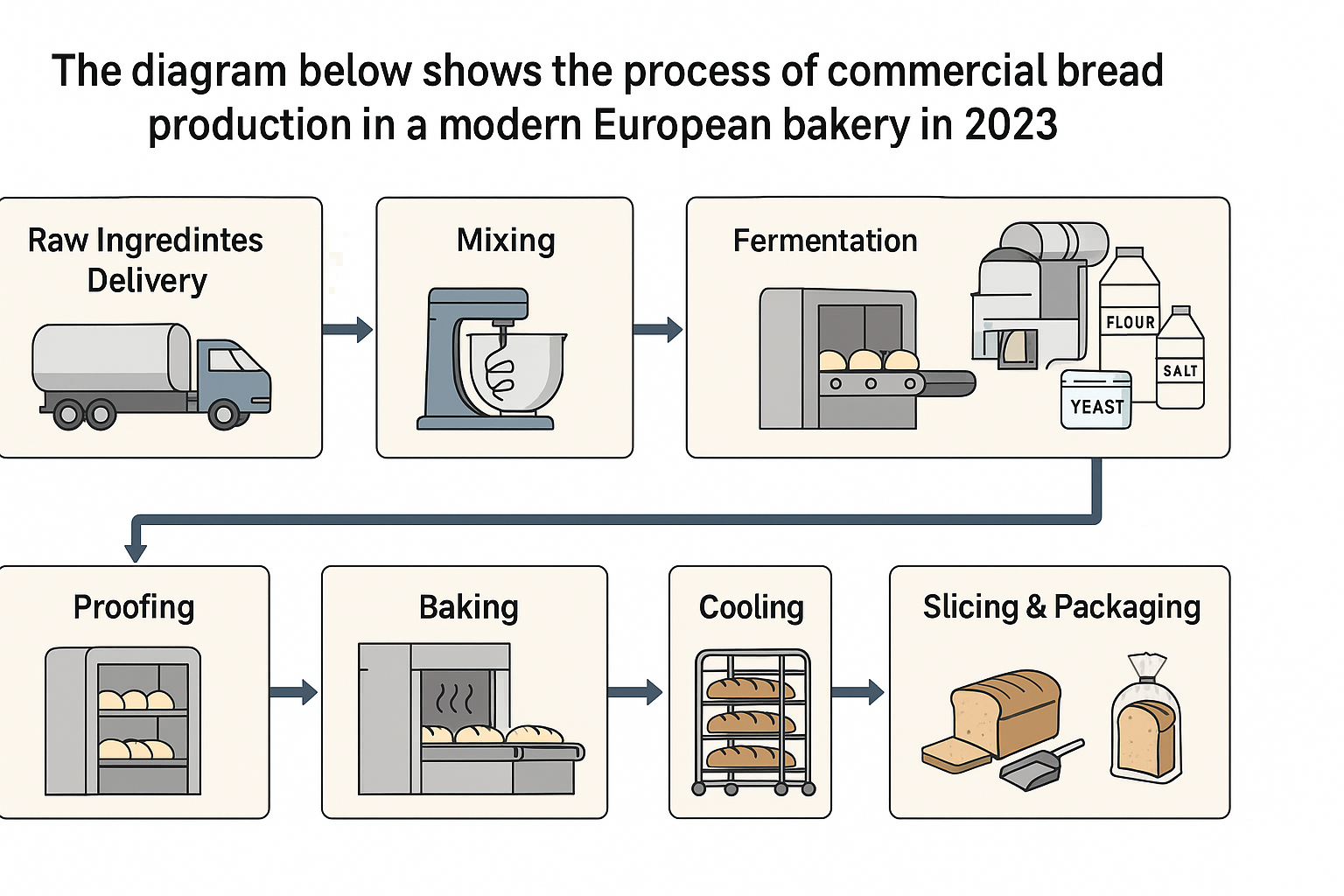
Click the diagram to view full screen & zoom
Your Answer:
Tip: After writing, check your grammar, describe every stage, and use sequence words (“First, Then, Next, Finally”) for a Band 7+ answer!
Band 9 Model Answer & Step-by-Step Explanations
Read the full Band 9 sample answer for the commercial bread process diagram, then expand each step to see why it earns a high score. Test your understanding with an interactive quiz!
1
Introduction:
(Show/Hide)
2
Overview:
(Show/Hide)
3
Body 1: Mixing and Kneading
(Show/Hide)
4
Body 2: Proofing, Shaping, Baking
(Show/Hide)
5
Body 3: Cooling and Packaging
(Show/Hide)
Test Yourself: Process Writing Mastery Quiz
Choose the best answer for each question about the Band 9 model and process writing strategy. Instantly see a full explanation!
20 Crucial Words for Describing a Bread Production Process
Master these key vocabulary items to write high-scoring process answers. Tap/click each word for its meaning, pattern, example, and common mistakes!
dough ▼
knead ▼
proof ▼
fermentation ▼
ingredient ▼
mixture ▼
chamber ▼
divide ▼
shape ▼
oven ▼
package ▼
automatically ▼
distribution ▼
commercial ▼
consistency ▼
industrial ▼
rest ▼
loaf / loaves ▼
texture ▼
retailer ▼
20 Crucial Phrases & Expressions for Bread Process Diagrams
Use these natural expressions to boost coherence, cohesion, and vocabulary range. Tap/click a phrase for all the details!
combine ingredients ▼
knead the dough ▼
allow to rise ▼
shape into loaves ▼
transfer to oven ▼
bake at a controlled temperature ▼
cool on racks ▼
package for sale ▼
ready for distribution ▼
begin with / end with ▼
involves several stages ▼
is carried out ▼
at a controlled temperature ▼
following this step ▼
subsequently ▼
for storage or immediate distribution ▼
is ready to be sold ▼
bread production process ▼
industrial mixer ▼
proofing chamber ▼
Practice Exercise 1: Vocabulary & Phrases (Bread Process)
Test your mastery of the most crucial words and expressions for this IELTS Task 1 process! Choose the best answer for each, then read the detailed explanation instantly.
Practice Exercise 2: Advanced Bread Process Vocabulary & Expressions
Take your process writing skills to the next level. These questions test deeper understanding and use of IELTS Band 8–9 vocabulary and phrases from this bread production task!


Join LingExam Language Academy on social media for exclusive lessons, quizzes, daily practice, and new modules every week!