IELTS Academic Writing Task 1: Band 9 Step-by-Step Tutorial (Table) (LingExam | Ultra-Interactive)
Welcome! In this tutorial, you’ll master IELTS Academic Writing Task 1 for the following table question:
The table below shows the number of students enrolled in four types of online courses (Business, IT, Languages, and Art) in five countries (USA, China, India, Brazil, and Germany) in 2024.
Follow each step below. Hover on any step to highlight and reveal advanced notes for Band 7+.
The table below shows the number of students enrolled in four types of online courses (Business, IT, Languages, and Art) in five countries (USA, China, India, Brazil, and Germany) in 2024.
Follow each step below. Hover on any step to highlight and reveal advanced notes for Band 7+.
How to Answer IELTS Academic Writing Task 1 (Table): 12 Essential Steps
1
Read the question carefully. Identify the type of chart (table), the variables (countries and course types), and the time frame (2024). Underline or mentally note all categories and countries.
2
Look at both axes/headers. Note the five countries and four course types. Check which are rows, which are columns, and what units are used (number of students, not percentages).
3
Find the most striking data. For example, which course is most popular in each country? Which country has the highest enrolment for each course? Are there any major gaps?
4
Write a general overview in your mind. For Band 7+, summarise the most obvious trends—e.g., IT courses are most popular overall, Brazil and Germany have the lowest numbers, etc. Use phrases like "Overall, IT courses were the most popular in every country except Germany."
5
Decide how to group your details. You can compare by course (all countries’ Business enrolments), by country (all courses in the USA), or by largest/smallest values.
6
Use comparative language. For example, "China had the highest number of IT students (34,000), while Germany had the lowest (12,000)." Always show contrasts and similarities.
7
Use specific numbers from the table. Avoid giving opinions or explanations for differences—just report the data clearly and objectively.
8
Don’t overload your overview paragraph with numbers. Mention only main patterns. Save detailed numbers for your body paragraphs.
9
Organise your writing clearly. For example, one paragraph for IT and Business courses, another for Languages and Art, or by high/low performing countries.
10
Show off academic language. Use synonyms for "number of students" (enrolments, candidates, participants), and use a variety of structures.
11
Keep your tenses correct (usually past/simple present for 2024 data). Use the passive voice where appropriate and avoid repetition.
12
Check you’ve summarised, compared, and reported the main features. Proofread your grammar, data, and logical flow before moving on!
Band 9 Sample Plan & Example Notes
Overview Example: “Overall, IT courses attracted the highest number of online students across most countries, while Art courses had the lowest enrolments everywhere. The USA and China showed the largest totals, whereas Brazil and Germany had the fewest students overall.”
Grouping Example: “China led IT enrolments (34,000), followed by the USA (27,000). In contrast, Germany had the smallest numbers in all courses except Art, where Brazil was the lowest (5,000).”
IELTS Academic Writing Task 1
Task:
The table below shows the number of students enrolled in four types of online courses (Business, IT, Languages, and Art) in five countries (USA, China, India, Brazil, and Germany) in 2024.
Summarise the information by selecting and reporting the main features, and make comparisons where relevant.
Table: Online Course Enrolments by Country (2024)
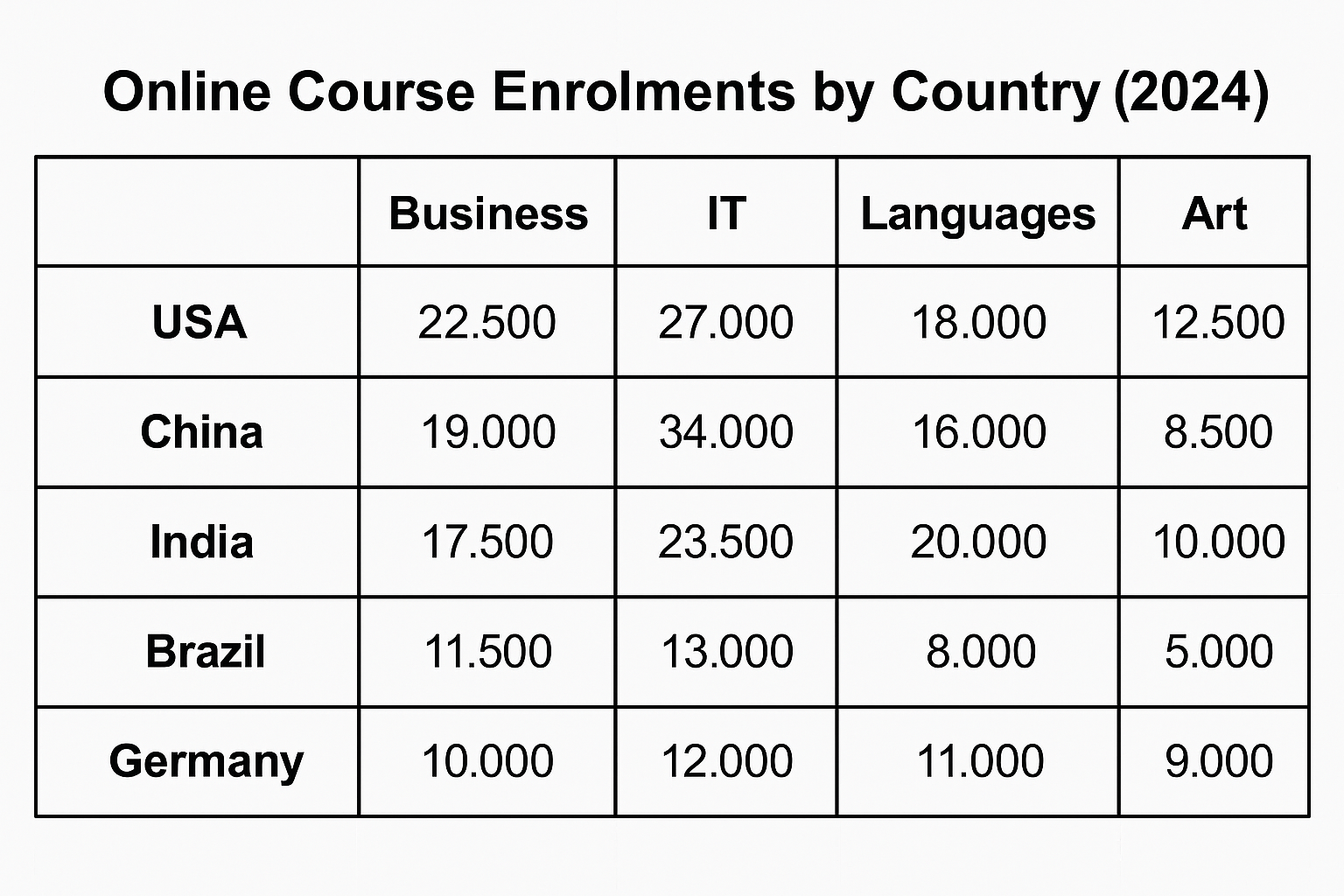
Click the table to view full screen & zoom
×
Pinch/scroll to zoom – Tap/click anywhere to exit
Your Answer:
Tip: After writing, check your grammar, report at least two major comparisons, and proofread for clear logic!
Band 9 Model Answer & Step-by-Step Explanations
Review the full Band 9 sample answer and reveal, step-by-step, how each part achieves a high score. Expand each step for a deep explanation, and test yourself with interactive quiz questions!
1
Introduction:
(Show/Hide)
The table presents data on the number of students who enrolled in four categories of online courses (Business, IT, Languages, and Art) across five countries in 2024.
Explanation:
The introduction accurately paraphrases the task, includes all variables (countries, course types, year), and avoids repeating the original wording. It sets a formal tone and signals clear task understanding.
2
Overview:
(Show/Hide)
Overall, IT courses had the highest enrolments in every country except Germany, while Art courses attracted the fewest students. The USA and China registered the largest totals, whereas Brazil and Germany had the lowest numbers overall.
Explanation:
The overview summarises the most obvious patterns, grouping by category and country, and avoids specific numbers. Clear, high-level comparisons are essential for Band 7+.
3
Body Paragraph 1: IT and Business Courses
(Show/Hide)
China led in IT enrolments (34,000 students), followed by the USA (27,000) and India (23,500). Germany and Brazil had considerably lower IT numbers, at 12,000 and 13,000 respectively. Business course participation was highest in the USA (22,500), with China (19,000) and India (17,500) close behind. Brazil and Germany again recorded the fewest students (11,500 and 10,000).
Explanation:
This paragraph groups and compares the two largest categories, referencing exact figures and showing logical progression by country. Note the use of “led,” “followed by,” and “respectively” for academic style.
4
Body Paragraph 2: Languages and Art Courses
(Show/Hide)
In the Languages category, India enrolled the most students (20,000), whereas the USA and China had 18,000 and 16,000 respectively. Brazil (8,000) and Germany (11,000) saw the smallest numbers. Art courses attracted the lowest participation across all countries, with the USA at 12,500 and China at 8,500, while Brazil had the least (5,000).
Explanation:
Here, the lowest-value categories are grouped and contrasted. Passive structures and comparative linking (“whereas”, “had the least”) strengthen academic tone.
5
Final Summary & Key Comparisons
(Show/Hide)
To summarise, IT was the most popular online course overall, especially in China and the USA. Enrolments in Business and Languages courses also remained high, while Art was consistently the least chosen field across all five countries.
Explanation:
The conclusion reinforces trends using wide-ranging vocabulary and comparative language, summarising without introducing new information. This is a Band 8–9 synthesis.
Test Yourself: Band 9 Answer Key Quiz
Choose the best answer for each analysis question about the model response. Instantly see a full explanation for each choice!
20 Crucial Words for This IELTS Task
Master these high-impact vocabulary items from the table question and model answer. Tap/click each word for a deep explanation, example, and common mistakes!
enrolment ▼
Phonetics: /ɪnˈrəʊlmənt/ (BrE), /ɪnˈroʊlmənt/ (AmE)
Part of speech: noun
Pattern: enrolment in/of, the number of enrolments
Definition: The process of registering or the number of people registered for a course.
Example: "Enrolment in IT courses was highest in China." (Most people registered for IT in China.)
Common synonym: registration
Common mistakes: Misspelling as "enrollment" (US) or "enroll" as a noun.
Part of speech: noun
Pattern: enrolment in/of, the number of enrolments
Definition: The process of registering or the number of people registered for a course.
Example: "Enrolment in IT courses was highest in China." (Most people registered for IT in China.)
Common synonym: registration
Common mistakes: Misspelling as "enrollment" (US) or "enroll" as a noun.
category ▼
Phonetics: /ˈkætəɡəri/ (BrE), /ˈkætəˌɡɔːri/ (AmE)
Part of speech: noun
Pattern: category of, in the category
Definition: A class or division of people or things regarded as having shared characteristics.
Example: "IT is one category of online courses." (Type/group.)
Common synonym: type, class
Common mistakes: Misspelling as "catagory".
Part of speech: noun
Pattern: category of, in the category
Definition: A class or division of people or things regarded as having shared characteristics.
Example: "IT is one category of online courses." (Type/group.)
Common synonym: type, class
Common mistakes: Misspelling as "catagory".
register ▼
Phonetics: /ˈredʒɪstə/ (BrE), /ˈredʒɪstər/ (AmE)
Part of speech: verb
Pattern: register for/in/on
Definition: To put your name on an official list for a course or event.
Example: "Many students registered for business courses." (They signed up.)
Common synonym: sign up, enrol
Common mistakes: Using "register" as a noun instead of "registration".
Part of speech: verb
Pattern: register for/in/on
Definition: To put your name on an official list for a course or event.
Example: "Many students registered for business courses." (They signed up.)
Common synonym: sign up, enrol
Common mistakes: Using "register" as a noun instead of "registration".
participation ▼
Phonetics: /pɑːˌtɪsɪˈpeɪʃən/ (BrE), /pɑːrˌtɪsəˈpeɪʃən/ (AmE)
Part of speech: noun
Pattern: participation in
Definition: The act of taking part in an activity or event.
Example: "Art course participation was lowest." (Fewest people took part.)
Common synonym: involvement
Common mistakes: Using "participate" as a noun.
Part of speech: noun
Pattern: participation in
Definition: The act of taking part in an activity or event.
Example: "Art course participation was lowest." (Fewest people took part.)
Common synonym: involvement
Common mistakes: Using "participate" as a noun.
consistently ▼
Phonetics: /kənˈsɪstəntli/ (BrE & AmE)
Part of speech: adverb
Pattern: consistently + verb/adjective
Definition: In every case or on every occasion; always the same.
Example: "Art courses were consistently least popular." (Everywhere, always.)
Common synonym: always, regularly
Common mistakes: Using "constant" instead of "consistently" for adverbs.
Part of speech: adverb
Pattern: consistently + verb/adjective
Definition: In every case or on every occasion; always the same.
Example: "Art courses were consistently least popular." (Everywhere, always.)
Common synonym: always, regularly
Common mistakes: Using "constant" instead of "consistently" for adverbs.
lead ▼
Phonetics: /liːd/ (BrE & AmE)
Part of speech: verb
Pattern: lead in, lead by, lead among
Definition: To be first or best in a ranking or competition.
Example: "China led in IT enrolments." (China was top.)
Common synonym: dominate, top
Common mistakes: Using the noun "lead" (metal, /lɛd/) for the verb /liːd/.
Part of speech: verb
Pattern: lead in, lead by, lead among
Definition: To be first or best in a ranking or competition.
Example: "China led in IT enrolments." (China was top.)
Common synonym: dominate, top
Common mistakes: Using the noun "lead" (metal, /lɛd/) for the verb /liːd/.
followed by ▼
Phonetics: /ˈfɒl.əʊd baɪ/ (BrE), /ˈfɑː.loʊd baɪ/ (AmE)
Part of speech: passive phrase
Pattern: X, followed by Y
Definition: Something comes after another in a list.
Example: "IT was most popular, followed by Business." (Business is second.)
Common synonym: next comes
Common mistakes: Writing "was follow by" (wrong tense).
Part of speech: passive phrase
Pattern: X, followed by Y
Definition: Something comes after another in a list.
Example: "IT was most popular, followed by Business." (Business is second.)
Common synonym: next comes
Common mistakes: Writing "was follow by" (wrong tense).
considerably ▼
Phonetics: /kənˈsɪdərəbli/ (BrE & AmE)
Part of speech: adverb
Pattern: considerably + adjective/adverb
Definition: By a notably large amount; much.
Example: "Germany had considerably fewer students." (Much less.)
Common synonym: significantly
Common mistakes: Using "considerate" instead of "considerably".
Part of speech: adverb
Pattern: considerably + adjective/adverb
Definition: By a notably large amount; much.
Example: "Germany had considerably fewer students." (Much less.)
Common synonym: significantly
Common mistakes: Using "considerate" instead of "considerably".
whereas ▼
Phonetics: /weəˈræz/ (BrE), /werˈæz/ (AmE)
Part of speech: conjunction
Pattern: sentence A, whereas sentence B
Definition: Used to contrast two things.
Example: "India had the most language students, whereas Germany had the least." (Contrast.)
Common synonym: while
Common mistakes: Using "whereas" at the beginning of the first clause.
Part of speech: conjunction
Pattern: sentence A, whereas sentence B
Definition: Used to contrast two things.
Example: "India had the most language students, whereas Germany had the least." (Contrast.)
Common synonym: while
Common mistakes: Using "whereas" at the beginning of the first clause.
overall ▼
Phonetics: /ˌəʊvərˈɔːl/ (BrE), /ˌoʊvərˈɑːl/ (AmE)
Part of speech: adverb, adjective
Pattern: overall, ...; the overall trend
Definition: Taking everything into account; in general.
Example: "Overall, IT was the most popular course." (In general.)
Common synonym: in general
Common mistakes: Using "overall" at the end of sentences (unnatural).
Part of speech: adverb, adjective
Pattern: overall, ...; the overall trend
Definition: Taking everything into account; in general.
Example: "Overall, IT was the most popular course." (In general.)
Common synonym: in general
Common mistakes: Using "overall" at the end of sentences (unnatural).
participate ▼
Phonetics: /pɑːˈtɪsɪpeɪt/ (BrE), /pɑːrˈtɪsəˌpeɪt/ (AmE)
Part of speech: verb
Pattern: participate in
Definition: To take part in an activity or event.
Example: "Few students participated in Art courses." (Took part.)
Common synonym: take part
Common mistakes: Using "participate" without "in".
Part of speech: verb
Pattern: participate in
Definition: To take part in an activity or event.
Example: "Few students participated in Art courses." (Took part.)
Common synonym: take part
Common mistakes: Using "participate" without "in".
dominate ▼
Phonetics: /ˈdɒmɪneɪt/ (BrE), /ˈdɑːməˌneɪt/ (AmE)
Part of speech: verb
Pattern: dominate X, be dominated by
Definition: To have control or power over; to be the most important.
Example: "IT courses dominated enrolments." (Most people chose IT.)
Common synonym: lead, control
Common mistakes: Using "dominate" with people as direct object (not always correct).
Part of speech: verb
Pattern: dominate X, be dominated by
Definition: To have control or power over; to be the most important.
Example: "IT courses dominated enrolments." (Most people chose IT.)
Common synonym: lead, control
Common mistakes: Using "dominate" with people as direct object (not always correct).
rank ▼
Phonetics: /ræŋk/ (BrE & AmE)
Part of speech: verb, noun
Pattern: rank first/second, rank among
Definition: To have a particular position in a list.
Example: "The USA ranked highest for business enrolment." (Was in first place.)
Common synonym: position, place
Common mistakes: Using "range" for "rank".
Part of speech: verb, noun
Pattern: rank first/second, rank among
Definition: To have a particular position in a list.
Example: "The USA ranked highest for business enrolment." (Was in first place.)
Common synonym: position, place
Common mistakes: Using "range" for "rank".
respectively ▼
Phonetics: /rɪˈspektɪvli/ (BrE & AmE)
Part of speech: adverb
Pattern: X and Y, respectively
Definition: Referring to two or more items in the order given.
Example: "USA and China had 27,000 and 34,000 IT students, respectively." (USA: 27k, China: 34k.)
Common synonym: in that order
Common mistakes: Using with only one item.
Part of speech: adverb
Pattern: X and Y, respectively
Definition: Referring to two or more items in the order given.
Example: "USA and China had 27,000 and 34,000 IT students, respectively." (USA: 27k, China: 34k.)
Common synonym: in that order
Common mistakes: Using with only one item.
notably ▼
Phonetics: /ˈnəʊtəbli/ (BrE), /ˈnoʊtəbli/ (AmE)
Part of speech: adverb
Pattern: notably + adjective/verb
Definition: Especially or particularly.
Example: "Brazil had notably fewer students in every category." (Especially low.)
Common synonym: especially
Common mistakes: Using "notable" as an adverb.
Part of speech: adverb
Pattern: notably + adjective/verb
Definition: Especially or particularly.
Example: "Brazil had notably fewer students in every category." (Especially low.)
Common synonym: especially
Common mistakes: Using "notable" as an adverb.
consist of ▼
Phonetics: /kənˈsɪst əv/ (BrE & AmE)
Part of speech: phrasal verb
Pattern: consist of + plural noun
Definition: To be made up of.
Example: "The table consists of four course types." (Is made up of four types.)
Common synonym: be composed of
Common mistakes: Using "consist" without "of".
Part of speech: phrasal verb
Pattern: consist of + plural noun
Definition: To be made up of.
Example: "The table consists of four course types." (Is made up of four types.)
Common synonym: be composed of
Common mistakes: Using "consist" without "of".
contrast ▼
Phonetics: /ˈkɒntrɑːst/ (n., BrE), /ˈkɑːntræst/ (v., AmE)
Part of speech: verb, noun
Pattern: contrast with, in contrast to
Definition: To compare two things in order to show their differences.
Example: "In contrast to India, Germany had lower enrolments." (Difference.)
Common synonym: differ
Common mistakes: Using as "contrast to" (noun), "contrast with" (verb).
Part of speech: verb, noun
Pattern: contrast with, in contrast to
Definition: To compare two things in order to show their differences.
Example: "In contrast to India, Germany had lower enrolments." (Difference.)
Common synonym: differ
Common mistakes: Using as "contrast to" (noun), "contrast with" (verb).
trend ▼
Phonetics: /trend/ (BrE & AmE)
Part of speech: noun
Pattern: trend in, overall trend
Definition: A general direction in which something is developing or changing.
Example: "The overall trend was a preference for IT courses." (General pattern.)
Common synonym: pattern
Common mistakes: Using "trend" as a verb in formal writing.
Part of speech: noun
Pattern: trend in, overall trend
Definition: A general direction in which something is developing or changing.
Example: "The overall trend was a preference for IT courses." (General pattern.)
Common synonym: pattern
Common mistakes: Using "trend" as a verb in formal writing.
attract ▼
Phonetics: /əˈtrækt/ (BrE & AmE)
Part of speech: verb
Pattern: attract + noun
Definition: To cause to come to a place or join an activity.
Example: "IT courses attracted the most students." (Most people joined.)
Common synonym: draw
Common mistakes: Using "attract" without a direct object.
Part of speech: verb
Pattern: attract + noun
Definition: To cause to come to a place or join an activity.
Example: "IT courses attracted the most students." (Most people joined.)
Common synonym: draw
Common mistakes: Using "attract" without a direct object.
comparison ▼
Phonetics: /kəmˈpærɪsən/ (BrE), /kəmˈperəsən/ (AmE)
Part of speech: noun
Pattern: comparison between, make a comparison
Definition: The act of examining similarities and differences.
Example: "Make comparisons between the countries." (Look for similarities and differences.)
Common synonym: contrast
Common mistakes: Using "comparison" as a verb.
Part of speech: noun
Pattern: comparison between, make a comparison
Definition: The act of examining similarities and differences.
Example: "Make comparisons between the countries." (Look for similarities and differences.)
Common synonym: contrast
Common mistakes: Using "comparison" as a verb.
20 Crucial Phrases & Expressions for This IELTS Task
Tap each expression to reveal meaning, usage, common errors, and tips for IELTS Band 7–9!
the number of ▼
Phonetics: /ðə ˈnʌmbər əv/ (BrE & AmE)
Part of speech: noun phrase
Pattern: the number of + plural noun
Definition: The quantity or count of something.
Example: "The number of IT students was highest in China." (Total IT students in China.)
Common synonym: quantity of
Common mistakes: Using "the number of" with a singular noun.
Part of speech: noun phrase
Pattern: the number of + plural noun
Definition: The quantity or count of something.
Example: "The number of IT students was highest in China." (Total IT students in China.)
Common synonym: quantity of
Common mistakes: Using "the number of" with a singular noun.
by comparison ▼
Phonetics: /baɪ kəmˈpærɪsən/ (BrE), /baɪ kəmˈperəsən/ (AmE)
Part of speech: adverbial phrase
Pattern: ..., by comparison, ...
Definition: Used when comparing one thing to another.
Example: "Germany had fewer students; by comparison, India had more." (Contrast.)
Common synonym: in contrast
Common mistakes: Using as a verb ("They by comparison the data"—incorrect).
Part of speech: adverbial phrase
Pattern: ..., by comparison, ...
Definition: Used when comparing one thing to another.
Example: "Germany had fewer students; by comparison, India had more." (Contrast.)
Common synonym: in contrast
Common mistakes: Using as a verb ("They by comparison the data"—incorrect).
make comparisons ▼
Phonetics: /meɪk kəmˈpærɪsnz/ (BrE), /meɪk kəmˈperəsənz/ (AmE)
Part of speech: verb phrase
Pattern: make comparisons between
Definition: To examine the similarities and differences between things.
Example: "Make comparisons between countries for higher marks." (Compare.)
Common synonym: draw contrasts
Common mistakes: Using "do comparisons" (unnatural).
Part of speech: verb phrase
Pattern: make comparisons between
Definition: To examine the similarities and differences between things.
Example: "Make comparisons between countries for higher marks." (Compare.)
Common synonym: draw contrasts
Common mistakes: Using "do comparisons" (unnatural).
show a trend ▼
Phonetics: /ʃəʊ ə trend/ (BrE), /ʃoʊ ə trend/ (AmE)
Part of speech: verb phrase
Pattern: show a trend in/toward
Definition: To indicate a general direction or change over time.
Example: "The table shows a trend towards online IT courses." (Pattern emerges.)
Common synonym: indicate a pattern
Common mistakes: Writing "shows trend" (missing article "a").
Part of speech: verb phrase
Pattern: show a trend in/toward
Definition: To indicate a general direction or change over time.
Example: "The table shows a trend towards online IT courses." (Pattern emerges.)
Common synonym: indicate a pattern
Common mistakes: Writing "shows trend" (missing article "a").
in contrast ▼
Phonetics: /ɪn ˈkɒntrɑːst/ (BrE), /ɪn ˈkɑːntræst/ (AmE)
Part of speech: prepositional phrase
Pattern: In contrast to/with
Definition: Used to show a clear difference.
Example: "In contrast, Art courses had fewer enrolments." (Big difference.)
Common synonym: on the other hand
Common mistakes: "On contrast" (incorrect).
Part of speech: prepositional phrase
Pattern: In contrast to/with
Definition: Used to show a clear difference.
Example: "In contrast, Art courses had fewer enrolments." (Big difference.)
Common synonym: on the other hand
Common mistakes: "On contrast" (incorrect).
the least/most popular ▼
Phonetics: /ðə liːst pɒpjʊlə/; /ðə məʊst pɒpjʊlə/ (BrE); /ðə list ˈpɑːpjələr/; /ðə moʊst ˈpɑːpjələr/ (AmE)
Part of speech: adjective phrase
Pattern: the least/most popular + noun
Definition: The lowest/highest in popularity.
Example: "Art was the least popular course." (Lowest enrolment.)
Common synonym: the least/most common
Common mistakes: Using "the most/least" with uncountable nouns incorrectly.
Part of speech: adjective phrase
Pattern: the least/most popular + noun
Definition: The lowest/highest in popularity.
Example: "Art was the least popular course." (Lowest enrolment.)
Common synonym: the least/most common
Common mistakes: Using "the most/least" with uncountable nouns incorrectly.
in every country ▼
Phonetics: /ɪn ˈevri ˈkʌntri/ (BrE & AmE)
Part of speech: prepositional phrase
Pattern: in every country
Definition: In all listed nations.
Example: "IT was most popular in every country except Germany." (All but one.)
Common synonym: in all countries
Common mistakes: Using "at every country".
Part of speech: prepositional phrase
Pattern: in every country
Definition: In all listed nations.
Example: "IT was most popular in every country except Germany." (All but one.)
Common synonym: in all countries
Common mistakes: Using "at every country".
the largest totals ▼
Phonetics: /ðə ˈlɑːdʒɪst ˈtəʊtəlz/ (BrE), /ðə ˈlɑːrdʒəst ˈtoʊtəlz/ (AmE)
Part of speech: noun phrase
Pattern: the largest totals + for/of
Definition: The biggest overall numbers.
Example: "The USA and China registered the largest totals." (Most students.)
Common synonym: highest numbers
Common mistakes: Using "largest" for physical size instead of number.
Part of speech: noun phrase
Pattern: the largest totals + for/of
Definition: The biggest overall numbers.
Example: "The USA and China registered the largest totals." (Most students.)
Common synonym: highest numbers
Common mistakes: Using "largest" for physical size instead of number.
across all countries ▼
Phonetics: /əˈkrɒs ɔːl ˈkʌntriz/ (BrE), /əˈkrɔːs ɔːl ˈkʌntriz/ (AmE)
Part of speech: prepositional phrase
Pattern: across all countries
Definition: In all of the mentioned nations.
Example: "Art courses attracted the fewest students across all countries." (In every country.)
Common synonym: in all countries
Common mistakes: Using "in all of countries".
Part of speech: prepositional phrase
Pattern: across all countries
Definition: In all of the mentioned nations.
Example: "Art courses attracted the fewest students across all countries." (In every country.)
Common synonym: in all countries
Common mistakes: Using "in all of countries".
registered ▼
Phonetics: /ˈredʒɪstəd/ (BrE), /ˈredʒɪstərd/ (AmE)
Part of speech: verb
Pattern: registered the most/least, registered as
Definition: Recorded or counted officially.
Example: "The USA registered the largest totals." (Was recorded as having the most.)
Common synonym: recorded
Common mistakes: Using "register" instead of "registered" (wrong tense).
Part of speech: verb
Pattern: registered the most/least, registered as
Definition: Recorded or counted officially.
Example: "The USA registered the largest totals." (Was recorded as having the most.)
Common synonym: recorded
Common mistakes: Using "register" instead of "registered" (wrong tense).
attracted the fewest students ▼
Phonetics: /əˈtræktɪd ðə ˈfjuːɪst ˈstjuːdənts/ (BrE), /əˈtræktɪd ðə ˈfjuːəst ˈstuːdənts/ (AmE)
Part of speech: verb phrase
Pattern: attracted the fewest/most students
Definition: Had the lowest number of participants.
Example: "Art attracted the fewest students." (Lowest enrolment.)
Common synonym: had the smallest number
Common mistakes: Using "attracted" without a direct object.
Part of speech: verb phrase
Pattern: attracted the fewest/most students
Definition: Had the lowest number of participants.
Example: "Art attracted the fewest students." (Lowest enrolment.)
Common synonym: had the smallest number
Common mistakes: Using "attracted" without a direct object.
had the highest number of ▼
Phonetics: /hæd ðə ˈhaɪɪst ˈnʌmbər əv/ (BrE & AmE)
Part of speech: verb phrase
Pattern: had the highest/lowest number of
Definition: Was top in terms of quantity.
Example: "China had the highest number of IT enrolments." (Most students in IT.)
Common synonym: had the most
Common mistakes: Using "had most" (missing article).
Part of speech: verb phrase
Pattern: had the highest/lowest number of
Definition: Was top in terms of quantity.
Example: "China had the highest number of IT enrolments." (Most students in IT.)
Common synonym: had the most
Common mistakes: Using "had most" (missing article).
by far ▼
Phonetics: /baɪ fɑː(r)/ (BrE & AmE)
Part of speech: adverbial phrase
Pattern: by far the most/least + adj.
Definition: By a great amount.
Example: "IT was by far the most popular." (Much more than others.)
Common synonym: significantly
Common mistakes: Using "by far" with negative sentences.
Part of speech: adverbial phrase
Pattern: by far the most/least + adj.
Definition: By a great amount.
Example: "IT was by far the most popular." (Much more than others.)
Common synonym: significantly
Common mistakes: Using "by far" with negative sentences.
close behind ▼
Phonetics: /kləʊs bɪˈhaɪnd/ (BrE), /kloʊs bɪˈhaɪnd/ (AmE)
Part of speech: adverbial phrase
Pattern: X, close behind
Definition: Only a little less or worse than.
Example: "India was close behind China in IT." (Not far below.)
Common synonym: nearly as much
Common mistakes: Using "closed" instead of "close".
Part of speech: adverbial phrase
Pattern: X, close behind
Definition: Only a little less or worse than.
Example: "India was close behind China in IT." (Not far below.)
Common synonym: nearly as much
Common mistakes: Using "closed" instead of "close".
in terms of ▼
Phonetics: /ɪn tɜːmz əv/ (BrE), /ɪn tɝːmz əv/ (AmE)
Part of speech: prepositional phrase
Pattern: in terms of + noun
Definition: Regarding, with respect to.
Example: "In terms of enrolments, IT was top." (Regarding enrolments.)
Common synonym: regarding
Common mistakes: Using "in term of".
Part of speech: prepositional phrase
Pattern: in terms of + noun
Definition: Regarding, with respect to.
Example: "In terms of enrolments, IT was top." (Regarding enrolments.)
Common synonym: regarding
Common mistakes: Using "in term of".
to summarise ▼
Phonetics: /tə ˈsʌməraɪz/ (BrE), /tə ˈsʌməˌraɪz/ (AmE)
Part of speech: verb phrase
Pattern: To summarise, ...
Definition: To briefly give the main points.
Example: "To summarise, IT was the most popular." (In short.)
Common synonym: in summary
Common mistakes: Using "to summary" (wrong form).
Part of speech: verb phrase
Pattern: To summarise, ...
Definition: To briefly give the main points.
Example: "To summarise, IT was the most popular." (In short.)
Common synonym: in summary
Common mistakes: Using "to summary" (wrong form).
reinforces the main message ▼
Phonetics: /ˌriːɪnˈfɔːsɪz ðə meɪn ˈmesɪdʒ/ (BrE), /ˌriːɪnˈfɔːrsɪz ðə meɪn ˈmesɪdʒ/ (AmE)
Part of speech: verb phrase
Pattern: reinforces the main message/trend
Definition: Makes the main point stronger.
Example: "The conclusion reinforces the main message." (Supports the main idea.)
Common synonym: strengthens
Common mistakes: Using "reinforce" for negative or irrelevant ideas.
Part of speech: verb phrase
Pattern: reinforces the main message/trend
Definition: Makes the main point stronger.
Example: "The conclusion reinforces the main message." (Supports the main idea.)
Common synonym: strengthens
Common mistakes: Using "reinforce" for negative or irrelevant ideas.
logical progression ▼
Phonetics: /ˈlɒdʒɪkl prəˈɡreʃən/ (BrE), /ˈlɑːdʒɪkl prəˈɡreʃən/ (AmE)
Part of speech: noun phrase
Pattern: logical progression of ideas
Definition: A sequence that makes sense.
Example: "Paragraphs must have logical progression." (Each follows logically.)
Common synonym: coherent flow
Common mistakes: Using "progress" for "progression".
Part of speech: noun phrase
Pattern: logical progression of ideas
Definition: A sequence that makes sense.
Example: "Paragraphs must have logical progression." (Each follows logically.)
Common synonym: coherent flow
Common mistakes: Using "progress" for "progression".
to a lesser/greater extent ▼
Phonetics: /tuː ə ˈlesə/ˈɡreɪtə ɪkˈstent/ (BrE), /tuː ə ˈlesər/ˈɡreɪdər ɪkˈstɛnt/ (AmE)
Part of speech: adverbial phrase
Pattern: to a lesser/greater extent
Definition: To a smaller/larger degree.
Example: "This trend was seen in every country, to a lesser extent in Germany." (Less in Germany.)
Common synonym: more/less
Common mistakes: "To less extent" (missing "a" and "er").
Part of speech: adverbial phrase
Pattern: to a lesser/greater extent
Definition: To a smaller/larger degree.
Example: "This trend was seen in every country, to a lesser extent in Germany." (Less in Germany.)
Common synonym: more/less
Common mistakes: "To less extent" (missing "a" and "er").
main features ▼
Phonetics: /meɪn ˈfiːtʃəz/ (BrE), /meɪn ˈfiːtʃərz/ (AmE)
Part of speech: noun phrase
Pattern: main features of
Definition: The most important aspects.
Example: "Summarise the main features." (Key points.)
Common synonym: major points
Common mistakes: Using "main feature" for only one item.
Part of speech: noun phrase
Pattern: main features of
Definition: The most important aspects.
Example: "Summarise the main features." (Key points.)
Common synonym: major points
Common mistakes: Using "main feature" for only one item.
Practice Exercise 1: Vocabulary & Phrase MCQs
Test your understanding! Select the best answer for each question. Instantly see a Band 9 explanation after each choice.
Practice Exercise 2: Advanced MCQs for Mastery
Challenge yourself with more advanced questions based on Band 7–9 IELTS vocabulary and phrases. Instantly see an in-depth answer key for each choice.